At MWC 2026 in Barcelona, SK Telecom outlined how it is rebuilding itself around AI, from its network core to its customer service desks. The shift goes beyond adding new AI tools. It involves rewriting internal systems, expanding data centre capacity to the gigawatt scale, and upgrading its own large language model to more than one trillion parameters.
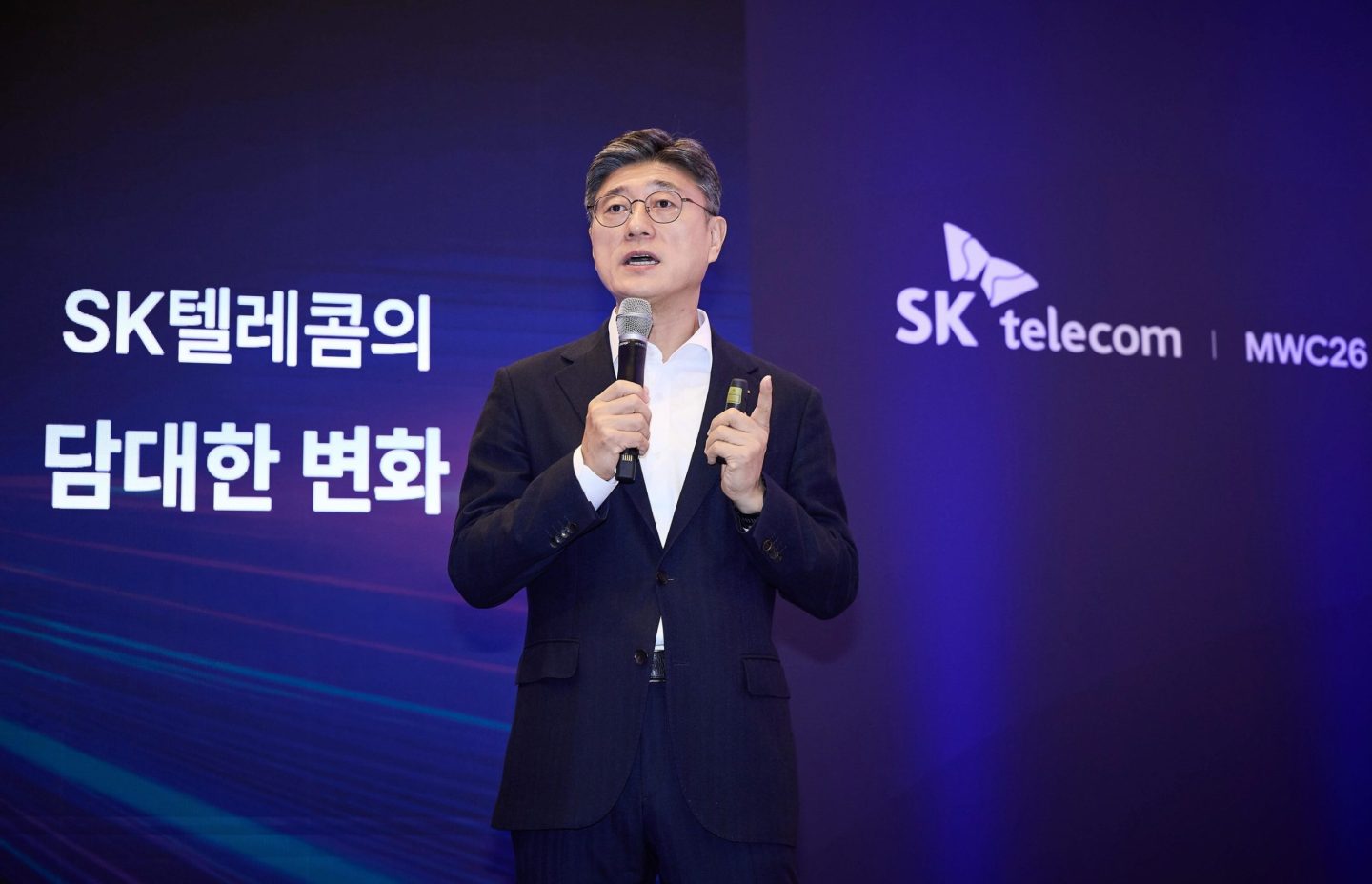
At a press conference during MWC 2026, SK Telecom CEO Jung Jai-hun outlined what the company calls an “AI Native” strategy. The plan centres on reorganising infrastructure and making large investments so the company can help position Korea among the world’s top three AI powers.
“SKT is currently at a golden time of transformation, where the two tasks of ‘customer value innovation’ and ‘AI innovation’ intersect in a borderless, converged environment that goes beyond telecommunications,” Jung said. “SKT defines ‘the customer as the very essence of our business,’ and through innovation driven by AI, we will evolve into a company that makes meaningful contributions to our customers and to Korea.”
Rewriting telecom systems around AI at MWC 2026
At the core of the plan is a rebuild of SK Telecom’s integrated IT systems. The company said it will redesign sales, line management, and billing systems to be optimised for AI. The aim is to let the operator design and offer personalised plans and memberships based on each customer’s usage and behaviour patterns.
The company also plans to apply a Zero Trust security framework across its systems. This will include stronger authentication, access controls, network segmentation, and AI-based monitoring, according to the company’s briefing at MWC 2026.
For enterprises watching the telecom sector, this signals a broader shift. Telecom operators have long relied on legacy billing stacks and network management tools. Rebuilding those systems around AI could change how pricing, service design, and fault detection work in practice. It also raises questions about data governance and how customer data is used to train or tune AI models.
SK Telecom is also expanding its “autonomous network operations” strategy. The company said it will use AI to automate wireless quality management, traffic control, and network equipment operations. With AI-RAN technology, it aims to improve speed and reduce latency. These efforts were described in company materials shared during the press event.
A single AI agent across touchpoints
Another part of the strategy focuses on customer interaction. SK Telecom plans to redesign pricing, roaming, and membership services to make them simpler and more automated. It is developing what it calls an integrated AI agent to connect experiences across its main customer portal, T world, and its online store, T Direct Shop.
The company said the agent will analyse daily usage patterns and offer tailored suggestions across channels. It also plans to expand its AI Contact Center so customer service representatives can use AI tools during support calls.
Offline retail stores are part of the shift. SK Telecom said AI will help staff identify customer needs and offer recommendations after a store visit. It is also building “AI Personas” to analyse digital behaviour across customer segments and support conversational Q&A.
For enterprise leaders, this mirrors a wider pattern. Telecom operators are trying to move from reactive service models to predictive ones. The difference now is scale. By embedding AI into billing, customer service, and retail, SK Telecom is treating AI as an operating layer rather than a separate feature.
Building 1GW-class AI data centres
The infrastructure build-out is equally ambitious. SK Telecom said it will construct hyperscale AI data centres across Korea, targeting capacity that exceeds 1 gigawatt. It aims to attract global investment and position the country as a major AI data centre hub in Asia.
The company already operates a GPU cluster called Haein and applied its virtualisation solution, Petasus AI Cloud, to support GPU-as-a-service workloads last year. It now plans to offer that cloud solution globally.
SK Telecom also plans to build an AI data centre in Korea’s southwestern region in collaboration with OpenAI, according to the company’s announcement at MWC 2026.
On the model side, SK Telecom said its sovereign AI foundation model currently has 519 billion parameters, making it the largest in Korea. The company plans to upgrade it to more than one trillion parameters and add multimodal capabilities so it can process image, voice, and video data starting in the second half of the year.
CEO Jung framed the data centre and model build-out in national terms. “AIDC can be seen as the heart of Korea, and hyperscale LLMs as the brain,” he said. “By combining SKT’s AI capabilities with collaboration from domestic and global partners, we will lead true AI-native transformation for Korean customers and enterprises.”
For enterprise readers, the key issue is not parameter count alone. It is how such models will be applied in sectors like manufacturing. SK Telecom said it is working with SK hynix on a manufacturing-focused AI package that analyses process data in real time to reduce defect rates and improve equipment efficiency. The package will be offered as infrastructure, model, and solution.
Changing internal culture
The transformation also extends to internal operations. SK Telecom has built an “AX Dashboard” to track AI use across departments and individuals. It operates an “AI Board” to oversee AI transformation efforts and has created an “AI playground” where employees can build AI agents without coding. More than 2,000 AI agents are already in use across marketing, legal, and public relations, according to the company’s figures shared at the event.
“To drive future growth, we must reinvent our way of working from the ground up. SKT will fundamentally transform its corporate culture to be centred around AI,” Jung said.
For other enterprises, the takeaway is less about branding and more about structure. SK Telecom is tying infrastructure, models, applications, and internal governance into a single program. Whether it can execute at the scale it describes remains to be seen. What is clear is that AI is no longer positioned as a side project. It is becoming the operating model.
(Photo by PR Newswire)
See also: Nokia and AWS pilot AI automation for real-time 5G network slicing
Want to learn more about AI and big data from industry leaders? Check out AI & Big Data Expo taking place in Amsterdam, California, and London. The comprehensive event is part of TechEx and is co-located with other leading technology events including the Cyber Security & Cloud Expo. Click here for more information.
AI News is powered by TechForge Media. Explore other upcoming enterprise technology events and webinars here.