Mark PoyntingClimate researcher

 Getty Images
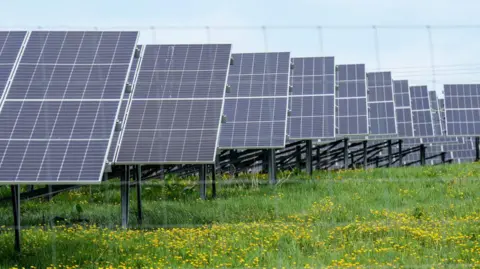
More solar farms are on the way around the UK, in a move that boosts the country’s clean power goals but could spark anger from local opponents.
The government awarded contracts to a record supply of renewables projects, including 157 solar developments across England, Scotland and Wales.
The results have been welcomed by climate and clean energy groups, who see solar as a relatively cheap way to reduce the UK’s reliance on fossil fuels during the summer months.
But some local communities oppose such large developments on their doorstep.
The West Burton solar farm planned for the Lincolnshire and Northamptonshire border has become the largest ever to win a government contract, but local opponents fear it could cause “mass industrialisation” of the countryside.
All of the solar projects had already been granted planning permission, and are now due to be delivered in the next few years.
Other renewable energy projects to get contracts include onshore wind – mainly in Scotland – and a small number of tidal power developments.
Energy Secretary Ed Miliband said: “By backing solar and onshore wind at scale, we’re driving bills down for good and protecting families, businesses, and our country from the fossil fuel rollercoaster controlled by petrostates and dictators.”
By 2030 the government wants at least 95% of Great Britain’s electricity to come from “clean” sources, including renewables – such as solar and wind – and nuclear energy.
The Conservatives have been asked for comment, but have previously accused the government’s clean power target of pushing up energy bills.
While solar cannot be relied on throughout the year – for example on short, dull winter days – it can complement wind power, particularly during the summer months when wind speeds tend to be lower.
Last year, solar energy provided more than 6% of Great Britain’s electricity – rising to more than 40% for a small number of half-hour periods in July.
The government is targeting at least 45 gigawatts (GW) of solar power capacity by 2030 to help meet its clean power goal – up from 21GW as of autumn 2025, according to government figures.
It also wants more batteries and other storage systems, to be able to make use of solar energy outside of sunny periods.
Today’s haul of solar farms secures another 4.9GW of capacity across 157 projects, higher than the 3.3GW across 93 projects in the previous auction in 2024.
The results have been broadly welcomed by clean energy groups as a major step-forward for the solar industry.
However, most analysts still have serious doubts about whether the government will meet its 2030 clean power target.