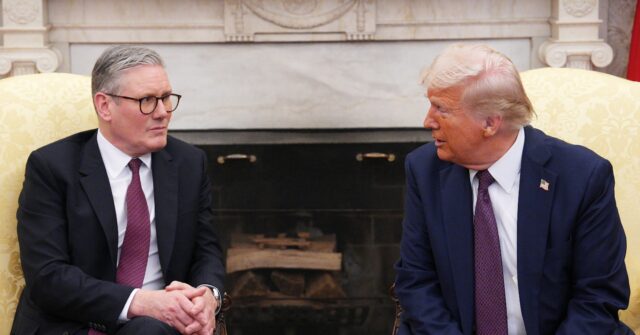
Brexit champion Nigel Farage has accused British Prime Minister Sir Keir Starmer of having “fractured” the relationship between the United Kingdom and the United States.
Fresh on the heels of a ceasefire agreement between the United States, Israel, and the Islamist regime in Iran, Prime Minister Starmer jetted off to Jeddah, Saudi Arabia, in an apparent bid to remain relevant after largely abstaining from involvement in the conflict.
However, opposition leader and longtime ally of President Trump, Nigel Farage heaped a heavy dose of scepticism on Starmer’s diplomatic push, morosely questioning “why bother?”
“He’s upset the Americans, he’s upset the Cypriots, he’s upset the Gulf states, and this level of indecision and chopping and changing your mind is quite extraordinary,” the Reform UK boss remarked. “So my guess is he will not be treated today with a great degree of respect.”
Mr Farage lamented: “Our relationship with those parts of the world is weak, and our relationship with America is fractured. This is a massive, massive problem. I don’t think it’s irreparable, but America has to respect us militarily… That’s going out the window.”
For his part, Prime Minister Starmer would not be drawn on the issue of whether his relationship with President Donald Trump has deteriorated in recent weeks, telling reporters in Saudi Arabia on Wednesday that his actions were motivated by serving his interpretation of the British “national interest”.
“My principles and values made sure that our decisions were that we wouldn’t get involved in the action without a lawful basis, without a viable, thought-through plan,” Starmer said.
“That was the right position for the United Kingdom, and of course, that has included us taking action, collective self-defence… but the principles of not getting dragged into this war, principles of always saying the UK will act only on a lawful basis and only for the viable, long-term plan.”
However, it remains to be seen whether the price of alienating Britain’s most valuable ally will have been worth the decision to largely abstain from the military intervention in Iran by the United States and Israel.
It is also questionable whether Starmer’s decisions were made out of pure self-interest or whether they were influenced by the “embarrassing” state of the British Royal Navy, which was forced on Sunday to port the only warship it deployed during the Iran conflict after having been sent off a week after Britain’s base in Cyprus came under attack by Iranian proxy terrorists.
The apparent fracturing of the “special relationship” began at the outset of the conflict, when Starmer took the drastic step of barring the United States from using its military bases to strike Iran, even bases which the United States built and maintains, such as the one on Diego Garcia in the Chagos Islands. While Starmer later backtracked slightly, he has still only allowed British bases to be used for “defensive” purposes during the conflict.
Perhaps more crucially, however, Starmer also refused to assist the United States in opening the Strait of Hormuz after the Iranians claimed to have laid down sea mines in the critical waterway.
Again, it is unclear if this was a matter of principle or rather a reflection of the degradation of Britain’s once fearsome navy, with London having chosen to retire almost all of its fleet of minesweeping boats without having their replacements ready to launch in what appears to have been a ‘capability gapping‘ scheme to save some room on the defence budget.
In response, President Trump has compared Starmer to former Prime Minister Neville Chamberlain, who oversaw the “appeasement” strategy towards Adolf Hitler’s Nazis during the lead-up to the Second World War. Republican allies of the President have also begun to question the benefits of the United States remaining in the NATO alliance if countries such as the United Kingdom refuse base access while being protected at great expense by the U.S. Military and the American taxpayer.