The same voices who demand “fairness” and insist every community must share the burden of mass illegal migration suddenly discover local democracy the moment the coaches might stop near their postcode.
A Mail on Sunday poll has laid bare the gap between principle and practice. Just 15 percent of people are happy with the idea of more illegal migrants arriving in their own area. Fifty-seven percent actively oppose it.
Yet many of those who back Prime Minister Andy Burnham’s call for affluent and rural places to “play their part” draw a firm line at their own front door.
The liberal wokerati back Burnham’s plan to house asylum seekers in affluent postcodes… as long as it’s not theirs, MoS poll reveals https://t.co/TuelsWxBxH
— Daily Mail (@DailyMail) August 15, 2026
Burnham has been explicit. He told GB News that Britain “cannot have a situation where it’s only the poorest communities in the country that receive all of the dispersal of refugees and asylum seekers.” All parts of the country, he said, must work and play their part. The policy is framed as equity. The reality on the ground looks very different.
The survey of 10,549 adults, conducted by Find Out Now and weighted to be representative by age and gender, also reveals the classic liberal tension: 51 percent agree asylum seekers should be housed evenly across the country, yet that abstract support collapses the moment the coaches head toward their own postcode.
What unites almost everyone is the demand to stop the problem at source. Eighty-two percent believe the Government should do more to prevent illegal small-boat entries. Only 5 percent disagree.
The areas most hostile to further arrivals are Lincolnshire (57 percent opposed), followed by Worcestershire, Shropshire and County Durham. The most accepting is Wiltshire, with just 21 percent opposed, trailed by East Sussex, Merseyside and Nottinghamshire.
The Mail on Sunday poll confirms what many already suspected. Support for the abstract principle of dispersal collapses the moment the principle lands next door.
Liberals and progressives who spent years lecturing poorer communities about compassion and shared responsibility now discover the virtues of local opposition when the coaches point toward their own leafy postcodes. The villages, meanwhile, are left to live with the consequences.
Three former military sites have been earmarked for conversion into large-scale accommodation for single adult male asylum seekers. Two of them sit less than a mile from primary schools, in direct tension with the Home Office’s own July guidance.
RAF Linton-on-Ouse in North Yorkshire, the base where Prince William once trained, is lined up for up to 1,200 men. The village itself numbers around 600 people. The arithmetic produces a six-to-one ratio of migrant men to local women. The site sits right beside a primary school, a nursery and a children’s play area.
North Yorkshire councillor Malcolm Taylor put the local mood plainly: “It’s quite an attractive site, it’s not one of your austere former military sites and it’s right in the heart of the village. So as a consequence, it’s right adjacent to the school, the play park. That’s what has really ramped up the concerns of the community.”
At RAF Barnham near Thetford in Suffolk, plans for as many as 1,250 asylum seekers have already prompted some parents to talk about withdrawing their children from Barnham School.
John Bauer, chairman of the parish council, warned that the proximity could threaten the school’s long-term future.
The third site, near the Oxfordshire village of Piddington, does not neighbour a school but sits beside a children’s play area and backs onto village gardens. The village has roughly 350–400 residents. The proposed intake is 1,250 single men.
This is not an isolated experiment. It is the latest chapter in a pattern that has already played out across quiet corners of England and Wales.

The same week Burnham was insisting every area must take its share, residents of the tiny Welsh seaside village of Gronant discovered that their former village hall—converted into 15 new-build homes they expected to serve local families—had been quietly allocated to asylum seekers.
Thirteen of the fifteen units went to Home Office contractor Clearsprings. Blacked-out minibuses arrived without warning. Kerrie Cox watched one pull up while she washed her car. “Nobody was told about the arrivals,” she said. Julie Tuson called it an “absolute betrayal.” Ted Huthwaite said he was “absolutely gobsmacked… it is devastating for the community.”
Borders minister Anna Turley has sought to reassure people by insisting the men will not be “in the village.” “Everything they need will be on that site,” she told LBC. In practice the sites are not locked facilities. Residents are free to come and go.
Infrastructure in these rural locations is already thin—limited bus services, strained water, sewage and electricity capacity. Policing is stretched. The cultural distance is vast.
High-trust, low-density English and Welsh villages with quiet streets, children’s parks and a long-standing sense of safety are being asked to absorb large numbers of single adult men from very different backgrounds, many of whom do not speak English.
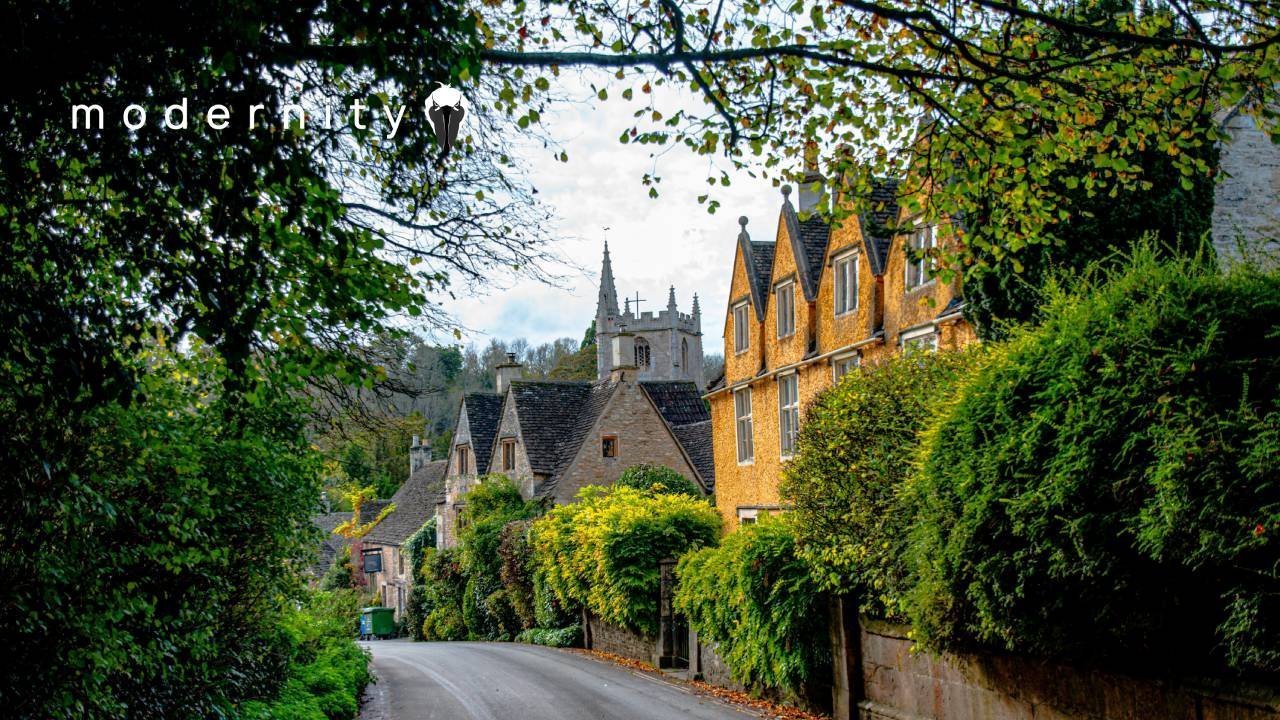
It repeatedly seems like an intentional choice calculated to produce the maximum friction and cultural upheaval. Officials could not possibly find settings more alien to the life experience of many of these arrivals. Quaint villages with medieval churches, village halls and play parks are the last places that resemble the environments many left behind.
The effect is predictable: local women and girls who once walked freely after dark now face a sudden demographic inversion. Parents weigh whether their children can still use the park. Communities that never asked for this feel ignored and overruled by Whitehall processes that bypass local planning authorities under the banner of “national interest.”
The Home Office maintains it is seeking to house people fairly across the country, closing hotels and moving arrivals into alternative accommodation including former military sites. Asylum costs, it says, are down by £1 billion since the general election. The numbers receiving support are falling.
Yet the boats keep coming, the contractors keep being paid, and the map of acceptable destinations keeps expanding deeper into the countryside. Closing hotels while upgrading the destination does nothing to reduce the pull factor. It simply relocates the pressure onto the places least equipped to absorb it.
Reform’s Zia Yusuf has been blunt about the Linton-on-Ouse proposal: “Andy Burnham is about to dump 1200 unvetted adult male illegal migrants on a tiny village, resulting in locals putting up with a ratio of SIX MEN TO EVERY WOMAN… Burnham is directly endangering British women and girls.”
This is the logical endpoint of a policy that refuses to stop the boats while insisting every corner of the country must absorb the results.
The high-trust rural communities that once defined the character of England and Wales are being asked to surrender the very qualities that made them desirable in the first place—peace, safety, and a sense that the place still belonged to the people who lived there. One village at a time.
Your support is crucial in helping us defeat mass censorship. Please consider donating via Locals or check out our unique merch. Follow us on X @ModernityNews.