Order Daniel Greenfield’s new book, Domestic Enemies: The Founding Fathers’ Fight Against the Left: HERE.
The right to establish places of worship in America remains all too unsettled as demonstrated by a series of landmark cases originating in the suburbs of Cleveland, Ohio — a region with a surprisingly significant role in shaping religious freedom jurisprudence.
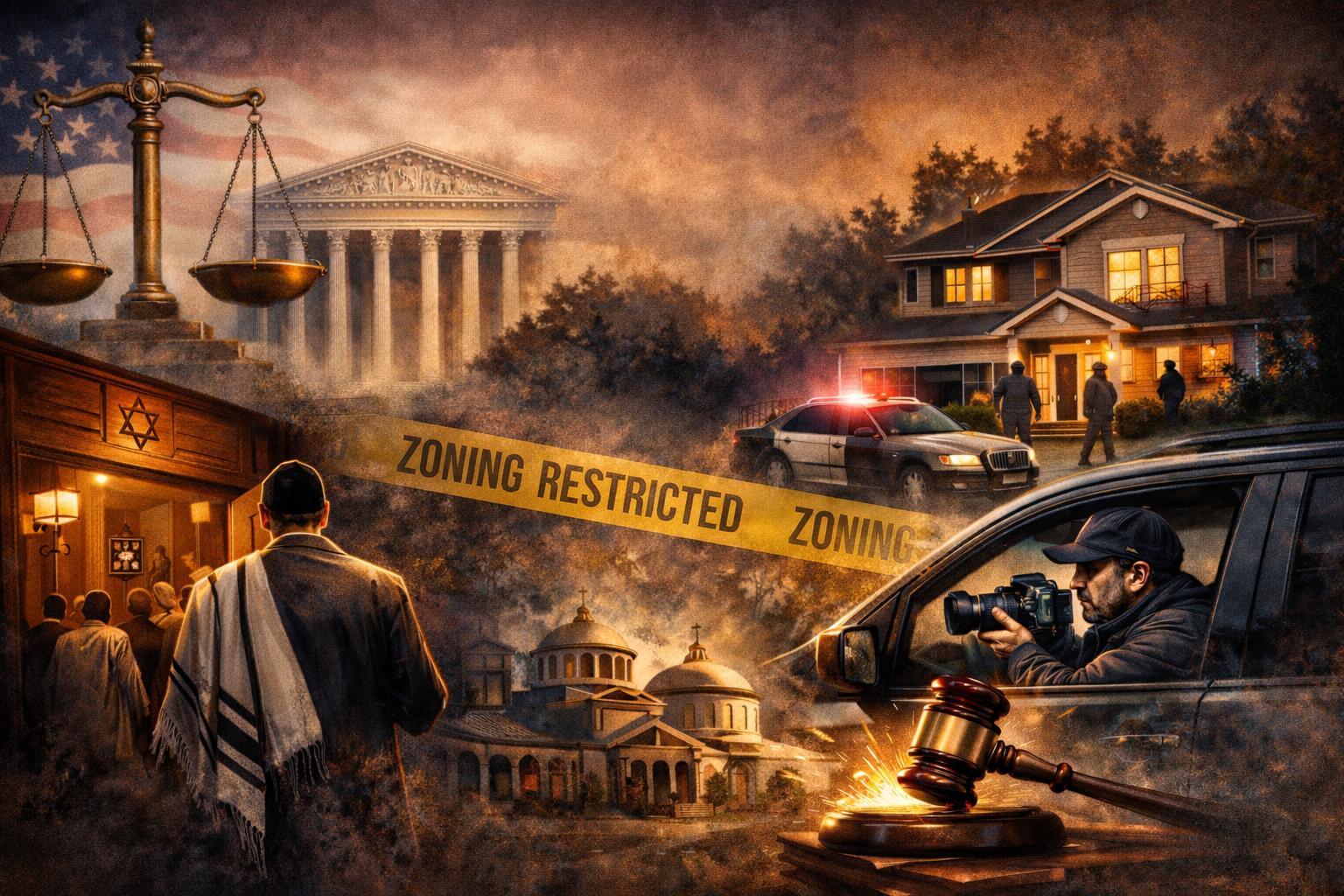
As Jews in a Cleveland, Ohio suburb went to the high holy day service of Rosh Hashanah, a private investigator was watching them. The man in the black SUV videotaped congregants entering the synagogue and the city of University Heights charged that 50 people had gone to pray, in excess of a court order limiting the number of congregants to only 36 people.
It was 2021 and existing battles over houses of worship had taken on a new intensity in the COVID era. While most cities, including Cleveland, generally avoided the level of extreme abuses seen in New York under Gov. Andrew Cuomo or California under Gov. Gavin Newsom, Cleveland, its suburbs and synagogues had long been in the curious position of creating legal precedents on religious freedom
Back in 1925, Cleveland Jewish Orphan Home v. Village of University Heights over discrimination against an orphanage, originally established in 1868 for orphans of the Civil War, helped set precedents for religious zoning cases including churches battling over being excluded from residential neighborhoods through municipal zoning regulations.
Tenafly Eruv Ass’n, Inc. v. Borough of Tenafly, also involving discrimination against Jewish religious practices out of nearby New Jersey, would go on to be cited in multiple COVID religious discrimination cases including Roman Catholic Diocese of Brooklyn v. Cuomo (which also included two Orthodox Jewish synagogues) and helped dismantle the COVID regime.
Now Grand v. City of University Heights, a case that dates back to 2021, is being appealed to the Supreme Court in the latest battle between municipalities and freedom of worship.
And the Trump administration had previously come out on Grand’s site with a supportive brief.
What is it about a case in an obscure suburb that led to a 28 page legal brief from the Department of Justice? The answer lies in the larger question of the right to prayer in America.
In 2021, Daniel Grand sent an email to a dozen people within two blocks inviting them to a prayer group at his house. Grand, who was new in town, received a phone call from the mayor warning him not to proceed. According to Grand, he was told that the city would “use any force necessary to prosecute” him if he insisted on having prayers at his house. Since then, Grand claims that he has faced multiple examples of legal harassment by the city against his property.
The prayer group was only intended to convene on Saturdays and holidays, times during which Orthodox Jews do not drive anywhere, so that parking would not be an issue.
Nevertheless a ‘cease and desist’ order was issued.
At the conclusion of a city Zoom meeting in March 2021, Mayor Michael Dylan Brennan publicly encouraged residents to report any observed prayer activity. “If you observe such activities, and I hope you do not, but if you do, you may report them to the city and the city will enforce its laws,” he stated. Grand has further alleged that police were directed to conduct surveillance of his home using unmarked vehicles, a claim consistent with the city’s documented use of private investigators to monitor a local synagogue.
Such battles have been taking place in the Cleveland suburbs for over a century.
Cleveland Jewish Orphan Home v. Village of University Heights had hinged in part on the use of selective zoning restrictions. The construction of the Fairmount Temple in Beachwood in the late 40s and 50s, a congregation whose origins had dated back to 1842, had led to four years of legal battles over the contention that the wealthy Reform synagogue would “be detrimental to the public safety, welfare, and convenience” that eventually ended up in the Ohio Supreme Court (State ex rel. Anshe Chesed Congregation v. Bruggemeir).
The same system that had previously blocked a Catholic Church was forced to give way, but human nature being what it is, battles over abuse of discretion and selective zoning for religious congregations continued.
In the late 90s the battle resumed over the construction of Orthodox synagogues and schools, with members of the Reform Temple leading the campaign against the congregations, one of which dated back to 1915, until the battle was finally won at the Ohio Supreme Court in 2000.
Daniel Grand’s battle and that of an actual synagogue which contends that zoning restrictions had functionally made it impossible to build a synagogue anywhere in the city shows the unfinished business of the Religious Freedom Restoration Act.
The Religious Freedom Restoration Act (RFRA) was one of the initiatives during the Clinton administration that was supposed to protect religious freedom in a country that was starting to become increasingly irreligious and even disdainful of religion. Like other ‘bipartisan’ initiatives from that era, the RFRA turned out to be a bait-and-switch and was gutted by the Supreme Court in City of Boerne v. Flores in a battle over the expansion of a Catholic church in Texas.
Bourne was one of a series of decisions by the Supreme Court that crippled the legislative vigorousness of Congress, eventually leaving it the useless shell that it is today. By the next decade, Congress existed to do little more than legislatively rubber stamp presidential agendas or block it, and a decade later, it could barely even manage to legislate, doing little more than holding hearings, conducting cable news hits and issuing press releases no one cared about.
Yet in the nineties, Congress still tried to compensate for RFRA’s death with the Religious Land Use and Institutionalized Persons Act (RLUIPA) and RLUIPA is being argued once again in cases involving churches and synagogues around the country. Including Daniel Grand’s case.
Grand’s case has attracted attention well beyond the local level. The Department of Justice had previously filed a 28-page brief in support of Grand before the Sixth Circuit Court of Appeals, arguing that “the fundamental premise of these land-use protections is that religious individuals should have a place to gather for worship and to carry out other religious activities.”
Grand v. City of University Heights raises broader questions about the extent to which local governments may use land-use authority to burden or effectively prohibit religious assembly. As American society grows increasingly secular and municipalities continue to press the boundaries of their regulatory authority, the legal framework protecting the right to worship — whether in a synagogue, a church, or a private home — continues to be tested. And in a country that is becoming ever more irreligious, the fight for the right to worship is still not resolved.
In order to eliminate spam comments that have historically flooded our comments section, comments containing certain keywords will be held in a moderation queue. All comments by legitimate commenters will be manually approved by a member of our team. If your comment is “Awaiting Moderation,” please give us up to 24 hours to manually approve your comment. Please do not re-post the same comment.