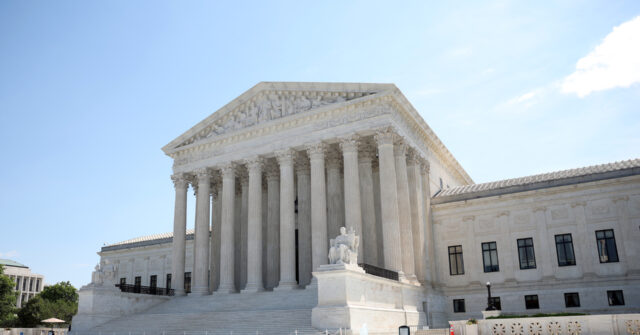
The Supreme Court on Monday handed President Trump a sweeping victory over the administrative state, ruling that Congress cannot shield the heads of independent regulatory agencies from presidential removal, and overturning a landmark 1935 precedent that had underpinned the modern regulatory framework for nearly a century.
The 6-3 decision in Trump v. Slaughter arose from the President’s firing of two Democratic-appointed Federal Trade Commission commissioners, Rebecca Slaughter and Alvaro Bedoya, at the start of his second term. Trump cited his constitutional authority under Article II rather than any cause recognized by the FTC’s governing statute, which permits removal only for “inefficiency, neglect of duty, or malfeasance in office.”
Writing for the majority, Chief Justice John Roberts concluded that the FTC’s for-cause removal protection is incompatible with the Constitution’s vesting of executive power in a single President. Officers who exercise executive power, the Court held, must remain accountable to the President — and accountability requires the ability to remove them at will.
The ruling explicitly overturned Humphrey’s Executor v. United States, which had carved out an exception to presidential removal authority for agencies exercising so-called quasi-legislative and quasi-judicial functions. The Court found that characterization had never made sense and had become increasingly untenable as the FTC’s powers expanded to cover virtually every corner of the American economy.
The decision’s reach extends well beyond the FTC, potentially exposing the leadership of dozens of independent agencies — including the SEC, CFTC, and NLRB — to at-will presidential removal.
One major institution stands apart. The Court indicated that the Federal Reserve may occupy a different constitutional category because of its unique historical lineage tracing to the First and Second Banks of the United States. In a companion decision released Monday, the Court rejected President Trump’s bid to stay a lower court order that allowed Fed Governor Lisa Cook to remain in place while litigation over her removal continues. The Court said the president failed to provide Cook with required notice and a fair opportunity to reply to allegations against her. The 5-4 majority opinion in that case said that “for cause” protection of Fed governors is consistent with the Constitution and the history of central bank independence in the U.S.
Justices Sotomayor, Kagan, and Jackson dissented.