Order Josh Hammer’s new book, Israel and Civilization: The Fate of the Jewish Nation and the Destiny of the West: HERE.
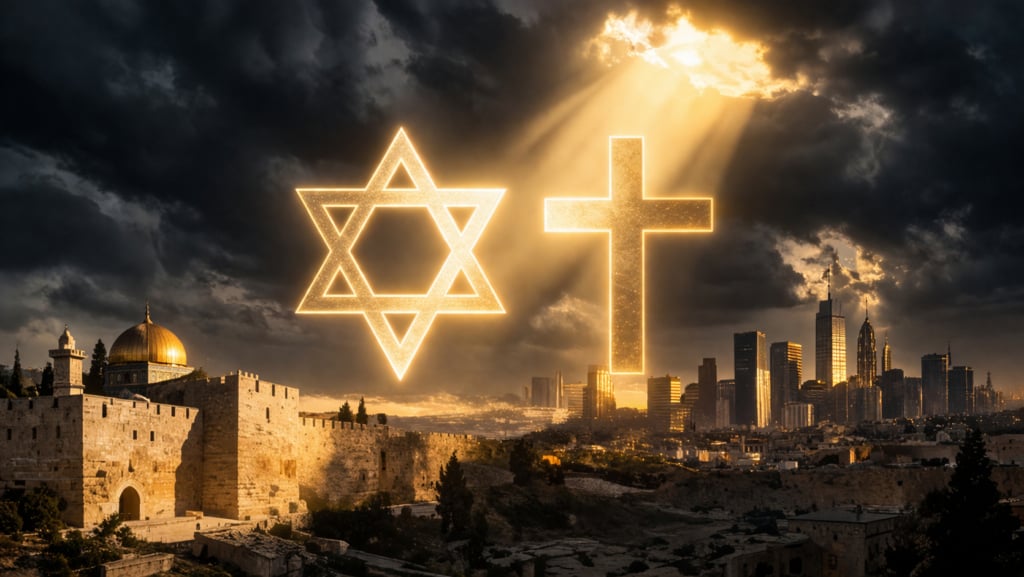
For a brief window this coming week, Passover and Holy Week, the sacred observances of Jews and Christians, respectively, will overlap. Jews around the world will gather this Wednesday and Thursday evenings for the Seder, which recounts the Exodus from Egypt and God’s redemptive hand in history. And after Good Friday and Holy Saturday on Sunday, April 5, Christians will celebrate the resurrection of Jesus Christ and the promise of eternal salvation. Two biblical traditions, distinct but from the same Abrahamic family tree, will thus find themselves marking holy seasons at the same time.
In this fraught moment, this calendar convergence feels like quite a bit more than mere serendipity. It is a visceral reminder of the shared moral and theological inheritance that undergirds Judaism and Christianity — the common foundation that has molded and shaped what we know today as Western civilization.
At their core, both holidays tell a story of redemption. For Jews, Passover is the story of a people delivered from bondage, divine justice meted out against tyranny, and covenantal purpose eventually forged after national liberation. Likewise for Christians, Easter is a story of redemption — of sin confronted and overcome, of sacrifice and renewal, of life triumphing over death. The theological particulars certainly differ and Judaism’s heavier emphasis on particularism contrasts with Christianity’s universalist orientation, but the underlying message is still strikingly similar: Hope springs eternal.
Equally central to both traditions, and both springtime holidays, is the idea of repentance. In Judaism, the concept of teshuvah — returning to God through repentance and righteous action — is a cornerstone of religious life. Jewish tradition teaches that in addition to the fall High Holiday season’s well-known focus on repentance, the springtime season of Passover is also a perfect occasion to atone and confidently step closer to God. Christianity, of course, also places repentance at the heart of spiritual renewal, calling believers to turn away from sin and toward charity and grace. The searing imagery of Christ’s crucifixion is ensconced in the West’s collective memory, perhaps more than anything else, for its emphasis on atonement for mankind’s sins.
These shared values — redemption, repentance, moral accountability — help constitute the bedrock of Western civilization today. Zooming out from the overarching themes of this season’s calendrical overlap, consider some of the West’s other defining principles: the rule of law, the dignity of the individual, the sanctity of life, the pursuit of justice. The fingerprints of the ecumenical biblical inheritance are ubiquitous. This is our common inheritance. This is who we are.
And yet, at this very moment when the alignment of Passover and Easter should prompt reflection on that shared inheritance, bad-faith actors on the home front are seeking to tear Jews and Christians apart at the seams. The timing of this subversion could not possibly be worse. The West finds itself under unprecedented strain. The threats are multifaceted and very real.
There is the challenge of Islamism — a totalitarian political ideology, historically beyond America’s borders but increasingly also found within, which seeks not peaceful coexistence but dominance. There is the rot of woke neo-Marxism, which rejects objective truth, undermines meritocracy, and seeks to replace individual responsibility with collective grievance and a debilitating victimhood culture. And there is the ever-insidious force of globalism, which threatens to erode national sovereignty, dilute cultural identity, and promote homogenized technocratic governance over the democratic accountability that only the nation-state can provide.
Against these challenges, Jews and Christians must not stand apart. We simply cannot afford to. The symbolic overlap of Passover and Easter this year should serve as a moment of reflection that, despite real theological differences, we are bound together by an overwhelming common inheritance and an inescapable common destiny.
This does not mean erasing distinctions. But it does mean acknowledging that we are allies in a broader civilizational struggle. It means recognizing the values we share are far more significant, at this juncture in history, than the doctrines that divide us. Loud provocateurs notwithstanding, the Judeo-Christian tradition has long been a powerful unifying force in the United States — a framework that transcends denominational lines.
Now is the time to build on that foundation. As families gather around the Seder table and for Easter services, there is an opportunity to reflect not only on the past but also on the future. What kind of civilization do we want to preserve and leave to our children? What values, customs and ways of life are worth defending? And who will stand together in that defense?
The story of the West is, in many ways, a shared story. It is a story rooted in the belief that man is made in God’s image, redemption is possible, repentance is necessary, and human beings are called to something higher. It’s up to us, ultimately, to take that message seriously — and to lock arms and stand shoulder to shoulder like never before to preserve our inheritance for many more generations to come.
In order to eliminate spam comments that have historically flooded our comments section, comments containing certain keywords will be held in a moderation queue. All comments by legitimate commenters will be manually approved by a member of our team. If your comment is “Awaiting Moderation,” please give us up to 24 hours to manually approve your comment. Please do not re-post the same comment.