
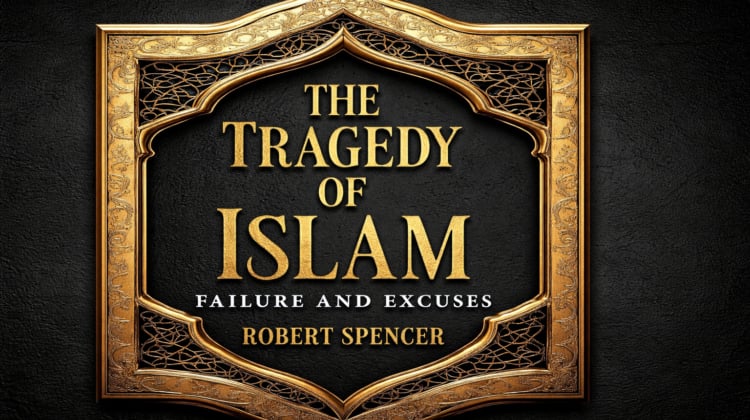
Order Robert Spencer’s new book, The Tragedy of Islam: Failure and Excuses: HERE.
It’s official: the list of Robert Spencer’s books is now longer than some books. No, not really, but it’s getting there. I frankly don’t know how he does it, because everything he writes is terrific. And although he keeps returning to his chief (but hardly his only) topic, namely Islam, he always has new information and new insights to offer – indeed, whole new angles to explore. So it is with his extremely engaging new volume, The Tragedy of Islam: Failure and Excuses. As he himself writes in his acknowledgments, he has “tried to express here something that doesn’t appear in my other books.” And what is that something? Well, in those other books, Spencer has delved into such topics as the life of Muhammed, the possible non-existence of Muhammed, the Koran, jihad, stealth jihad, the Crusades, and Islam’s treatment of women. This time around, his emphasis is on “exposing the contradictions” in the lies that Westerners have been told, since 9/11, “about the superior morals and history of the culture that has given rise to numerous deadly terror attacks.”
Needless to say, it’s depressing that in the wake of so many deadly terror attacks, and in the wake of countless other demonstrations of the radical shortcomings of Islam, such exposure should even be necessary. But it is. Millions of Americans actually believe that a U.S. under sharia would be just fine – or perhaps even better than what we have now. It wouldn’t. “In keeping with Islamic law,” explains Spencer, “a majority-Muslim United States would likely criminalize behaviors that Islam forbids: the sale and consumption of alcohol and pork, the use of interest in financial transactions, and more. The veil would almost certainly be made mandatory for women, as it is in the Islamic Republic of Iran and other Sharia states. Certain behaviors, such as homosexual acts, fornication, and adultery could also be criminalized, while polygamy would be legalized.” Every American should know such things by now. It’s the fault of our politicians, journalists, and educators that millions don’t.
Oh, and one more thing: if America were to turn Islamic, the economy would tank. America’s wealth, you see, was created by the Protestant work ethic; the poverty of Muslim countries – except, naturally, for those that have reaped the benefits of oil wealth – is owing to Islam’s utter lack of a work ethic. This goes all the way back to Muhammed, who, instead of encouraging his followers to become farmers or merchants or tradesmen, urged them to raid and steal and plunder; as Spencer writes, he inculcated in them “an aversion to manual labor,” a belief that “work is a curse,” and “a spirit of parasitism,” whereby the wealth of Islamic polities has always been derived almost exclusively from the labor of subjugated peoples. No subjugated peoples, then, no wealth. Hence Islam, when it lacks a hard-working, productive class of subordinate heathens, is nothing more than a formula for poverty – a fact that has resulted, over history, in a series of Muslim polities that Spencer calls “failed societies.” Yes, thanks to its fixation on conquest, Islam may well have done a remarkable job of expanding over the centuries, but what exactly did it bring to its newly conquered territories other than ignorance, intolerance, and a demand that their new underlings provide them with the cash they themselves were incapable of earning?
Failure is a running theme in this book, because Islam is failure. One of Spencer’s chapter titles is “Failure Breeds Jihad.” How so? Because the more that Islam leads to socioeconomic decay, the clearer the solution is, at least according to the cockeyed logic of Islam: spread the faith even further afield, and Allah will reward you with good fortune. Other chapters explore the objectively irrational but deeply ingrained Islamic connections between (a) failure and Jew-hatred and (b) failure and suspicion of outsiders. Another chapter, entitled “The Fictional Palace of Islamic Achievements” (this book is called The Tragedy of Islam, but when certain things, such as this chapter title, make one laugh out loud, one reflects that it might well have been entitled The Comedy of Islam), makes quick work of the absurd claims, often made by respected historians, that Muslims were the real minds behind such inventions as the airplane – which some Andalusian genius is said to have demonstrated in the year 852, no less. Still other chapters focus on the perverse phenomenon, which has been observed for centuries, of famous Westerners who’ve had a soft spot for Islam (among them Luther, Voltaire, Gibbon, Carlyle, and Washington Irving) and of Westerners (notably Thomas Jefferson, Einstein, Neil Armstrong, Jacques Cousteau, and Morgan Freeman – now there’s an idea for a fantasy dinner party) who’ve been falsely described as having converted to Islam.
Alas, there’s hardly any need to invent false converts to Islam, because there have been more than enough real ones, many of whom have become skillful practitioners of violent jihad. Among them: Mujahida bint Isamah, who having taken advantage of the opportunity to become a physician in Britain, joined ISIS and posted on Twitter a photo of herself holding a severed head along with the caption “Dream job, a terrorist doc.” Then there’s Mike Hawash, an Intel executive in Portland, Oregon, who became a recruiter for al-Qaeda and the Taliban. The perpetrator of the 2017 Westminster Bridge attack was a convert, too. The list goes on – and on and on. If so many of these converts manage to fly under the radar of the law, it’s because there’s a strong disinclination among officials throughout the West to upset “the dogma that Islam is a religion of peace and tolerance that has nothing whatsoever to do with terrorism.”
Yet whatever pretty illusions some Westerners may harbor, seriously reflective Muslims know better. They’re aware that Islam is a mess – which can be an uncomfortable fact for them to deal with, given that Allah himself has told them that Islam is perfect. And the more that the Internet exposes them to the remarkable intellectual and cultural achievements of other cultures, the more powerfully they’re reminded of Islam’s fundamental mediocrity. Now, any culture other than Islam might respond to its inferiority with a strong impulse for self-improvement, a determination to become a light unto the nations. Not Islam. As we’ve already seen, productive work is not on the Muslim menu. No, in Islam, an awareness of inferiority leads to shame, and shame leads to hate, and hate leads to a lust for revenge – period. If Israel is such an obsession among Muslims, it’s not just because the Koran commands them to loathe Jews, but also because these objects of their divinely directed loathing have turned their tiny patch of desert into a booming modern economy – one that shames every Islamic state on earth, past or present.
Spencer doesn’t neglect to note that where Islam is concerned, we’re living in a strange time. “It would be one of the supreme ironies of history,” writes Spencer, “if the West embraced Islam just as Iran and other areas of the Islamic world were liberating themselves from it.” Ironic indeed. The Emirates, Bahrain, Morocco, and Sudan all signed the Abraham Accords with Israel. While several Western European countries have fulminated against America’s war on Iran, Islamic states like Saudi Arabia, the Emirates, Bahrain, Qatar, and Kuwait have supported it. During his presidency, Donald Trump seems to have talked many major Islamic governments into turning away from the Islamic tradition of war and poverty and embracing, instead, the opportunity to give their people peace and prosperity. If this development continues, it will truly mark a historic turning point for Islam. Meanwhile, however, much of Europe is already in the grip of Islam at its most truculent, and, given the continued inability of many if not most native Europeans to understand – and withstand – the enemy within, the prospects for the future of European liberty look bleak indeed. As Spencer puts it in his closing sentences, an Islamic Europe seems unlikely to differ significantly “from an Islamic Middle East, an Islamic North Africa, and an Islamic Asia.” How lamentable it is that while Spencer – more, probably, than anyone else, certainly in the English language – has striven over the past quarter century to sound the alarm, all too few readers have heeded his warning. Yes, his efforts may be quixotic. But that doesn’t make them any less heroic.
In order to eliminate spam comments that have historically flooded our comments section, comments containing certain keywords will be held in a moderation queue. All comments by legitimate commenters will be manually approved by a member of our team. If your comment is “Awaiting Moderation,” please give us up to 24 hours to manually approve your comment. Please do not re-post the same comment.


