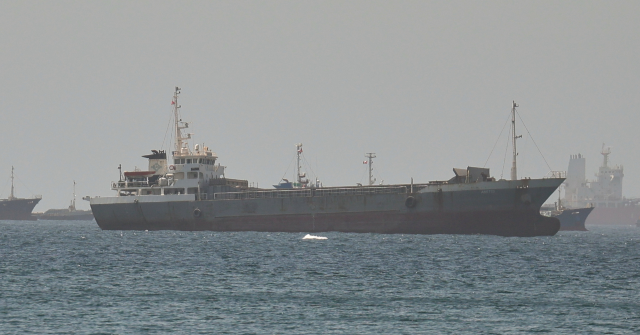
Iran’s Islamic Revolutionary Guard Corps (IRGC) attacked a Singapore-flagged commercial vessel in the Strait of Hormuz on Thursday, forcing the United Nations to temporarily pause its evacuation operation and raising fresh questions about Iran’s commitment to keeping the critical waterway open.
Multiple U.S. officials later told news outlets that the cargo ship Ever Lovely had been struck by an Iranian one-way attack drone and that the vessel’s approach pattern appeared to indicate a deliberate strike.
The reported attack came hours after Iran warned that vessels using routes through the strait that had not been approved by Tehran were “extremely dangerous and prohibited” and cautioned that “violators will be dealt with,” underscoring the Islamic Republic’s increasingly assertive posture as it seeks a greater role in managing traffic through the strategic waterway.
The United Kingdom Maritime Trade Operations center said the vessel was struck by an “unknown projectile” roughly 7.5 nautical miles southeast of Dahit, Oman, damaging the ship’s bridge but causing no casualties or environmental damage.
The attack prompted the International Maritime Organization (IMO), a specialized U.N. agency, to temporarily pause a plan launched only days earlier to evacuate more than 11,000 stranded seafarers from the Persian Gulf region.
“Following the launch of the IMO’s evacuation plan, through which several vessels have already been successfully evacuated, I have decided to temporarily pause its implementation in order to reconfirm that the necessary safety guarantees continue to be in place for the ships on our evacuation list and all those in the region,” IMO Secretary-General Arsenio Dominguez said.
Dominguez noted that the Ever Lovely had already transited the Strait of Hormuz and was not participating in the U.N.-coordinated evacuation framework.
“I have always reiterated that the safety of the seafarers remains paramount,” he added. “Therefore, to ensure a coordinated approach and navigational safety, the evacuation plan will be paused until further clarity is obtained.”
Iran’s Persian Gulf Strait Authority (PGSA), a newly established Iranian body tasked with overseeing transit through the waterway, later warned that vessels traveling outside routes it designated would not receive safe-passage guarantees or insurance protections.
“Any passage through routes outside the framework designated by PGSA will not be covered by safe passage guarantees and will not be entitled to insurance coverage or related liabilities,” the body said.
It added that any consequences arising from travel through what it described as unauthorized routes would be the responsibility of the vessel’s owner, operator, and master.
The warnings came as the United States, Oman and the IMO had been working to establish a temporary maritime corridor along the Omani coast to allow vessels stranded for months in the Persian Gulf to safely leave the region.
Iran’s IRGC Navy objected to the arrangement Thursday, saying the route had been announced “without notice or coordination with the Islamic Republic of Iran.”
“The only authorized route for passing through the Strait of Hormuz is the one declared by the Islamic Republic of Iran,” the IRGC said, according to Iranian state media. “Vessel traffic outside these routes is extremely dangerous and prohibited.”
“Violators will be dealt with,” it added.
The incident quickly put renewed attention on maritime provisions contained in last week’s U.S.-Iran memorandum of understanding, which calls on Iran to use its “best efforts” to facilitate safe, toll-free commercial passage through the strait for 60 days while negotiations continue on a broader agreement.
Secretary of State Marco Rubio, who met Thursday with Gulf Cooperation Council officials in Bahrain, warned that Washington would judge Tehran by whether or not vessels can move freely through the waterway.
“If ships are moving as they should be moving, then that’s what we’re going to judge, and that’s what we’re going to react to,” Rubio said.
“If, on the other hand, this rhetoric is backed up by actual ships being threatened and ships are not moving, that’s a violation of the agreement, and we’re going to have a problem with it,” he added.
Rubio also rejected any effort by Iran to impose tolls or fees on maritime traffic.
“International waterways do not belong to any nation-state,” Rubio said. “If in fact we accepted that you can charge money to use an international waterway because it happens to be near your territorial space, well then, this will spread throughout the world like a contagion.”
The United States and Gulf states later issued a joint statement rejecting Iranian fees or restrictions on transit through the Strait of Hormuz and stressing that “free, unconditional and unrestricted navigation” remains essential to regional and global security.
Iranian officials, however, have increasingly argued that management of the waterway cannot simply return to the pre-conflict status quo.
Iranian Foreign Minister Abbas Araghchi said Thursday that Iran and Oman would hold discussions “to define future administration and maritime services in the Strait of Hormuz,” while Iranian Parliament Speaker and chief negotiator Mohammad Bagher Ghalibaf said earlier this week that “management of the strait will never return to the way it was before.”
The Wall Street Journal reported Thursday that Iran has floated maritime service fees that could generate billions of dollars annually, though Oman reportedly assured Rubio and Gulf officials that future arrangements would not include transit tolls.
President Donald Trump warned on Wednesday that any attempt by Iran to impose tolls, insurance costs, or other charges on vessels using the waterway would be “unacceptable” and could immediately derail negotiations.
“Iran has informed the U.S. that, despite troublemaking Fake News reporting to the contrary, there are ‘NO TOLLS, NO INSURANCE COSTS, & NO OTHER CHARGES OF ANY KIND BEING SOUGHT OR RECEIVED BY IRAN ON SHIPS TRAVELING THE STRAIT OF HORMUZ,’” Trump wrote on Truth Social.
“If this is false information, negotiations would end, immediately!” he added.
U.S. Central Command (CENTCOM) posted photographs Thursday showing American F-16 fighter jets flying over the Middle East and said U.S. forces remain positioned throughout the region.
“U.S. forces remain present and vigilant throughout the region,” CENTCOM said.
The incident also places new focus on deconfliction mechanisms established during talks in Switzerland, including a channel Vice President JD Vance said would place IRGC representatives in Doha alongside U.S. Central Command officials to help resolve disputes involving the waterway.
“They were like, ‘OK, fine, we’ll send somebody from the IRGC to go hang out in Doha with somebody from CENTCOM, and that’s how we’re going to settle a lot of these disputes,’” Vance said in an interview published Thursday by British outlet UnHerd.
Vance has described the memorandum as a “foundational document” intended to “open the strait,” “stop shooting at each other,” and begin negotiations on a broader nuclear and sanctions agreement.
Commercial traffic through Hormuz had been gradually recovering in recent days, with maritime tracking data showing a growing number of ships once again traversing the chokepoint, though traffic remained below pre-conflict levels.
The reported strike on the Ever Lovely places fresh pressure on maritime provisions in the memorandum and on Washington’s insistence that the Strait of Hormuz remain open without Iranian tolls, fees, or unilateral control over one of the world’s most strategically important shipping lanes.
Joshua Klein is a reporter for Breitbart News. Email him at jklein@breitbart.com. Follow him on Twitter @JoshuaKlein.