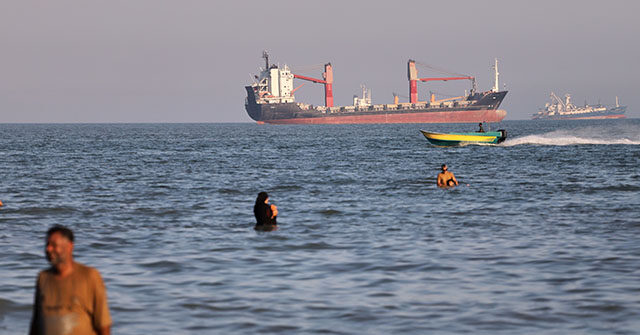
Ship tracking services say at least three Iranian oil tankers, carrying about five million barrels of oil, have passed through the former U.S. blockade line since President Donald Trump announced his ceasefire deal with Tehran on Sunday.
According to ship trackers Kpler and Vortexa, two very large crude carriers (VLCC) named Hero II and Diona, each loaded with about 2 million barrels of Iranian oil, completed their passage through the Gulf of Oman on Wednesday and are now heading for destinations in Asia.
Another, smaller tanker named Sonia I has also passed the blockade line and is bound for Singapore.
All three ships are owned by the National Iranian Tanker Company, which was sanctioned by the U.S. Treasury Department in October 2020 for providing income to the Islamic Revolutionary Guard Corps (IRGC), a designated terrorist organization.
According to the Windward maritime intelligence firm, Hero II, Diona, and Sonia I are the first Iranian ships to run with their identification transponders turned on since March. Although they are broadcasting their current positions, none of the ships are broadcasting their ultimate destination.
An empty VLCC linked to Iran called Stream is approaching the blockade line from the other direction, as is a partially loaded supertanker called Herby. The Stream was broadcasting its position until it reached the blockade line, at which point it switched off its transponder.
“The signal has gone out and they are repositioning in expectation of the end of the U.S. blockade. Clearly, a system reboot is in progress,” said Charlie Brown of United Against Nuclear Iran (UANI).
UANI said at least five Iran-flagged cargo ships that departed from parking spots near Malaysia are now returning to Iran.
The U.S. blockade is technically still in effect until the Memorandum of Understanding (MOU) with Iran is formally signed on Friday, but Iranian vessels are apparently more confident about crossing the former blockade early than the international ships bottled up in the Persian Gulf. Only a handful of those ships have yet been willing to test President Donald Trump’s assurances that the Strait of Hormuz has been reopened for traffic.
“The maritime sector is treating the news with something closer to wary disbelief than celebration,” Lloyd’s List Intelligence observed in a note to clients on Tuesday.
“While a pause in hostilities will free stranded mariners and boost tanker and bulk markets, the sector sees this as a fragile reprieve rather than a return to normality,” the intelligence firm said, anticipating that a few heavily-loaded VLCCs will soon try their luck to get a “first-mover advantage” for the reopened Strait of Hormuz.
Windward said on Wednesday that dozens of VLCC’s have sailed from the South China Sea and Indian Ocean, bound for fuel-loading ports in the United Arab Emirates (UAE), which they can only reach by passing through the Strait of Hormuz.