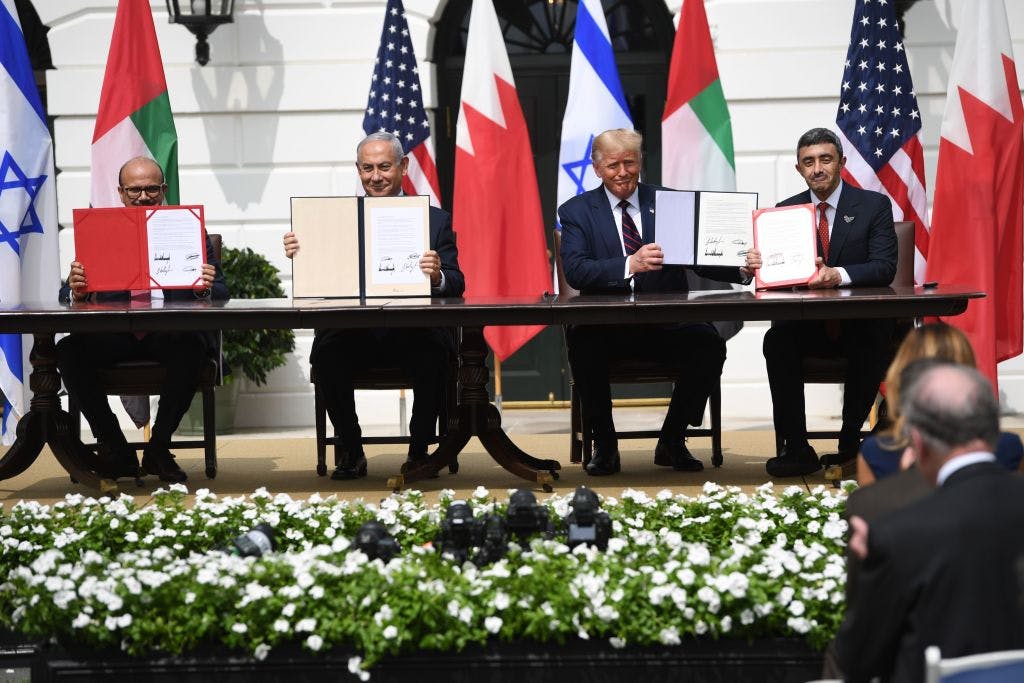
The war with Iran is putting the Abraham Accords to the test, but experts say the conflict could ultimately pave the way for new normalization agreements.
The U.S.-brokered normalization agreements between Israel and several Arab states faced strain during Israel’s recent war with Hamas, triggering widespread anger across the Arab world and putting governments such as the United Arab Emirates, Bahrain, and Morocco under pressure to distance themselves from Israel.
But Iran’s expanding campaign of missile and drone attacks on its neighbors has shifted the strategic picture, potentially pushing several Arab states closer to the United States and Israel, experts say.
Existing Abraham Accords members are already seeing the practical benefits of that cooperation as they work to defend themselves from Iranian attacks on both civilian and military sites within their countries.
Nir Boms, the director of the Tel Aviv University Workshop on Israel and the Middle East, said the conflict has effectively become a real-world stress test for the Abraham Accords.
“The Iranian strategy was to cause damage — economic damage, damage to even civilian infrastructure — in order to increase the pressure by the regional countries to work against Israel and work against the United States,” Boms said.
Instead, he said, the war has highlighted the benefits of regional cooperation.
“We’ve actually had more channels where Israel could be of assistance when it comes to civilian defense, when it comes to some of the systems that the Gulf countries now have to adopt very quickly,” he said.
Israeli defense technology, including the Barak missile system, is being used by the United Arab Emirates as part of its air defense network. Israeli experts have also reportedly advised regional partners on strengthening civilian warning systems and defenses.
Defense sales have also increased between Israel and Abraham Accords partners. Israel’s defense exports reached a record $14.8 billion in 2024, with countries that signed the accords accounting for about 12% of those exports — up from just 3% in 2023, according to a report from the Institute for National Security Studies. Sales to the United Arab Emirates and Bahrain were among the fastest-growing.
Rawan Osman, a research and diplomacy fellow at the Jerusalem Center for Security and Foreign Affairs, said the war is clarifying a strategic reality that many governments in the region already understood privately.
“Paradoxically, the war with Iran is likely strengthening Israel’s ties with the countries that signed the Abraham Accords,” Osman said. “Moments of crisis often clarify political realities.”
Iran’s decision to fire missiles not only at Israel but also at Gulf states such as the UAE is making it “difficult to maintain the old narrative that Israel is the primary enemy,” Osman said.
At the same time, Osman said Iran views the Abraham Accords themselves as a direct challenge to its regional ambitions.
“By attacking neighbors that have aligned themselves with Israel, Iran is trying to send a message: cooperation with Israel carries a cost.”
But Jason Brodsky, policy director at United Against Nuclear Iran, said the strategy could ultimately backfire.
“Iran has aimed for years to encircle Israel in a ring of fire,” Brodsky said. “But with its missile and drone strikes against Gulf countries and other neighbors, it’s actually risking encircling itself in a ring of fire.”
Brodsky added that the attacks could do long-term damage to Tehran’s relationships across the region and create new opportunities for Israel and the United States to deepen cooperation with regional partners.
“To externalize the costs economically, politically, and militarily, Iran sought to expand the geography of the conflict to deter the U.S.,” Brodsky said, and instead made its missile program “the center of international attention.”
Asher Fredman, executive director of the Misgav Institute for National Security and a visiting fellow at the Heritage Foundation, who specializes in Abraham ties, said cooperation has continued even during periods of conflict.
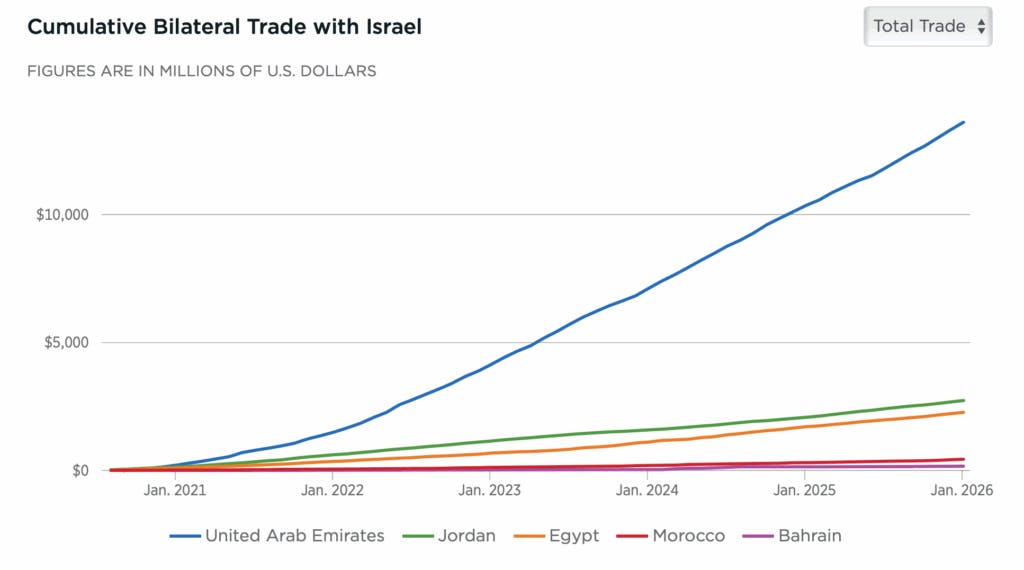
“If you look at the numbers, trade between Israel and Morocco, the UAE, Bahrain — even Egypt and Jordan — is up across the board,” Fredman said.
Since the Abraham Accords were signed in 2020, trade between Israel and its Abraham Accords partners has continued to rise despite the war with Hamas and pressure from anti-Israel voices. In January 2026, trade with Bahrain reached $3.6 million, up from virtually zero a year earlier; trade with Morocco totaled $21.8 million, a 7% increase; and trade with the United Arab Emirates reached $301.9 million, up 22% from January 2025, according to data compiled by the Heritage Foundation.
Relations between the UAE and Israel have been the quickest to grow. Over one million Israelis have visited the United Arab Emirates, more than nine kosher restaurants have opened, and bilateral trade reached $3 billion in 2024, according to Israel’s Central Bureau of Statistics.
According to Fredman, Iran’s attempts to disrupt global shipping by threatening traffic through the Strait of Hormuz could end up strengthening economic cooperation between Israel and its regional partners.
Fredman said instability has renewed interest in the India–Middle East–Europe Economic Corridor (IMEC), a proposed overland trade route connecting India to Europe through Gulf states, Jordan, and Israel.
“There’s growing interest in the IMEC overland trade route because the Strait of Hormuz is once again being disrupted,” Fredman said. “As maritime insurance goes up and uncertainty grows, the economic case for this overland route grows as well.”
The rising regional security threat is also contributing to a growing sense of shared interests among Israel and its Arab partners.
“There is a growing sense of, ‘we’re in this together,’” Fredman said.
(Heritage Foundation)
The economic momentum has also reached Israel’s neighboring countries, which did not sign the Abraham Accords. Trade with Egypt totaled $51.8 million in January 2026, while trade with Jordan reached $55.7 million. In December, Israeli Prime Minister Benjamin Netanyahu announced that Israel had signed a $34.7 billion natural gas deal with Egypt, the largest energy agreement in the country’s history.
Some analysts believe the war could eventually expand the accords if Iran emerges weakened.
Elie Pieprz, director of international relations at the Israel Defense and Security Forum, said the conflict is demonstrating the strategic value of Israel’s growing regional alliances.
“This war is demonstrating the effectiveness of the alliance,” Pieprz said. “Israel is emerging as the regional superpower that no one wants to mess with.”
If countries like the United Arab Emirates and Bahrain continue to benefit from their cooperation with Israel, Pieprz said, other governments may become more willing to pursue normalization agreements.
Saudi Arabia remains the most significant potential addition to the accords, though political disputes have continued to delay diplomatic talks.
The war is also reshaping political conversations inside countries that have historically opposed normalization. Osman noted that even in Lebanon — where Hezbollah has long dominated the political landscape — recent public discussions about normalization with Israel have begun to emerge.
“The conflict is exposing the real source of instability in the region,” Osman said. “For many Sunni states, Iran’s revolutionary project and its network of militias pose the far greater long-term danger.”
Ultimately, experts say the future of the Abraham Accords will depend on how the war with Iran ends.
If Tehran’s regional influence weakens or the Islamic regime is overthrown, the conflict could accelerate a broader realignment in the Middle East, bringing more countries into cooperation with Israel.