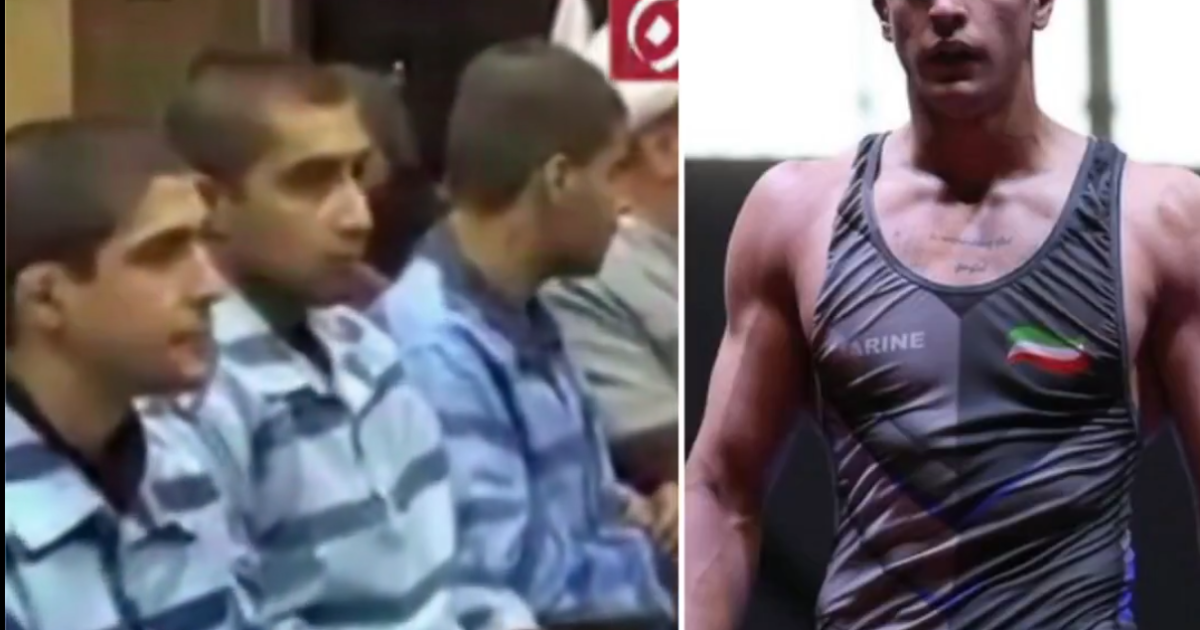
Iran executed 19-year-old freestyle wrestling champion Saleh Mohammadi on March 19, 2026, in a public hanging in Qom alongside Saeed Davoudi and Mehdi Ghasemi. The three had been arrested on December 18, 2025, and charged with moharebeh, waging war against God, in connection with the deaths of two police officers during protests on January 8. The regime frequently applies this capital charge in protest-related cases.
The Islamic Republic has positioned itself as the embodiment of divine governance on earth, a principle established in its constitution through the concept of velayat-e faqih, the guardianship of the Islamic jurist, which holds that the supreme leader rules as the representative of God and the Hidden Imam.
Under this framework, opposition to the state is framed as opposition to God’s ordained order, making moharebeh a charge applied to protesters, dissidents, and political prisoners. The charge carries the death penalty under the Islamic Penal Code of Iran.
Mohammadi turned 19 in prison on March 11 and was sentenced to death by a Qom court on February 4, less than three weeks after his arrest. He told the court his confessions had been extracted under torture. The court disregarded witness testimony from family members and CCTV footage that failed to place him at the scene and denied him independent legal representation.
These were the first announced hangings tied to the December 2025 nationwide protests against the regime. Iran Human Rights has warned that hundreds of detainees face charges that could carry death sentences. Iran executed at least 1,500 people in 2025, making it one of the world’s most prolific executioners after China.
The execution of Mohammadi follows a pattern of executing wrestlers that the Islamic Republic has maintained since its founding. Hooshang Montazeralzohour, a champion wrestler who represented Iran at the 1976 Montreal Olympics and the 1977 Summer Universiade, was arrested in 1981 and executed by firing squad alongside 29 others on charges of PMOI membership.
PMOI stands for the People’s Mujahedin Organization of Iran, also known by its Persian acronym MEK (Mujahedin-e Khalq). It was founded in the 1960s as an opposition group combining Islamist and Marxist ideology and participated in the 1979 revolution against the Shah. It quickly fell out with Khomeini, was banned, and the regime declared membership a capital offense.
Throughout the 1980s, the regime used PMOI membership charges, whether real or fabricated, as the primary legal mechanism to execute political prisoners, including athletes and the tens of thousands killed in the 1988 massacre.
The 1988 massacre, carried out under a fatwa from Supreme Leader Ayatollah Khomeini, was the regime’s deadliest single episode of political killing. Death Commissions operated across Iran, targeting primarily PMOI supporters. Amnesty International and Human Rights Watch estimate between 2,800 and 5,000 were killed; the PMOI puts the figure at 30,000.
Navid Afkari, born July 22, 1993, became the most internationally recognized of these cases. A Greco-Roman wrestler, he was arrested during the 2018 protests in Shiraz, convicted of murdering a security guard, and executed on September 12, 2020, despite calls for clemency from IOC President Thomas Bach and then-U.S. President Donald Trump.
In a recording smuggled from prison, he stated: “I’ve exhausted all resorts to the justice system of the Islamic Republic. They’ve rejected my requests for a retrial. The Islamic Republic of Iran is about to execute an innocent person.” His brothers Vahid and Habib were sentenced to 54 and 27 years respectively. The family was forced to bury him in secrecy under security supervision in his village near Shiraz.
Sculptor Reza Olia of the National Council of Resistance of Iran created a statue of Afkari, stating: “I offer the statue of the national hero Navid Afkari to the people of Iran.” A memorial to Afkari, surrounded by roses and red flowers, the symbol of the Iranian resistance, was displayed at a Free Iran summit on a rooftop overlooking the U.S. Capitol, attended by Iranian-Americans and addressed by Sen. Marco Rubio.
On the fifth anniversary of the execution, the U.S. State Department stated that Afkari’s case reflects a broader pattern of systematic impunity for torture, forced confessions, and executions carried out without due process.
Saleh Mohammadi’s execution on March 19, 2026, follows the same pattern applied across five decades: athletes are selected as high-profile targets, charged with involvement in the deaths of security personnel, subjected to torture to produce confessions, denied independent counsel, and executed despite international condemnation.
The post Iran Continues Decades-Long History of Executing Wrestlers appeared first on The Gateway Pundit.