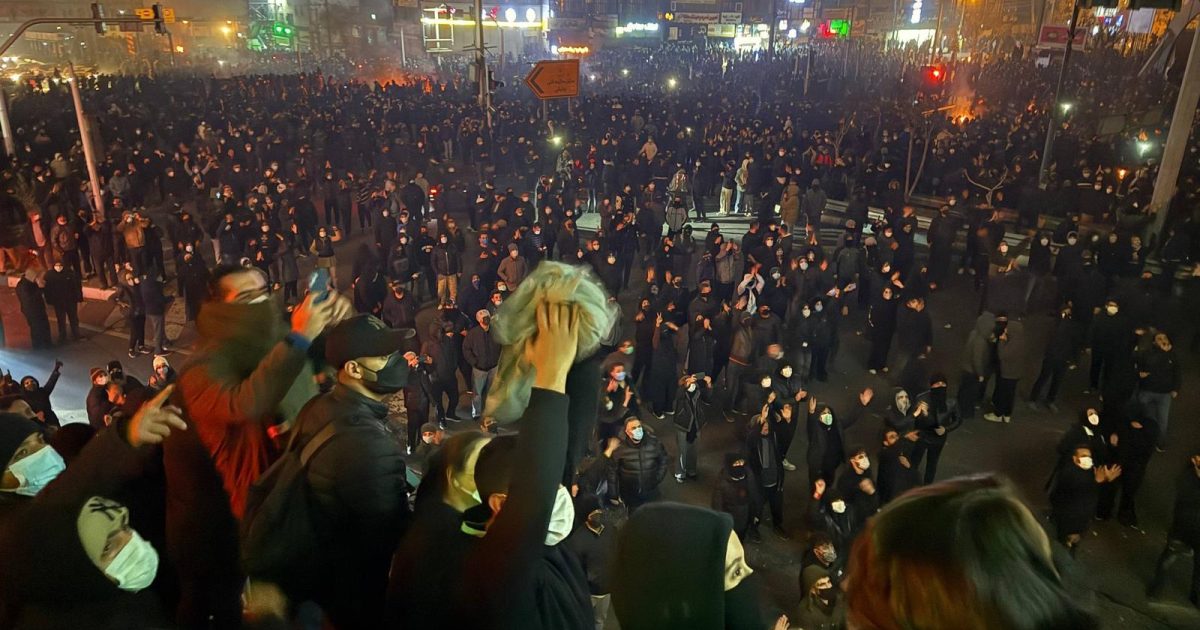
“I watched millions of people come to the street and thousands died,” said Saghar Erica Kasraie, a naturalized U.S. citizen, Christian convert, and anti-Iranian regime activist. In an interview with The Gateway Pundit, she described how the recent protests, during which more than 30,000 people were killed by the regime, inspired her to make her movie, titled Occupied Homeland.
She said the title reflects how many Iranians view the Islamic Republic. “We Iranians see the Islamic regime as a terrorist organization that has taken our country, our homeland, hostage. We believe it is occupied by the Islamic regime and its ideology.”
According to Kasraie, the regime has drained the country’s wealth to advance its revolutionary agenda abroad. “It’s depleted our resources for exporting its ideology with its proxies and with its ideological mission to destroy the land of Israel and to kill all the infidels so that Islam will be glorified.”
Kasraie’s family fled Iran shortly after the 1979 Islamic Revolution. She recalled how suddenly life changed for children as the new regime rapidly imposed Islamic rule.
“One day I went to school with no hijab, and the next day I went to school with hijab,” she said, remembering how students were required to chant “Death to America” and “Death to Israel.” While her father’s relatives reached the United States quickly, Kasraie, her mother, and sister became stranded in Italy while waiting for visas during the Iran-Iraq War and the hostage crisis.
With no refugee system in place at the time, they spent about a year living in a Catholic convent. There, as a child surrounded by unfamiliar Christian imagery, she began asking questions about faith. “Why is a man hanging on the wall with nails in his hands and feet?” she recalled wondering as she looked at the crucifix.
The family eventually settled in the United States, where a babysitter began taking her to a Baptist church. The experience contrasted sharply with the rituals she had seen in the convent. The cross was there, but without the image of the man.
“There was no stand up, sit down, no kneeling, no bells, no rituals,” she said. “Just people singing.” She said she sensed the same feeling she had first experienced in the church in Italy, a sense of peace that eventually led her to be baptized as a young teenager. She learned English and became a patriotic American, as did countless other Iranians who fled the ayatollahs’ regime.
In the wake of the Islamic Revolution and the Iran-Iraq War through the early 2000s, approximately 330,000 Iranians came to the United States. As of 2024, there were about 750,000 Iranian Americans, including U.S.-born children of immigrants. Nearly 60 percent of Iranians abroad have earned at least an undergraduate degree. They also have some of the highest rates of self-employment among immigrant groups and are one of the higher-income earning demographics in the country.
At least half of Iranians historically voted Democrat but became disillusioned by what they saw as the weak handling of the regime by the Carter and Biden administrations. Consequently, there had already been a growing trend toward Republican voting even before President Trump launched the strike that killed Ayatollah Khamenei. In that one moment, he likely flipped much of the remaining community, gaining several hundred thousand new Republican voters.
“I think the Iranian people after 47 years are showing the world that we Iranians love America,” Kasraie said, referencing the massive pro-Trump marches that broke out in diaspora communities around the world after news broke of the ayatollah’s death. “And every rally that Iranians have organized, you see the American flag, the Israeli flag, and the Lion and Sun flag.”
The Lion and Sun flag is a historic Iranian national flag consisting of a green-white-red horizontal tricolor charged with the Lion and Sun emblem. It served as the state flag of Iran from 1907 until the 1979 Islamic Revolution, after which it was strictly banned. It has since become a symbol of resistance against the regime and what many opponents describe as the occupation of Iran by Islamist forces.
Another cultural divide appears in language. Persian, or Farsi, is the original language of Iran, but the religious regime uses Arabic script and Islamic symbolism on its flag and official government seals. Many in the anti-regime movement want to remove Arabic language and symbols from national emblems and eliminate Arabic loanwords that have entered everyday speech. Supporters say this reflects the deeper difference between Persian national identity and the Islamist identity imposed by the regime.
“Iranians are now choosing to omit Arabic words from our language because they want nothing to do with Islam.” Kasraie explained that many people see themselves primarily as Persian and want a secular state. This claim is supported by recent research by GAMAAN, the Group for Analyzing and Measuring Attitudes in Iran, an independent, non-profit research foundation registered in the Netherlands that studies Iranian public opinion on social, political, and religious issues.
GAMAAN found that 89 percent of Iranians want democracy, while only about 20 percent support the continuation of the Islamic Republic. The majority prefer a different political system, such as a secular republic, a constitutional monarchy, or a more decentralized democracy.
When Kasraie first began speaking out against the Islamist regime in America, people criticized her. “People would say to me, you should not say things like that out loud. That is Islamophobic.” As a result, she said she began to censor herself. But the recent protests changed her position. “When I now see Iranians in Iran risking their lives to show the world that they don’t want Islam, then I should be ashamed of myself for not having the courage to point out the truth.”
“The reason I made this film is because all of the people who have left Iran want to go back. But we can’t go back,” she said. At the same time, “everyone in the homeland wants to get out because they’re occupied, because they’re held hostage.”
There have always been periodic anti-regime protests in Iran, which typically ended when the government killed or arrested large numbers of people. But this time the massacre was on such a scale that Kasraie said, “You cannot just ignore 30,000 people being massacred.”
She said many Iranians had long hoped that the world would step in and help, but no one did anything. “Now you see that the world finally did something. Well, Trump and Israel did something.”
“We never thought that Iran would be free,” she said. Even now, she explained, “Iran does not yet feel free, but it appears to be moving in that direction.”
She noted that millions of Iranians are refugees or scattered across the world in exile. Kasraie said the Islamic Republic deliberately fractured the diaspora through propaganda and competing narratives. “This film was birthed out of those in exile who have totally different backgrounds, ideologies, and religions,” she said.
Despite those divisions, the filmmakers decided to come together and tell a shared story about protesters being killed and a people standing up to reject an Islamist regime that has imprisoned them for 47 years.
The post Iran, A Country Occupied by an Islamist Regime appeared first on The Gateway Pundit.