On Tuesday, at the UCLA School of Law, history repeated itself — this time without even the courtesy of waiting for a federal judge. James Percival, the general counsel of the Department of Homeland Security, had been invited by the UCLA Federalist Society for a conversation about immigration law. More than 150 demonstrators protested the event. Many heckled Percival throughout, yelling, playing doorbell sounds and ringtones, and tapping on desks after being asked to silence their phones. The open Q&A never occurred. The Federalist Society had put it plainly in its invitation: “Come, ask your hardest questions, and make your case.” The students answered with noise.
This should sound familiar. In 2023, the UCLA script played out at my alma mater, Stanford Law, now ranked first in the nation. Judge Kyle Duncan — a Fifth Circuit judge nominated by President Donald Trump during his first term — had been invited by Stanford’s Federalist Society to speak. Students greeted him with shouted insults, sustained disruption, and signs. Stanford’s own associate dean joined the heckling from the podium. Duncan was ultimately escorted out by federal marshals. Stanford’s president and dean later apologized.
Duncan, life-tenured and apparently unbothered, returned to his chambers and kept writing opinions.
This week, he may have written his finest.
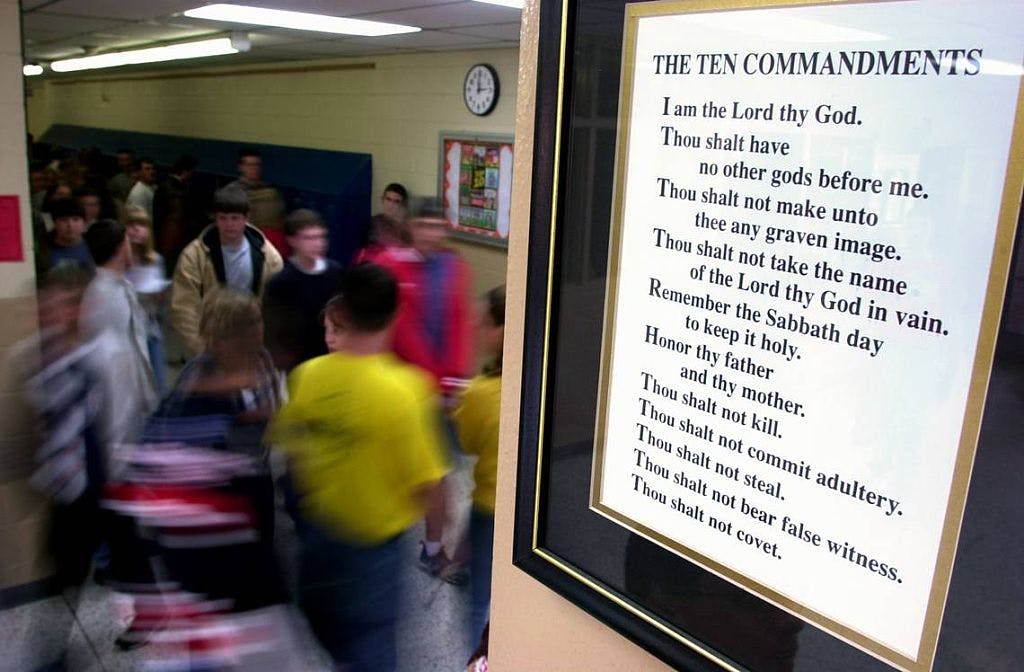
On Tuesday — the same day UCLA students were busy shouting down the DHS’s top lawyer — the full Fifth Circuit, sitting en banc, upheld a Texas law requiring public school classrooms to display the Ten Commandments. Judge Duncan wrote the opinion in Rabbi Mara Nathan v. Alamo Heights Independent School District. It is a serious, carefully constructed piece of constitutional reasoning, and it deserves more attention than the protest theater unfolding across the law school quad. (Full disclosure: Rabbi Nathan is a college friend whom I respect but disagree with.)
The legal question before the court was straightforward: Does a classroom display of the Ten Commandments resemble any of the historic hallmarks of an established religion? Duncan shows, methodically, that it does not. No student is compelled to recite the Commandments, profess belief in them, or even glance at them. They are present as part of the moral and legal inheritance that shaped Western civilization and, with it, the country those students live in.
Critics reach reflexively for Jefferson’s “wall of separation between church and state,” a phrase that appears nowhere in the First Amendment. It comes from a 1802 letter Jefferson wrote to the Danbury Baptists as a promise of non-interference, not a mandate to scrub faith from civic life. George Washington was blunter in his Farewell Address: A republican government depends on a moral people, and religion and morality are its indispensable supports.
And then there are claims that the display text is somehow sectarian. In First Things, a Protestant scholar, Mark David Hall, and a rabbi, Stuart Halpern of Yeshiva University, joined me, a Catholic, to show that the text these states require was crafted through deliberate interfaith collaboration and recognized by multiple courts as nonsectarian. Judge Duncan wisely observes that it is not the province of federal courts to opine on such theological matters.
It’s worth noting that the generation least likely to have encountered the Ten Commandments in any formal setting is also the one now turning to faith in quietly remarkable numbers. Gen Z, raised on curated content and institutional skepticism, is discovering that ancient things sometimes endure for good reason. Washington feared that a republic without religion and morality could not long endure. A generation quietly proving him right is a development worth more than a classroom wall. But the wall is a good place to start.
The Texas case will likely reach the Supreme Court. When it does, the justices will have the opportunity to confirm what most people outside law schools already sense: that a civilization that acknowledges its moral inheritance is not establishing a religion. A classroom wall is not an established church. It is a reminder.
Meanwhile, Judge Kyle Duncan — the man they tried to silence at Stanford Law — just handed down the opinion of his career. He didn’t need a microphone; he had a pen.
Back at UCLA, the noise has likely faded. James Percival returned to Washington.
Stanford Law students shouted down a federal judge; now their counterparts at UCLA have done the same to the government’s top immigration lawyer. The targets were different. The impulse was identical. And the man they couldn’t silence at Stanford has just written an opinion that will serve as the roadmap for the Supreme Court when a key religious freedom issue arrives there — and it will.
***
Andrea Picciotti Bayer is director of the Conscience Project and recipient of the Religious Freedom Institute’s 2025 Religious Freedom Impact Award.