 The Federal Register, the official journal of the U.S. government.
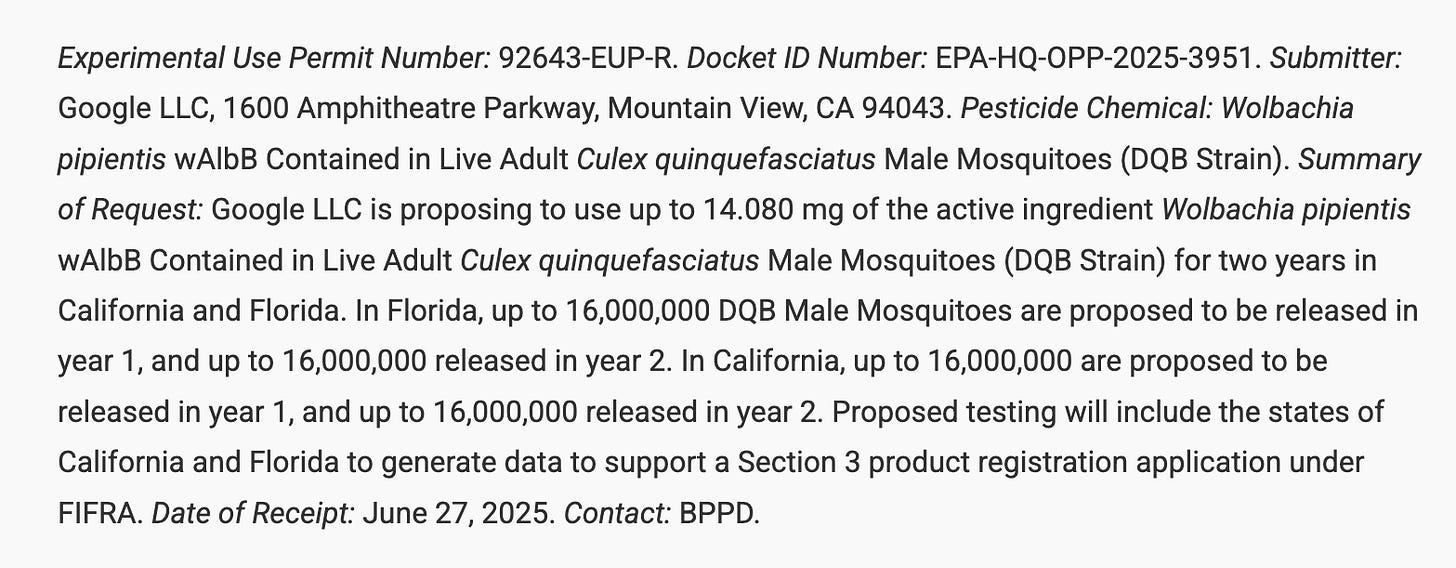
The tech giant is “requesting an experimental use permit (EUP) for the Wolbachia pipientis wAlbB contained in live adult Culex quinquefasciatus male mosquitoes (DQB Strain),” according to the announcement.
A summary of the request reads:
“Google LLC is proposing to use up to 14.080 mg of the active ingredient Wolbachia pipientis wAlbB Contained in Live Adult Culex quinquefasciatus Male Mosquitoes (DQB Strain) for two years in California and Florida. In Florida, up to 16,000,000 DQB Male Mosquitoes are proposed to be released in year 1, and up to 16,000,000 released in year 2. In California, up to 16,000,000 are proposed to be released in year 1, and up to 16,000,000 released in year 2. Proposed testing will include the states of California and Florida to generate data to support a Section 3 product registration application under FIFRA.”
Submit a Comment to the EPA
Since the EPA “has determined that the permit may be of regional and national significance,” the agency is “seeking comments on this application.”
Comments from the public must be received on or before June 5, 2026.
The Federal Register publication explains the process:
“Submit your comments, identified by docket identification (ID) number EPA-HQ-OPP-2025-3951, through the Federal eRulemaking Portal at https://www.regulations.gov. Follow the online instructions for submitting comments. Do not submit electronically any information you consider to be Confidential Business Information (CBI) or other information whose disclosure is restricted by statute. Additional instructions on commenting on and visiting the docket, along with more information about dockets generally, are available at https://www.epa.gov/?dockets.”
For further information:
“Each application summary in Unit II. specifies a contact division. The appropriate division contacts are identified as follows: BPPD (Biopesticides and Pollution Prevention Division) (7511M); Shannon Borges; main telephone number: (202) 566-1400; email address: BPPDFRNotices@epa.gov. The mailing address for each contact person is Office of Pesticide Programs, Environmental Protection Agency, 1200 Pennsylvania Ave. NW, Washington, DC 20460-0001. As part of the mailing address, include the contact person’s name, division, and mail code. The division to contact is listed at the end of each application summary.”
The Stated Plan
Google’s “Debug” project rears large numbers of Culex mosquitoes in the laboratory and infects them with a naturally occurring strain of Wolbachia pipientis bacteria.
Wolbachia pipientis is not said to cause direct human infection or disease in humans.
Non-biting males are said to be separated from biting females by using automated sorting systems and released in high volume.
When these Wolbachia-infected males mate with wild female mosquitoes that do not carry the same bacterial strain, a biological mechanism called cytoplasmic incompatibility occurs, causing the fertilized eggs to fail to develop properly.
The stated plan is that, as a result, the next generation of mosquitoes is greatly reduced, gradually suppressing the overall wild population and lowering the transmission of diseases such as West Nile virus, all without chemicals, radiation, or genetic modification of the insects.
Females Can Still Make It Through the Sorting Process
A peer-reviewed 2020 study in BMC Biology warns that the core technology behind the automated systems used to separate male and female mosquitoes is inherently imperfect and risks backfiring.
The paper reveals that “processes for sex-separating mosquitoes are typically error-prone,” even with advanced sorters, and that accidental release of Wolbachia-infected females can trigger “population replacement rather than elimination”—creating biting, Wolbachia-carrying mosquitoes in the wild.
Their stochastic modelling shows that keeping establishment risk below 1% requires an extraordinarily high fidelity (female contamination probability of 10?? or better, ideally 10??).
That means even a single female in millions of releases could push the risk of permanent Wolbachia establishment across large urban areas like those targeted in Florida and California, turning the project’s intended population suppression into the opposite outcome: widespread biting mosquitoes now carrying the bacteria.
The findings directly undercut claims of near-perfect reliability, especially at the scale of Google’s planned 16–32 million mosquito releases in Florida and California.
Moreover, a 2022 reply paper in Nature Biotechnology from Google’s own Verily/Debug team reveals that the automated systems powering their mosquito releases were still in “prototype or very-early-version stages” during major field trials and continue to need “ongoing iteration and improvement in stability, throughput, and efficiency.”
Wolbachia’s ‘Guaranteed Sterility’ Mechanism Is Not 100% Reliable
When these Wolbachia-infected males mate with wild female mosquitoes that do not carry the same bacterial strain, a biological mechanism called cytoplasmic incompatibility occurs, said to cause the fertilized eggs to fail to develop properly.
But the incompatibility is not biologically infallible.
A 2024 study published in Nature Communications recreated wAlbB’s exact sterility genes in lab mosquitoes and found that 6% to 75% of eggs still produced live embryos in certain mating scenarios.
A 2022 paper in Frontiers in Microbiology—testing the same wAlbB strain Verily uses described the effect as only “nearly complete (98–100%)” cytoplasmic incompatibility, meaning a small but real percentage of eggs can survive.
A 2019 study in PLOS Neglected Tropical Diseases showed that high temperatures (common in Florida and California summers) reduce Wolbachia levels inside mosquitoes and weaken or break the sterility effect entirely.
At the massive scale Google is proposing—millions of mosquitoes released across Florida and California—even a tiny failure rate could let enough eggs hatch to undermine the entire project.
Bottom Line
Millions of bacteria-infected mosquitoes are now being prepared for open-air release over populated American communities under an “experimental use permit,” while the public is expected to simply trust that the sorting systems, sterility mechanisms, and biological containment assumptions will work exactly as promised at massive scale.
But the scientific literature itself shows the systems are not perfect.
Females can make it through the sorting process.
Eggs can still hatch.
Heat can weaken the sterility effect.
And even Google’s own team acknowledged parts of the release infrastructure were still in early-stage development and undergoing continued refinement.
Residents living in the targeted areas never voted for this experiment.
They were never individually asked for informed consent before being turned into participants in a regional biological field trial involving tens of millions of live insects released into the environment.
Once released, these mosquitoes cannot realistically be recalled.
That raises serious questions about informed consent, environmental exposure, public transparency, long-term ecological effects, and whether corporations and government agencies should be permitted to conduct large-scale biological interventions over entire communities before the long-term consequences are fully understood.
People have the right to know exactly what is being released into their environment, what the failure rates are, what happens if the suppression system fails, and who will be held accountable if unintended consequences emerge years later.
Your support is crucial in helping us defeat mass censorship. Please consider donating via Locals or check out our unique merch. Follow us on X @ModernityNews.