David Henderson,Scotland news correspondentand
Rachel Grant,BBC Scotland

 Network Rail
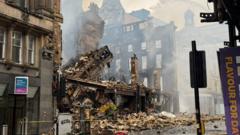
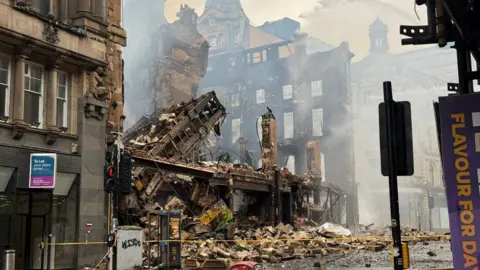
Scotland’s busiest railway station remains closed following a huge fire that destroyed a neighbouring building – but appears to have avoided any major damage in the blaze.
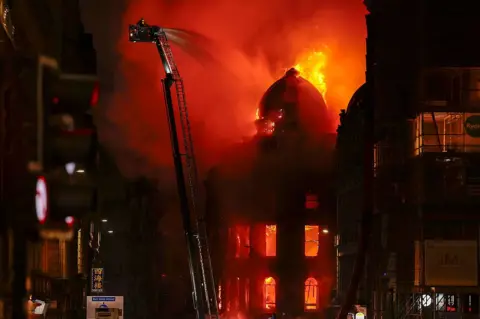
Glasgow Central Station has been shut since Sunday, when a blaze spread from a vape shop on Union Street through a B-listed Victorian building.
Network Rail said its staff and fire service teams were continuing to work on the site and disruption to services is expected to continue for the coming days.
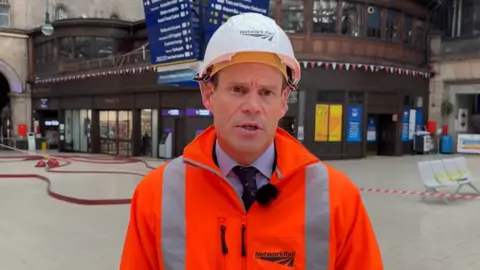
However, BBC Scotland News understands Network Rail staff believe there has not been serious damage inside the station, which they have now been able to visit following the fire.
Engineers at the rail operator also believe the station concourse is in good shape and have also visited the nearby Caledonian Chambers building, which apparently has not suffered major damage either.
A fire break between the Union Corner building – which was destroyed in the blaze – and the external wall of the station is thought to have stopped Sunday’s inferno spreading further.
Glasgow Central is one of the busiest stations in the UK, with 25 million passenger visits each year. It is the main station for all services on the west coast mainline to England and also operates services throughout central Scotland.
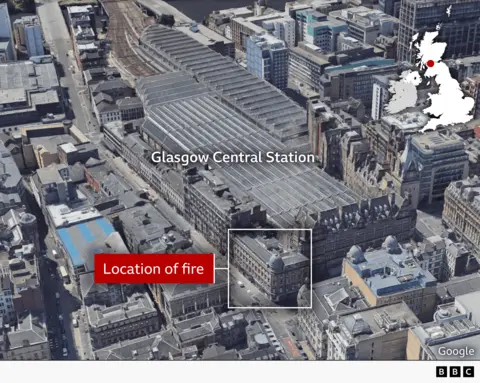
A step-by-step process will need to be undertaken before the station can re-open.
Hot spots in the rubble must be damped down to prevent fire from flaring up again. Once the fire service is confident the fire has been extinguished, it will hand the site over to Glasgow City Council.
The local authority will then decide what happens to the remains of Union Corner. The façade of the building is still standing and could cause damage to the station if it fell.
It is thought that demolishing the façade would make reopening the front entrance of the station on Gordon Street much more straightforward.
After that, Network Rail will began carrying out safety inspections to determine when services can resume.
 Getty
Getty
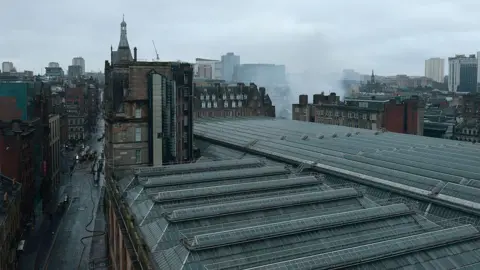
The belief at this stage is that the glass roof of the station does not appear to have suffered significant damage.
Made of metal, it is likely to have been heated when the blaze was raging, then cooled and doused with water as the fire was overcome, so it will need to be inspected for damage.
Controlling the flow of trains will be another key consideration, but the station does not appear to be central to this process, even if all its computer systems are not back online.
That is because the points system – which regulates the flow of trains in and out of the station – is controlled from another secure site elsewhere in Glasgow.
Electrical overhead lines were switched off when the fire took hold, which is standard procedure. They are also controlled from elsewhere on the network.
 Network Rail
The tannoy system and announcements are controlled from within Central Station, but Network Rail may choose to live without this.
Network Rail Scotland’s route director Ross Moran previously said when the fire service response moved into the “recovery stage”, engineers would inspect affected areas of the station to assess what damage had been done.
Moran said the company was “extremely grateful” for the hard work of the firefighters.
About 250 of them worked around the clock to contain the fire in the Orr and Sons building on the Union Street junction with Gordon Street.
The building, known as Union Corner, dates back to 1851 – pre-dating the station which opened in 1879.
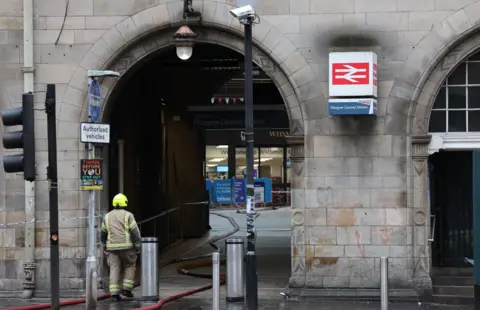
ScotRail previously said no services would operate in or out of Central Station on Tuesday but low level trains would pass through the station to stop at nearby Argyle Street and Anderston stations.
Avanti West Coast said tickets dated between 8 -13 March can be used at no extra cost on any Avanti West Coast train on the same route until Friday, with services between Glasgow and London instead running from Motherwell or Edinburgh.
Union Street, where the fire took place, is a main drop-off point for many city centre passengers.
Police Scotland said several roads around Union Street and Central Station would remain closed. They are:
- Renfield Street at West George Street
- St Vincent Street at West Nile Street
- West Nile Street southbound from Bath Street
- Broomielaw between Oswald Street and Jamaica Street
A warning has also been issued for drone operators wanting to access the airspace around the fire site.
A statement from Police Scotland said: “Drone pilots and operators are reminded it is an offence to fly over an ongoing emergency response and are encouraged to check NOTAM information and drone safety map before flying.”
 PA Media
The SFRS said its response to the incident was scaled back on Tuesday with four fire engines and two high-reach vehicles still on site.
The SFRS confirmed the fire broke out in a vape shop and said a preliminary multi-agency investigation into the cause had begun.
Assistant Chief Officer David Farries said on Monday: “We need to do a full investigation with our multi-agency partners to understand the nature of the fire and understand why the fire spread the way that it did.”
Susan Aitken, leader of Glasgow City Council, said the building was in a state of “ongoing and uncontrolled collapse”.
“The top priority is public safety, but after that we want to get Central Station open as soon as possible,” she told BBC’s Radio Scotland Breakfast.
 Getty Images
Aitken said she wanted to speak to the Scottish government and partners such as the Scottish National Investment Bank about how they can quickly help with “not just recovery but regeneration”.
She said the majority owner of the building had made contact with the council.
Aitken said the council could “potentially expand on that existing work” and it was planning to reach out to the city’s “developer and investor community” to discuss the future of the site.
The council leader warned about speculating on the cause of the fire, but said there needed to be a “wider discussion than just vape shops” about the storage and location of batteries – including those for mobile phones and e-bikes.
First Minister John Swinney previously acknowledged that there would be a “significant cost” in the aftermath of the blaze and said the Scottish government would offer financial support to Glasgow City Council.