The first time I watched Steven Spielberg’s Close Encounters of the Third Kind, I was just a kid. I wasn’t able to grasp the full scope of that final scene in which Roy Neary (played by Richard Dreyfuss) is walking into the alien mothership. Several years and rewatches later it finally dawned on me, and with it a question sparked in my mind which I am sure is shared by most of the people with a deep interest in the UFO phenomenon:
Given the choice, would I be able to leave all behind—my family, my friends, my home— for the chance to jump inside a flying saucer, perhaps never to come back?

The question has remained with me ever since, and was rekindled with every close encounter report I got my hands into over the years. Then around the late 90s and early 2000s, I became acquainted with a very interesting story that made me wonder whether a flying saucer was even necessary to go and live with the aliens. Perhaps, as the story suggested, the aliens are already settled and living among us, hiding in some remote location of the planet, waiting for the right time to make their presence known to the world; but in the meantime, they might invite special individuals to join and collaborate with them in their goal to bring about a new era of enlightenment to humanity, the same way Neary and several others were invited in Spielberg’s movie.
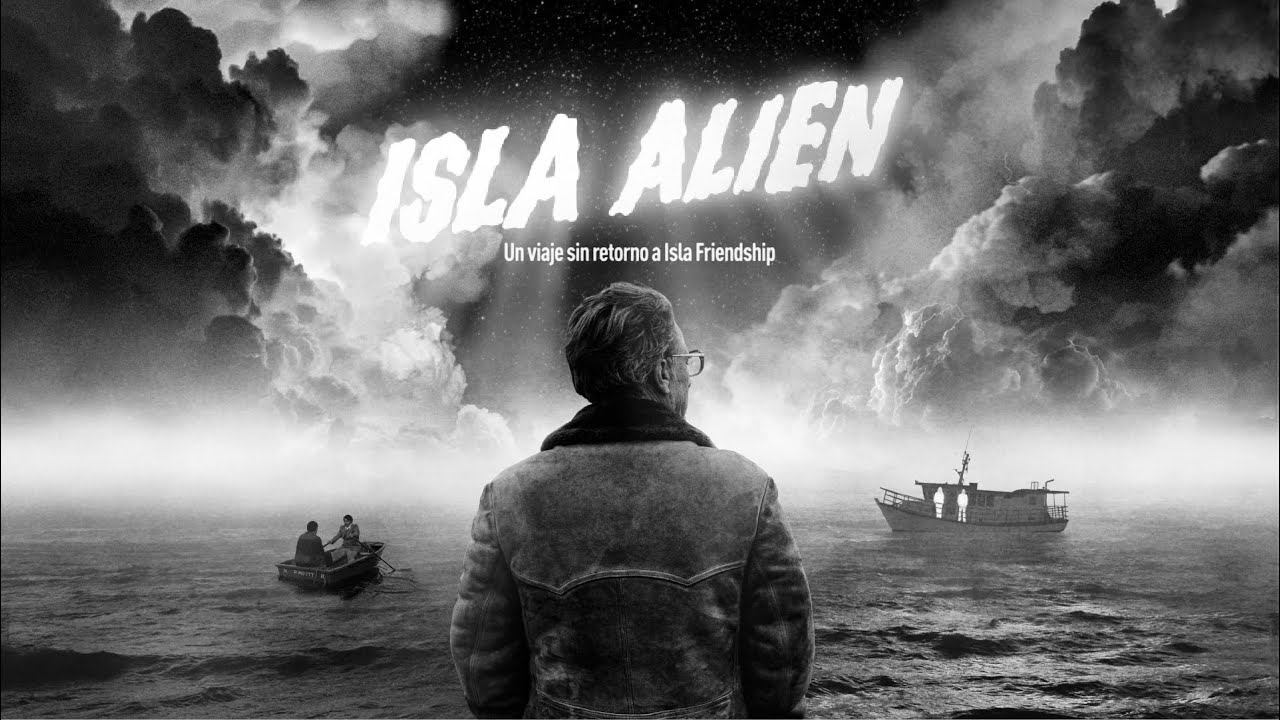
The story I’m referring to is the controversial Friendship Island urban myth, which is the subject of a 2023 Chilean documentary: Isla Alien (Alien Island) directed by Cristóbal Valenzuela Berríos.
[Spoilers Ahead]
I have written over the years that, despite my lifelong interest in UFOs, I’m not really that fond of ufological documentaries per se. In fact, I can probably count with one hand the ones that have had a positive impact in me (you can find reviews of them on our page, like this one and this one).
I think I can confidently say ‘Isla Alien’ has been added to that list, because not only does it touch upon one of my favorite UFO topics—which I’ve always wanted my Anglo friends to be more acquainted with—but it does so in a very creative and artistic way, using tropes from old low-budget B-movies that reminds you of Ed Wood’s Plan Nine from Outer Space (the film was shot entirely on black and white!) and even employing the gimmicks of Derek Waters’ Drunk History series on Comedy Central, as they reenact some of the testimonies from the witnesses when speaking in third person.

As a long-time connoisseur of the Friendship Island mythos, I give the filmmakers an A+ in their efforts to bring together the main characters of this crazy story: from the people residing in Chile’s capital, Santiago, who in the mid-1980s started receiving alleged strange messages through their ham radio (this is what people used before the Internet, kids) from an undisclosed location somewhere near Patagonia said to be inhabited by mysterious people referring to themselves as ‘Friendship’, who used angelic names like Ariel or Miguel; to Ernesto de la Fuente, the man at the crux of this mythology, who was considered to be the conduit or messenger between the outside world and the Friendship community—a quasi-religious congregation of ‘foreigners’ which was seemingly equipped with highly sophisticated technology (as demonstrated once with a highly publicized sighting of a UFO over Santiago in August of 1985, which they claimed was under their control while they were speaking to their CV contacts) so advanced and magical that they not only were able to ‘cure’ terminal diseases like cancer, but they were even able to predict future events.

In the exposition of who (or what) exactly the Friendship islanders were supposed to be, I give the film a B+. Because it simply parrots the simplistic notion that these were ‘Nordic’ type extraterrestrials, who had built a secret underground base in one of the countless little islands forming the Chonos archipelago, and then secured the services first of ‘Alberto’—the captain of a fishing boat named the Mitylus II— and then of Ernesto—who was living at the time all alone in a State-leased logging ranch, as the story goes— for the task of transporting people to their island for purposes unknown.
As I’ve said, I’ve been interested in this story for a long time, ever since I first read about it on some esoteric Spanish magazine. And during one of my Internet searches in the early 2000s—back when Google worked like a charm and the net wasn’t owned by proprietary algorithms—I stumbled upon an obscure blog hosting the actual journals of Ernesto de la Fuente, in which he shared what supposedly happened to him and all involved with the Friendship saga in his own words.
The entries were captivating and very well-written (something that should have raised my alarm bells in retrospect) but for the first time I managed to find a supposed first-person detailed description of the Friendship people: According to Ernesto, they were not extraterrestrials, but they were in contact with what they called ‘the Angels of the Lord’ (beings so far ahead of humans, they told him, communication was as difficult as if we tried to establish a relationship with a colony of ants). The origins of the organization, which was heavily religious, supposedly started in other countries (mainly in the United States, hence why so many of the Friendship folks supposedly had American accent when they spoke to their friends through CV radio, their only contact with the outside world) and Ernesto’s writings hinted to the idea that all of the members had gone through some ‘transformation’ which kept them healthy and young beyond their years—Ariel, one of the main ‘leaders’ of the Congregation, had supposedly been a fighter pilot during ‘the Great War’; even though he, along with all the members of Friendship, was always described as being tall, tanned, athletically built, and looking no older than forty.

Regarding their purpose in the island, Ernesto’s writings—like all good stories—left many strategic gaps, but it seemed their mission was linked with their ability to predict the future based on an upgraded version of the ‘Bible code’ (a popular New Age trope a few decades ago) although in their case, the Friendship group had supposedly created a ‘holographic’ version of the Bible using a computer 3d matrix composed of all the Hebrew symbols in the ancient texts.
It was through this technology that they had managed to not only accurately predict the destruction of the space shuttle Challenger in 1986, but also conclude that our society had crossed an irreversible threshold toward self-annihilation, after the human population had reached the 6,666 millionth mark. As such, their task was to weather Armageddon from the safety of their underground installations, and to slowly rebuild the world from the ashes of our failed civilization—a process, they told Ernesto, that had occurred many times in the ancient past…

As for their methods of selecting those who got invited to live among them, Ernesto’s blog entries and the documentary coincide that it had something to do with the ‘genetic memory’ of a few special individuals. Ernesto’s writings, however, went more in depth by explaining how these genetic characteristics were linked to ‘psychic abilities’, and he described in detail how when he was a young kid he was able to accurately guess playing cards, predict when a family member was going to die, or even ‘move’ marbles by just looking at them. Over time, he wrote, he slowly lost those abilities, but was encouraged to rediscover them by the Friendship people through different tests and exercises he needed to perform while alone in his cabin. Tobacco and drinking alcohol, they told him, diminished the psychic functioning in the brain, which is why along with his daily meditation practices, he was coaxed into a strict ascetic lifestyle which he eventually grew tired of.
Ernesto’s chain-smoking habit finally took its bleak toll, and this is where the Friendship Island saga attains a mythical status, after he goes back to the city to see a doctor who coldly discloses to him he has 4th-level lung cancer, and should set his affairs in order.
Shocked and depressed by the medical death sentence, he returns to his cabin to die—or so he thought, because that’s when he receives a radio message from his enigmatic friends (with whom he’d lost contact months prior, once he quit the psychic exercises and decided to focus instead on trying to save his failing logging business): “Come. Perhaps there is still time.”

With nothing left to lose, the story goes, Ernesto grabbed a suitcase and embarked on the same journey he’d made many times, when he’d driven all those strangers who had taken that one-way trip before him, to the small port where the Mitylus II would be waiting to ferry them to the mystery island. Unlike these anonymous individuals, though, Ernesto did return to tell the tale of what he’d seen while in the presence of his arcane benefactors, who brought him back from the brink of death using techniques that seemed almost miraculous.
After I found those entries on a now-defunct little website whose URL I can’t even remember anymore (ah, the frailty of digital information!), I had assumed I had read the last that was there to learn about the Friendship enigma, leaving many questions unanswered—until I watched this newest 2023 documentary, for which I was totally unprepared.
Because even though I was aware of all the rumors and legends trying to mix the Friendship story with the Damanhur New Age sect in Italy, with the American ultra-conservationist philanthropist Douglas Tompkins, or even with the infamous Dignidad Nazi colony (none of which was mentioned in the film, by the way)I was still naively oblivious to the link between this colorful UFO mythology of people going to live on a super-secret subterranean HQ a-la ‘Dharma initiative’ (hello Lost fans!) and the very real and very bleak chapter of the political prisoners who were disappeared during the military dictatorship of Augusto Pinochet.

The testimony of Ernesto’s former brother-in-law, and that of the daughter of one of the thousands of men who vanished without a trace after being arrested by soldiers during those dark years in the early 1970s, persuasively seed into the viewer’s mind the notion that Ernesto de la Fuente was somehow connected with these heinous crimes, which are still largely unsolved after so many decades. Here the non-Chilean audience would welcome some much-needed historical context to explain things like the Rettig report—which is quoted in the film, and was elaborated by the National Commission for Truth and Reconciliation after democracy was restored in Chile— especially if the film is intended for the US market; given the collaboration between the CIA and the Nixon administration with the Fascist regimes that proliferated in South America during that not-so-long age.
Friendship Island has never been able to be located, probably because it never existed in the first place. But what did exist was Dawson Island, a secret concentration camp were political prisoners were tortured during the heyday of the Pinochet regime. Was a UFO fantasy invented to conceal a Fascist nightmare?

The documentary’s tone turns bleaker by its end, as it moves away from seemingly innocent ufological speculation, into the uncomfortable truths of political repression and state crimes. It is one thing to fantasize about leaving without a trace because you’re going to another planet like in Spielberg’s movies—I’ve always wondered, by the way: did Lacombe and the G-men tell Neary’s wife and children anything to explain his disappearance, or did they just let them draw their own conclusions to assume the worst about their missing father and husband? —but if instead of benevolent aliens your abductors are a military junta who think you’re an enemy of the State, then your disappearance takes an entirely different significance. For it becomes not only an unresolved trauma in the lives of those who lost a loved one (a mother, a husband, a sibling), but a festering wound in the collective consciousness of an entire nation—a wound that no amount of esoteric escapism will be able to heal.

‘Isla Alien’ is a valuable documentary that deserves to be watched not just by people who are interested in UFOs, but also by those who want to understand why these topics have a disquieting tendency to ‘cross paths’ with far-right ideology. Perhaps those ‘innocent’ ufological fantasies are not so innocent once you scrutinize them more closely: the notion of a secret society of advanced human beings selecting ‘special’ people for some higher purpose, while they quietly wait for the rest of mankind to perish—is it just a coincidence that Ariel sounds an awful lot like Aryan?
I will reiterate once again that this is a damn good documentary. It’s almost the exact kind of film that I would have made had I had the resources and wherewithal. Perhaps its biggest flaw is that the producers, for whatever reason, never managed to press Ernesto enough when they had him in front of the camera, feeble and dying from the cancer his weird friends had supposedly cured him of decades ago. He passed away in 2019, and whatever final truth he still possessed about this mythology spun around him, he took it to his grave.

Was it all a fantasy concocted by a brilliant con-man, in order to escape from the burden of his sins brough upon by his collaboration with a murderous regime? While ‘Isla Alien’ seems to lead to that inevitable conclusion, I however remain uncertain.
For even though I am fairly convinced the Friendship Island story was a hoax—even the famous UFO sighting over Santiago in ’85 that propelled it to international attention, has been satisfactorily debunked as a meteorological balloon launched by the French space agency—I am still left wondering: just what kind of a hoaxer was Ernesto de la Fuente?
Was he a delusional mythomaniac, like Carl Allen, who tricked Morris K. Jessup to attain a dubious fame through the famous Philadelphia experiment story?
Was he maybe an ego-driven ‘useful idiot’, like Bob Lazar, who was perhaps unawaredly entrusted to propagate a UFO fantasy, in order to drive attention away from real government classified projects?
Or perhaps he was more like José Luis Jordán Peña, the man behind another prominent UFO hoax—the UMMO story—who always claimed until the day he died that he received help from intelligence secret services in order to pull off the deception.
It’s not hard to deduce that ‘Alberto’ (the enigmatic captain of the Mitylus II) never existed, but what about Ariel and the other voices heard (and recorded) by the other witnesses of the Friendship case? How did Ernesto find out about the French balloon so he could trick his contacts with it? Was his cancer sickness just a rigorous act to convince his friends he was dying? And how did he know the Challenger was going to explode before it happened, as one of the witnesses (Octavio Ortiz, who remained a lifelong friend of Ernesto until the end of his life) still claims?
I already mentioned the CIA’s involvement in Pinochet’s coup-d’etat. Putting on my old tinfoil hat for a minute, would it be so crazy to entertain the possibility that the American ‘spooks’ took advantage of an allied regime on the other side of the globe, providing a regular supply of human guinea pigs, in order to conduct illegal mind-control experiments away from the eyes of the world?
Maybe Ernesto tried to leave some breadcrumbs in his yarn so somebody could find out the truth someday. Perhaps the name of that ferryboat to the island (Mitylus) was an anagram to suggest ‘US military intervention’.
The MK Ultra project was terminated in 1973. Same year Pinochet deposed elected president Salvador Allende. Curious coincidence…
Crazy? Maybe, but it would hardly be the first time it has been suggested that intelligence services have exploited the UFO phenomenon to conceal morally questionable operations. Just ask the victims of Havana syndrome.
In any case, we can leave these speculations from some other occasion. In the meantime, go watch Isla Alien if you have the chance —it’s currently available on Netflix and Amazon Prime, although I am not sure if they are offered with English subtitles. If not, hopefully the producers will add that feature, because it is a story that deserves to be known outside the boundaries of Latin America.