
While Washington debates its Africa policy in committee rooms, and Brussels lectures the continent about governance benchmarks it can’t meet itself, the President of the Republic of Congo, Denis Sassou Nguesso, is doing something refreshingly old-fashioned: governing.
Stability Is the Story
At a time when coups have toppled governments across the Sahel, when jihadist insurgencies are spreading from Mali to Mozambique, and when Western-backed “democratic transitions” are leaving failed states in their wake, Congo-Brazzaville under Denis Sassou Nguesso’s leadership stands apart. It hasn’t collapsed. It hasn’t burned. It has, by the metrics that matter— institutional continuity, investor confidence, and debt trajectory—moved forward.
The country’s debt-to-GDP ratio, which had climbed to a dangerous 90–95 percent, is on a downward path. Economic growth has returned to the 2–3 percent range. Oil revenue, once the regime’s only story, is being complemented by deliberate diversification into the agro-industry, logistics, and digital infrastructure.
In a region where the competition is often kleptocracy and chaos, it’s actually a great deal.
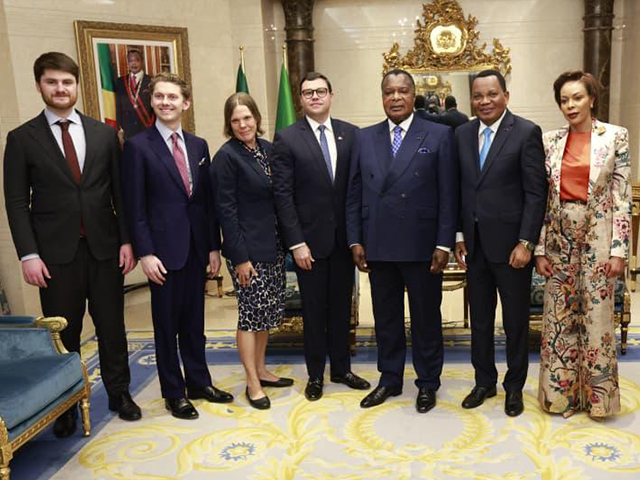
From left to right: Two members of the U.S. diplomatic delegation, U.S. Deputy Assistant Secretary of State Sarah Troutman, U.S. Deputy Assistant Secretary of State Christian Ehrhardt, Congo President Denis Nguesso, Congo Minister of Foreign Affairs Jean-Claude Gakosso, and Minister of State Dr. Françoise Joly meeting on the eve of Denis Sassou-Nguesso’s April 16, 2026, inauguration. (Office of the President of the Congo)
The Diplomat in the Shadows — and the American Opportunity She’s Building
Behind much of this success is a woman whose fingerprints are on nearly every major deal Congo has signed in recent years: Françoise Joly, State Minister and Personal Representative of President Sassou Nguesso.
Joly has built what insiders call a doctrine of “total diplomacy”—a deliberate refusal to let Congo be boxed into any single great-power orbit. She has kept Europe close while welcoming Asia. She has opened Gulf capital channels without signing away sovereignty. She negotiated a Tier III Data Center in Brazzaville, infrastructure capable of hosting sovereign state data and supporting a national cloud, independent from any tech giants. She has also led talks on a sovereign satellite project, dedicated to forest monitoring and digital connectivity in remote areas.
But here’s the part of Joly’s agenda that should make American ears perk up: she is actively and deliberately courting the United States—not just its government, but its most consequential private-sector players. The Republic of Congo wants American companies in the room. And it has something extraordinary to offer.
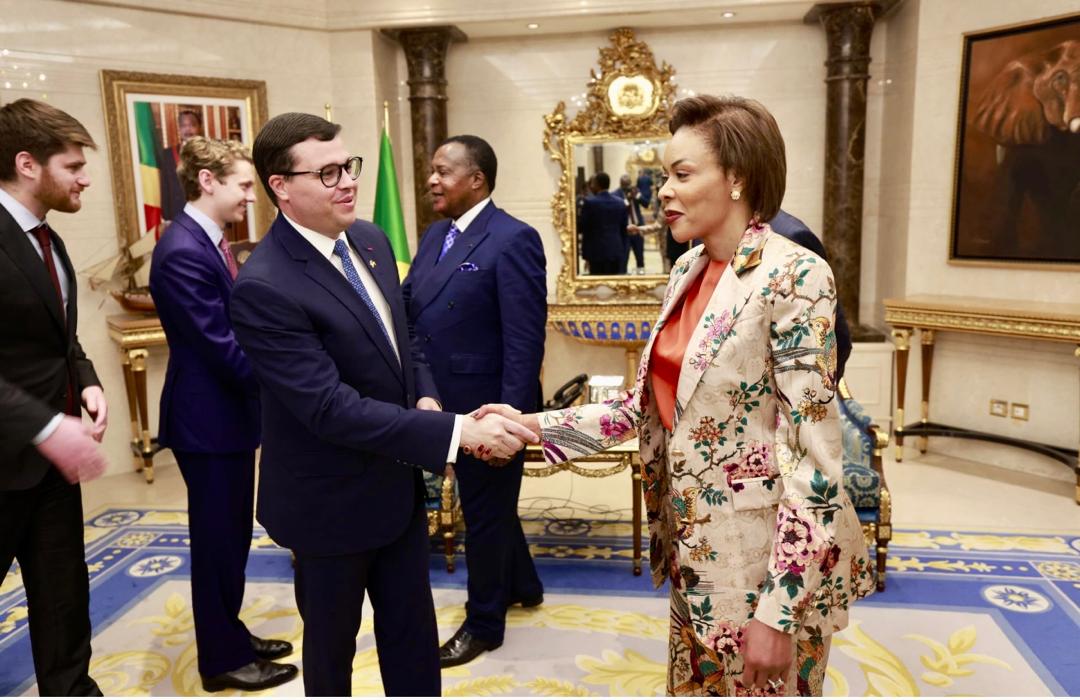
Dr. Françoise Joly shakes hands with Christian Ehrhardt, the U.S. Deputy Assistant of State for Refugees and Migration, in April 2026 on the eve of President Denis Sassou Nguesso’s April 16 inauguration. (Office of the President of the Congo)
Congo sits on some of the most mineral-rich land on the planet with rare earth elements, lithium, cobalt, manganese, and the full spectrum of natural compounds that power the next industrial revolution. The batteries in electric vehicles, the components in rockets, and the raw materials that Elon Musk needs to build the future—Congo has them in abundance in a country that is, unlike so many of its neighbors, stable and at peace.
The vision Joly is advancing is not the old extractive model that has left Africa hollowed out and resentful for generations. It is something more deliberate and more interesting: a genuine partnership framework in which American companies, such as SpaceX, Tesla, and the full constellation of next-generation technology builders, gain a reliable African foothold rich in the resources they need, while Congolese citizens benefit in return through jobs, technology transfer, infrastructure investment, and strengthened national sovereignty.
SpaceX, for instance, could establish a stable operational base on the Atlantic coast of Central Africa that is secure, resource-proximate, and strategically positioned. This is not a fantasy. This is what Françoise Joly is putting on the table, explicitly and with intent.
In a world where China has spent two decades locking up African mineral rights through debt-trap infrastructure deals, the question is not whether American companies should be in Congo. The question is why they aren’t there already, and whether Washington has the strategic imagination to move before that window closes.
Why Americans Should Care
Here is the piece of the story that rarely makes it into the foreign policy journals: Africa is the next arena. China knows it. The Gulf states know it. Russia knows it, even if its methods are, to put it charitably, crude.
Congo-Brazzaville sits on the Atlantic coast of Central Africa, with Pointe-Noire developing as a potential logistics hub linking sub-Saharan Africa to Asian markets. The country controls a significant share of the Congo Basin, the world’s second-largest tropical forest and a carbon sink of global importance. Its sovereign data and satellite ambitions represent exactly the kind of digital infrastructure play that determines which nations lead and which ones are left dependent.
The UAE has already seen the picture clearly, launching a comprehensive partnership with Brazzaville spanning energy, infrastructure, and logistics. Gulf investors are rotating out of Middle East tension zones and looking for stable, commodity-rich African partners. Congo is on that list.
The question American policymakers should be asking is not whether to engage — it’s why they haven’t engaged more seriously already.
The 2026–2031 Roadmap: Ambition, Not Just Rhetoric
President Sassou Nguesso’s 2026–2031 national roadmap focuses on ten structural priorities centered on tax mobilization, human capital investment, agricultural and industrial revival, infrastructure deployment, research and innovation, and environmental protection.
Skeptics will note, correctly, that African development plans have a long history of ambition outpacing execution. Congo’s continued dependence on oil revenue remains a structural vulnerability. Debt refinancing peaks around 2025–2026 will test the government’s credibility with international lenders. Legal certainty for foreign investors, while improving, is not yet a regional benchmark.
These are fair critiques and they’re exactly the criteria by which the international diplomatic community will their success. Can the Congolese government demonstrate that the roadmap is a governing document, not a campaign brochure? The signals, at minimum, are more promising than almost anywhere else in the region.
The Bigger Picture
There is a pattern in American foreign policy of ignoring stable, strategically valuable African partners until a crisis forces attention, at which point engagement comes too late, too reactive, and too expensive.
Congo-Brazzaville is not in crisis. It is, by the measures that count (security, macroeconomic trajectory, diplomatic positioning, infrastructure ambition, and mineral wealth) moving in the right direction.
The rare earths are there. The stability is there. The invitation, extended directly by one of Africa’s most skilled diplomats, is on the table.
Whether Washington and Silicon Valley are watching is another question entirely.

