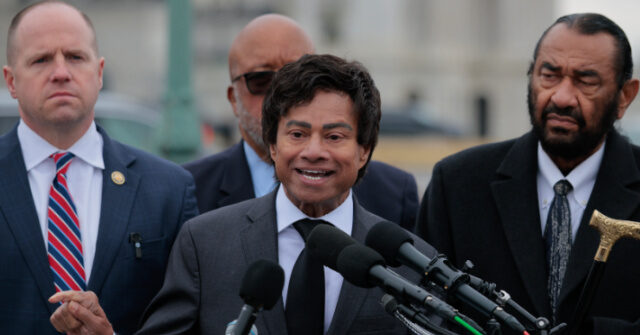
India-born Rep. Shrinivas Thanedar (D-MI) says it is essential that the federal government accelerate the inflow of migrants into seasonal jobs throughout his very poor district in Michigan.
“We are falling behind because we don’t have a robust immigration policy,” Thanedar told a May 28 meeting of business executives at the northern Michigan Mackinac Island resort, adding:
I have talked with business owners … [about] the H-2B visa [seasonal worker] program. People just don’t have enough skilled and unskilled labor to grow their businesses. It’s impacting our GDP [Gross Domestic Product], and it will continue the impact if this current trend and thinking in Washington, D.C., about anti-immigrant, anti-migration, and anti-fixing our immigration system, broken immigration system … I think it is very, very essential that we reform our immigration policy and make it easier for our businesses to get the skills that they need.
Thanedar’s support for migration may win him support among the many owners of local resorts, hotels, and restaurants that use the H-2B visa labor program to reduce the seasonal hiring of local Americans. But it will invite rational opposition among the overwhelmingly black and poor electorate in his district and in his primary battle with Michigan Rep. Donavan McKinney.
Thanedar’s district is 42 percent black, 38 percent white, and three percent Asian, according to CensusReporter.org. Half of the households earn less than $51,000, making it the second-poorest district in the nation.
A May poll of 1,456 Michigan residents shows significant opposition to migration in the state. Only 19 percent of 1,456 residents say migration is good for the state, while 35 percent say it is bad for the state, according to the poll, which was conducted by TIPP for the League of American Workers.
The poll included 322 black and Hispanic respondents, where the split was 20 percent good, 27 percent bad. Thirty-nine percent of the subgroup said migration does not make much difference.
Many polls show that widespread black opposition to migration is often offset by sympathy for the ordinary migrants who are used by employers to sideline Americans.
But Thandar –like other ethnic Indian politicians in the United States — is a loud champion for greater Indian migration into Americans’ jobs, especially for the white-collar jobs that are the gateway to the middle-class. He repeatedly touts the H-1B program, which keeps roughly one million Indians in jobs that would otherwise he beld by Americans.
For example, Thanedar told his Makinac audience:
Our broken immigration system is a huge problem … I’ve talked to many CEOs of technology companies, and they are hurting for skilled workforce, getting the engineers, the scientists that are our technology companies need, and the United States is going to continue to lose focus and our status in terms of growing our innovation, in discovery, if we can’t attract the right talent, whether it be home-grown talent or immigrants coming to this country skills who have skills.
The Indian government uses lobbyists, diplomats, trade deals, investors, social media, and ethnic-Indian politicians and Indian migrants to defend and promote Indian migration into U.S. jobs. For example, the H-1B program enables ethnic-Indian corporate managers to sell American professionals’ jobs to mid-skill Indian migrants, often paid via salary kickbacks.
The growing population of Indian white-collar workers in the United States is also accelerating the inflow of blue-collar workers from India.
Many Indian migrants enter the United States illegally on B-1/B-2 tourist visas and then illegally work for several months. For example, they illegally work in seasonal jobs offered by tourist-sector CEOs in Michigan, California-based trucking companies, and service-sector jobs in franchise hotels and restaurants, many of which are run by Indian managers with E-2 visas.
As Thanedar touted a greater role for Indian migrants in the U.S. economy, he also talked about the difficulty facing young Americans:
The access to America dream is missing, you know. Young people growing up don’t feel that they can have a life better than their parents did. I mean, the whole thing about the American dream is that our children should have a better life, more opportunities than we as parents did, and we don’t see that happening.
His rival in the Democrat primary, McKinney, says little about immigration, likely to avoid a clash with the party’s pro-migration donors. He declined to answer questions from Breitbart News, but his web page says:
He credits his career in service to his mother, grandmother, and his surrounding community for coming together to invest in him despite their lack of resources. Donavan wants to ensure Washington does the same for every Michigan family.