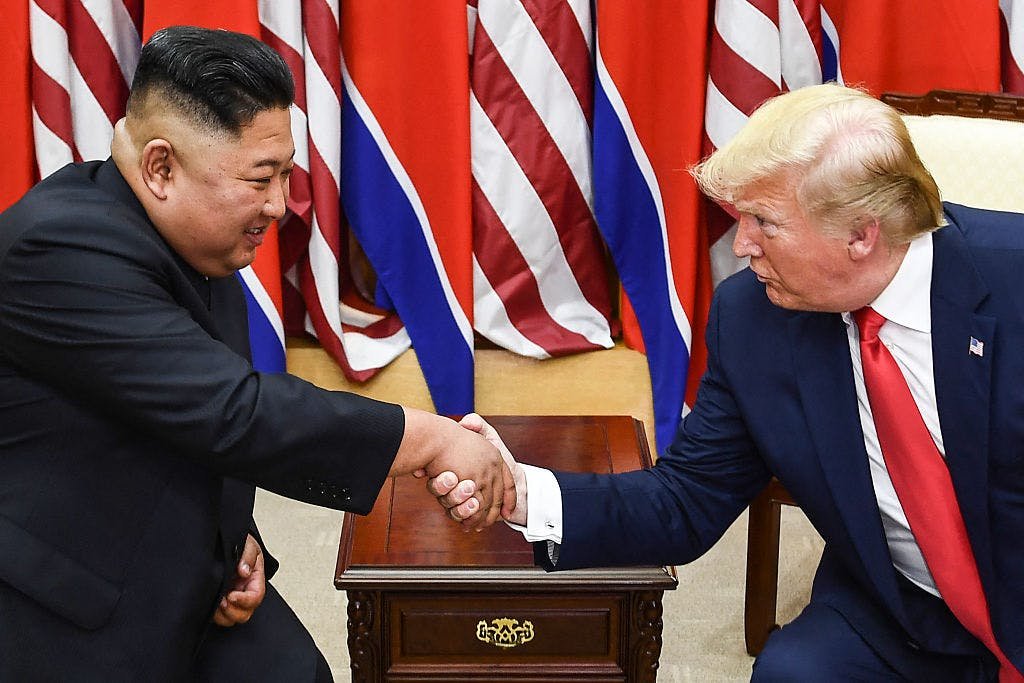
President Donald Trump made history during his first term by meeting North Korean leader Kim Jong Un in two summits and a brief third encounter. The United States and North Korea turned the dangerous escalation of 2017 into summit diplomacy in 2018. But after a promising first meeting in Singapore in June 2018, the two leaders left Hanoi in early 2019 without an agreement, and their brief encounter at the Demilitarized Zone later that year failed to revive the process. Relations have deteriorated ever since.
Kim has used the intervening years to strengthen his nuclear and missile programs, entrench North Korea as a permanent nuclear-weapon state, rejuvenate his alliance with Russia, and ensure that Xi Jinping remains invested in preserving Beijing’s influence on the Korean Peninsula. Despite South Korea’s sharp political shift from Yoon Suk-yeol to Lee Jae-myung, and President Lee’s recent calls for renewed inter-Korean dialogue, Kim remains resolutely uninterested in serious engagement.
President Trump frequently emphasizes his good personal relationship with Kim, and few would question his confidence in dealing directly with strong leaders or pursuing unconventional diplomacy. But personal rapport with North Korea’s dictator does little to alter Kim’s strategic calculations. Those calculations center on strengthening Pyongyang’s nuclear posture, securing a survivable second-strike capability, deterring a preemptive attack, and exploiting growing military capabilities for coercive leverage.
Against that backdrop, the decision to pull U.S. troops out of one of the two major annual U.S.–South Korean military exercises erodes deterrence and represents an unnecessary retreat from “peace through strength.” Dialogue is worthwhile, but the United States should negotiate from strength. We should not expect Kim to reward weakness.
More troubling, President Trump’s social-media commentary suggests that Washington is penalizing South Korea in part because of Seoul’s reluctance to be drawn into a conflict with Iran, a conflict on which South Korea was hardly consulted. Nor did Seoul have a say as the United States depleted stocks of standoff weapons and missile interceptors to levels that raise questions about the administration’s own strategy of deterrence by denial along the first island chain.
Washington may disagree with some of President Lee’s policies, but it should not fault his government for failing to contribute to the alliance. South Korea carries a substantial defense burden and possesses industrial capabilities increasingly vital to American security. Few major U.S. allies devote a larger share of their economy to defense, and South Korea is indispensable to revitalizing the U.S. defense industrial base, particularly in shipbuilding, while remaining a critical partner in technologies such as semiconductors.
President Trump’s social-media commentary and apparently hasty decision on military exercises could nonetheless have some unintended benefits. First, they may test whether Kim will finally respond to the Trump administration’s repeated back-channel overtures, perhaps setting the stage for another encounter when Trump travels to Asia later this year. Second, scaling back the exercise aligns with the Lee administration’s own emphasis on reopening dialogue with North Korea. Third, Kim’s strengthened ties with Russia and renewed support from China may leave him feeling secure enough to meet the American president again.
But expectations should remain modest. Serious arms control is unlikely. At best, another encounter might produce a rhetorical commitment to peace or vague language on nuclear weapons that future governments could readily disown. Such diplomacy should therefore remain secondary to the more urgent task of rebuilding American economic and military strength.
The administration should concentrate on executing its broad trade and investment agreement with South Korea, including Seoul’s pledged $150 billion investment in shipbuilding and $200 billion in other sectors. That is real money directed toward concrete American and South Korean interests.
By contrast, another round of photo opportunities with Kim, whose export of KN-23 and KN-24 missiles and deployment of troops have helped sustain Russia’s war against Ukraine, is of secondary strategic importance. Washington should focus more, not less, on rebuilding the U.S. defense industrial base, replenishing depleted munitions, accelerating military modernization, and fielding new systems at scale.
President Trump is too quick to use social media to make and signal consequential strategic decisions. The task now is to ensure that his next steps advance U.S. interests rather than undermine them. That means keeping the door open to diplomacy with Kim Jong Un while negotiating from strength. Above all, it means strengthening strategic alignment with South Korea and America’s other key Asian allies.
***
Patrick M. Cronin is the Asia-Pacific security chair at Hudson Institute.