A blip? A dip? A slip? None will do any longer.
Their 23-18 defeat in Rome showed England are going through something far more serious and deeper seated than that.
As England’s players stood stark, separate and slumped – and Italy celebrated a first-ever win in the fixture – talk of a crisis, perhaps premature before, felt entirely apt.
On the back of three successive defeats, England are distant underdogs for their meeting against France next weekend. If those odds play out and they lose again, they will have lost four matches in a Six Nations campaign for the first time.
Waiting next on the fixture list is an away match, at altitude, against world champions South Africa.
Things could well get uglier before they get better for England.
If the only way is forward though, who should lead them?
Captain Maro Itoje, whose appointment last year coincided with a 12-match winning run, has been at the heart of England’s best days in his 101 appearances for his country.
Unfortunately for him, he was also at the heart of this one.
After an indifferent first half, along with the rest of his team, he made a good start to the second half, nabbing two turnovers in quick succession.
That work was undone in an instant.
With his side two points up, but a man down with Sam Underhill in the sin-bin, Itoje snaked an arm though a breakdown and slapped the ball out of the hands of scrum-half Alessandro Garbisi.
For an intelligent man, it was a howlingly brainless offence.
“He will be furious with himself for that penalty and yellow card,” said England’s Rugby World Cup-winning scrum-half Matt Dawson on BBC Radio 5 Live.
“He won’t sleep well tonight, and unfortunately, it’s only going to get worse. The media will be on him, the fans will be on him and the team, because it is absolutely unacceptable.”
England survived their brief period down to 13 men, hauling an Italian line-out drive into touch.
But his absence drained England’s energy and fuelled Italy’s sprint finish.
With Itoje prowling the touchline, coach Steve Borthwick could not risk destabilising England’s line-out – and robbing it of precious on-pitch leadership – by removing veteran hooker Jamie George.
And so the team’s most reliable line-out thrower stayed on, when Borthwick might have preferred to replace him with the younger Luke Cowan-Dickie.
It meant the 35-year-old George was still doing heavy-duty ball carrying in the final five minutes as England chased in vain.
England rolled one dice repeatedly, taking to the air in the hope of winning aerial contest.
They did at times.
Cadan Murley came down with a couple early on to earn territory, but when their number wasn’t come up, England wouldn’t or couldn’t walk away and find another gameplan.
“Questions need to be asked about England’s strategy and methodology – about how they believe the game should be played at this level,” said England Rugby World Cup winner Matt Dawson on BBC Radio 5 Live.
“The way England are playing, they are not going to win international matches.”
They aren’t winning many friends either.
Their style – high kicks and short of flair – is hard to love. Now England aren’t winning with it, fans’ patience is wearing thin fast.
Itoje insisted afterwards that the fault lay with him and his fellow players.
“The coaches set us up to do well, and we as players have to take responsibility. It is us – myself as captain and the guys on the field,” he told BBC Sport.
Nobody else will give Borthwick and his regime a free pass though.
Whatever the result against France, this campaign, which arrived with such high hopes and has dragged through such lows, will rightly be scrutinised to find the cause of England’s underachievement.
Borthwick will have to explain his own part in it. And his Rugby Football Union bosses will have to consider whether he has any further part to play.
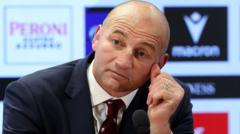
The former England captain is convinced he should remain in charge, replying “absolutely” when asked if he remains the right man for the job and saying he speaks regularly with his bosses to “discuss the vision of the team going forward”.
“The team’s growth in the last 12 months has been very, very strong and you can see the vision of where the team is going to be and you see the players coming through,” he added.
“Right now this is a tough period, but what we will do is learn from it and make sure we are stronger going forward.
“It is tough right now and we are not hiding away from the fact it is tough. We are not where we want to be in terms of results and in terms of performances.”
In many ways, the RFU will be reluctant to change the team’s management.
The last Rugby World Cup cycle involved late coach churn when Eddie Jones was axed less than a year out from France 2023.
While Borthwick, as his successor, guided England to within touching distance of the final, he was hamstrung by a lack of preparation.
Given time with the team, he delivered a 12-match year-long run that only ended three weeks ago.
There are plenty of potential successors and candidates for one of the biggest jobs in the sport.
Scott Robertson, sacked as All Blacks coach in January, and Franco Smith, who has driven Glasgow to new heights, have both had talks with the RFU about different roles in the past., external
Pat Lam, who has combined steel and silk at Bristol and managed admirably with a raft of injuries this season, has made no secret of his international ambitions.
If an English coach is the preference, and it was last time, then Andy Farrell and Shaun Edwards have done highly impressive work with England’s Six Nations rivals.
Phil Dowson has moulded a winning, stylish Northampton team out of many of the same players in this England squad.
All come with caveats, complications and doubts.
The trouble for the RFU is, so does the status quo.