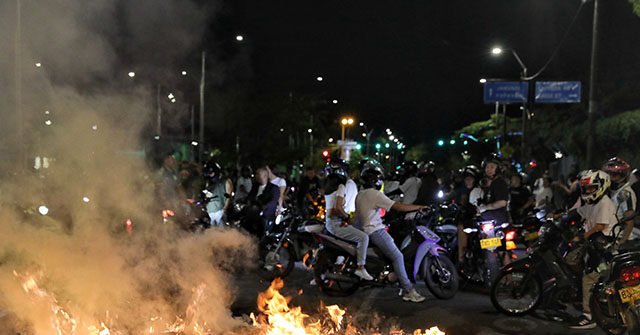
Colombian leftists rioted and attempted to block the streets of Bogotá and other cities on Sunday to protest the election of conservative outsider Abelardo de la Espriella as the next president of Colombia.
At least one person was shot dead during the riots that took place in the city of Cali. Authorities are still investigating the death at press time.
Colombia held its highly anticipated 2026 presidential runoff election on Sunday, June 21, in which President-elect de la Espriella, a 47-year-old lawyer and businessman, defeated far-left Senator Iván Cepeda. The Organization of American States (OAS), highlighted the election as a peaceful, orderly, and transparent one — saluting Colombia’s electoral authorities for their professional labor throughout the election and for their timely vote count.
Leonel Fernández, former president of the Dominican Republic and head of the OAS’s electoral observer mission to Colombia, told reporters on Sunday that the election occurred without any instances of alteration of the public order and that the OAS representatives observed the free participation of the Colombian electorate in the process.
Despite Sunday’s runoff election highly marked as a peaceful and free election, several groups of Colombian leftists rioted over the victory of conservative President-elect de la Espriella.
The Colombian newspaper El Espectador reported that as soon as de la Espriella’s victory was announced on Sunday night, individuals began rioting across several blocks in southwestern and central Bogotá.
Hooded rioters reportedly erected barricades using burned tires, a motorcycle, and piles of trash. Residents of Bogotá’s Chicalá neighborhood denounced damages to windows and private vehicles caused by stones and other projectile objects during clashes between the rioters and local law enforcement. The use of force against the rioters was reportedly authorized after the protesters physically assaulted a member of Bogotá’s District Dialogue Team — officials in the Colombian capital city tasked with mediating in social conflicts. In the Bogotá districts of Usme and Kennedy, the protesters directly assaulted police facilities.
Mayor of Bogotá Carlos Fernando Galán detailed to local outlets on Monday that three adults and two children were detained for attempting to assault a police station in Usme.
El Espectador noted that the riots caused disruptions to public transportation affecting some 183,000 users. The protests also forced the administration of Colombia’s National University to suspend in-person activities on Monday. The local radio station Alerta Bogotá published footage of Colombian users having no choice but to walk as a result of the disruption of public transportation.
The city of Cali also saw incidents of rioters in response to de la Espriella’s electoral victory. El Espectador detailed that the riots in Cali left damage to public and private infrastructure and at least one dead.
Cali’s police force confirmed to the Colombian magazine Semana on Sunday night that the male victim was riding a motorcycle when he was shot by unknown assailants, who then fled in an unknown direction. The circumstances surrounding the man’s death are still under investigation by local authorities.
“Unfortunately, in the late afternoon hours, there was a large gathering in the Puerto Rellena area, where some people — some troublemakers — began clashing with law enforcement and attempted to vandalize public property,” Mayor of Cali Alejandro Éder said on Sunday.
“In the process, they damaged about 15 traffic cameras in the city of Cali and knocked down three of them, but we managed to contain the situation and keep them confined to that same area, thereby protecting Cali,” he continued.
Speaking to reporters after Sunday’s runoff election and the protests, Colombian Defense Minister Pedro Sánchez and the director of Colombia’s National Police, William Rincón, informed that about 250 individuals participated in the Cali protests.
“We already have our team on the ground to prevent any kind of disruption and to stop these incidents from continuing, incidents that only cause damage and, of course, anxiety in the community,” Rincón reportedly said.
Minister Sánchez, for his part, stressed that the priority of Colombia’s law enforcement is to preserve the peace in the locations where protests were reported, and called upon Colombian citizens to act with respect.
President-elect de la Espriella is set to take office on August 7, 2026, succeeding outgoing Marxist President Gustavo Petro, Colombia’s first leftist president ever. De la Espriella’s election as president marks a return of a conservative-led government in Colombia following four years of leftist rule under Petro.
At press time, Petro has refused to publicly recognize the results of Sunday’s election and has instead accused Israel of having “compromised” the voting software used for the election.
Christian K. Caruzo is a Venezuelan writer and documents life under socialism. You can follow him on Twitter here.