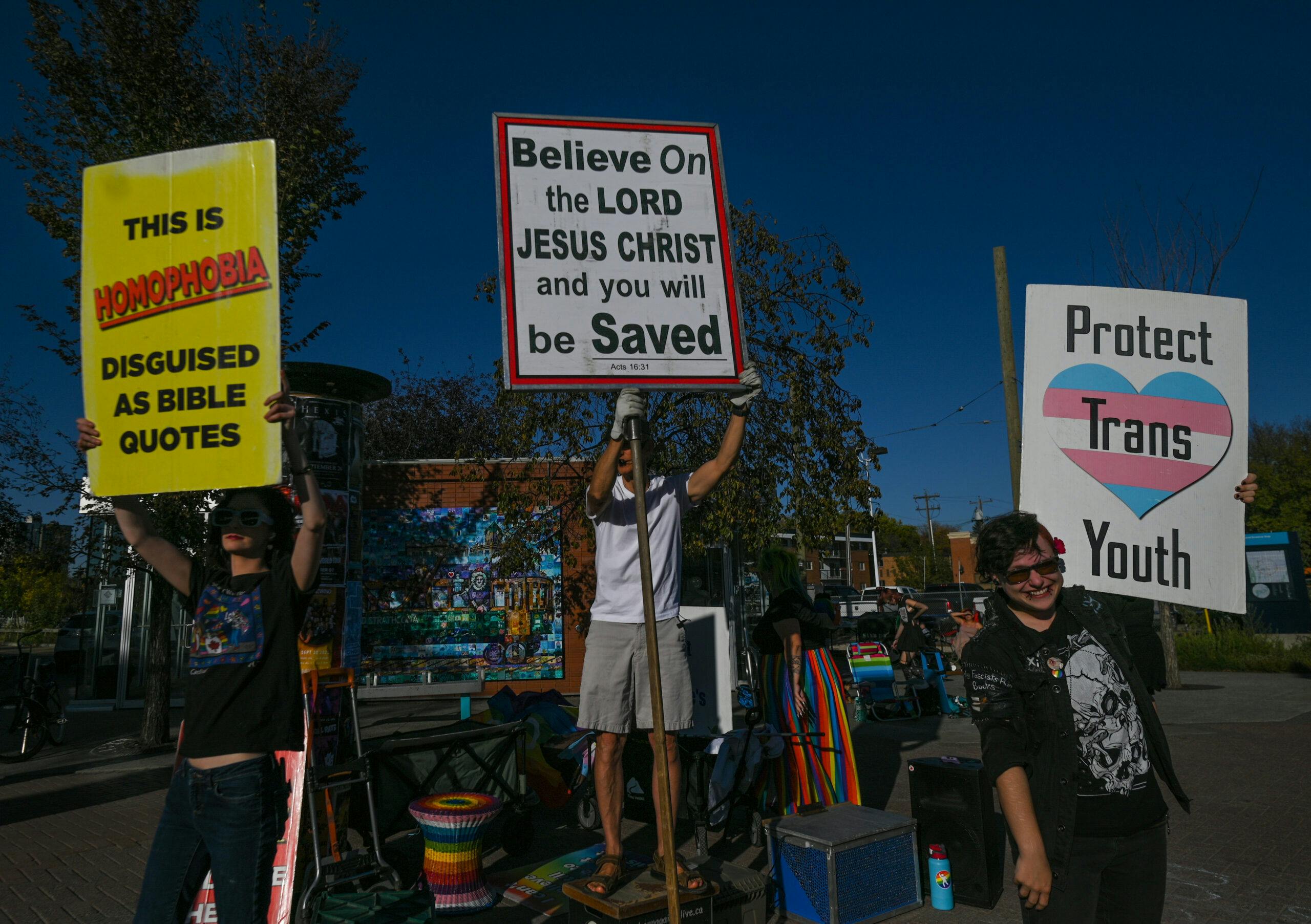
The Canadian Parliament is poised to pass a bill that would ramp up restrictions on so-called hate speech and remove religious protections in a move that concerns conservatives and Christians whose worldview stands in opposition to the LGBT ideology.
Canada’s “Combatting Hate Act,” or Bill C-9, targets so-called hate crimes such as the public display of the Nazi swastika and other terrorist symbols, and it also increases the punishment for “intimidation” around places of worship and safe places. But also buried inside the bill is a controversial section that removes Canada’s religious exemption for so-called hate speech. Some worry that the bill could be used to silence Christian expression that opposes gay marriage.
The bill passed the country’s House of Commons in March and was adopted by the Senate last week. It was then sent back to the House of Commons to resolve amendments made in the Senate, and it is expected to be accepted without opposition and be signed into law by the governor general.
Canada’s Liberal government made an agreement with the secular Bloc Quebecois, a party devoted to Quebecois nationalism, to include in the bill a section that removes the religious exemption clause to hate speech that is currently in Canadian law code. With the removal of the religious exemption, people can be prosecuted for hate speech even if “the person expressed or attempted to establish by an argument an opinion on a religious subject or an opinion based on a belief in a religious text.”
Josh Dehaas from the Canadian Constitution Foundation warned that the bill could even target the reading of certain scripture passages due to the removal of this religious protection.
“It is unlikely passages from religious texts read on their own will lead to criminal charges,” Dehaas stated. “The Crown would need to believe that the intention of reading the text was to incite hatred, promote hatred or promote antisemitism.”
“However, with the defence now removed, certain passages from religious texts could now lead to charges depending on the context including when they are read, where they are read, and what other words are used when they are read,” he added.
The Canadian Supreme Court has made a test for hate speech by looking for “hallmarks of hatred.” The “hallmarks” include calling a specific group a “powerful menace,” accusing “a group of carrying out secret conspiracies to gain global control or that they are plotting to destroy western civilization,” calling a group “liars, cheats, criminals and thugs,” labeling a people group “subhuman,” or blaming a group for the problems of society.
The bill does include at least one protection against abuse, requiring the approval of the provincial attorneys, so the charge cannot be weaponized by local police.
Hillsdale assistant professor Dr. John Petrakis, an expert in comparative political systems and Canadian and American law, told The Daily Wire that the Canadian Supreme Court would likely defend bill if it becomes law, following its decision in Saskatchewan (Human Rights Commission) v. Whatcott, in which the court upheld a penalty for a man who spread anti-gay pamphlets.
“It is difficult to predict exactly how these legal changes will operate in practice, and whether people might be able to challenge them on constitutional grounds (freedom of speech and freedom of religion,)” Petrakis declared. “I will say that the Court’s Whatcott decision should make one pessimistic. The courts are likely to dismiss constitutional challenges by saying that the laws and their application to specific cases are ‘reasonable’ limitations to constitutional rights.”
Petrakis said that with the advent of this new legislation, Canada will likely emulate countries such as Great Britain in their crackdown on reported hate speech.
“My overall take is that Canadian free speech law and culture is much less robust than the U.S., though more robust than Western Europe, but that this new law will reinforce our trend away from American-style speech culture towards the European version,” Petrakis said.
The Senate sponsor of the bill, the Honorable Kristopher Wells, described his experience working with the “Jewish, Muslim, Asian, black, indigenous and 2SLGBTQI+ communities,” stating that their universal plea to the government is that “they do not feel safe, do not feel seen and do not feel the law is there to help them at their time of greatest need.”
“Bill C-9 is our answer to those responses,” Wells stated. “It is an opportunity for Parliament to say, with unwavering moral clarity and with the strength of criminal law, that our country sees you, Canada will stand with you and hate will not be tolerated in this country.”
One section of the bill creates a separate hate crime offense for an “offense … motivated by hatred based on race, national or ethnic origin, language, color, religion, sex, age, mental or physical disability, sexual orientation or gender identity or expression.” Previously, the charge of a hate crime could only be used to extend the sentence for a crime, but this bill creates it as a separate, punishable offense.
Wells argued that Canada needs a separate hate crime offense after claiming to witness a rise in so-called hate crimes against the LGBT community.
“Drag storytimes are protested; pride flags are burned or removed from municipalities and schools; and 25% of adolescents in Canada have experienced at least one form of cyberbullying, with trans and non-binary adolescents almost twice as likely to be targeted,” Wells said.
“Bill C-9 corrects this by creating a dedicated hate crime offence, ensuring that when someone wilfully commits a criminal act motivated by hatred against an identifiable group, that motivation is recognized as the very essence of the wrongdoing,” he added.
The bill also prohibits the public display of a symbol that “is principally used by, or principally associated with, a listed entity.” This bans hosting the flags for designated terror organizations, such as the Palestine Liberation Front, the Taliban, and Al Qaida, and gangs such as La Mara Salvatrucha, along with far-Right groups such as the Proud Boys.
The bill seeks to prevent terrorist demonstrations like the pro-Hamas demonstrations in the United States, where Left-wing rioters shouted “Allahu Akbar” and burned the American flag in response to a speech by Israeli Prime Minister Benjamin Netanyahu.