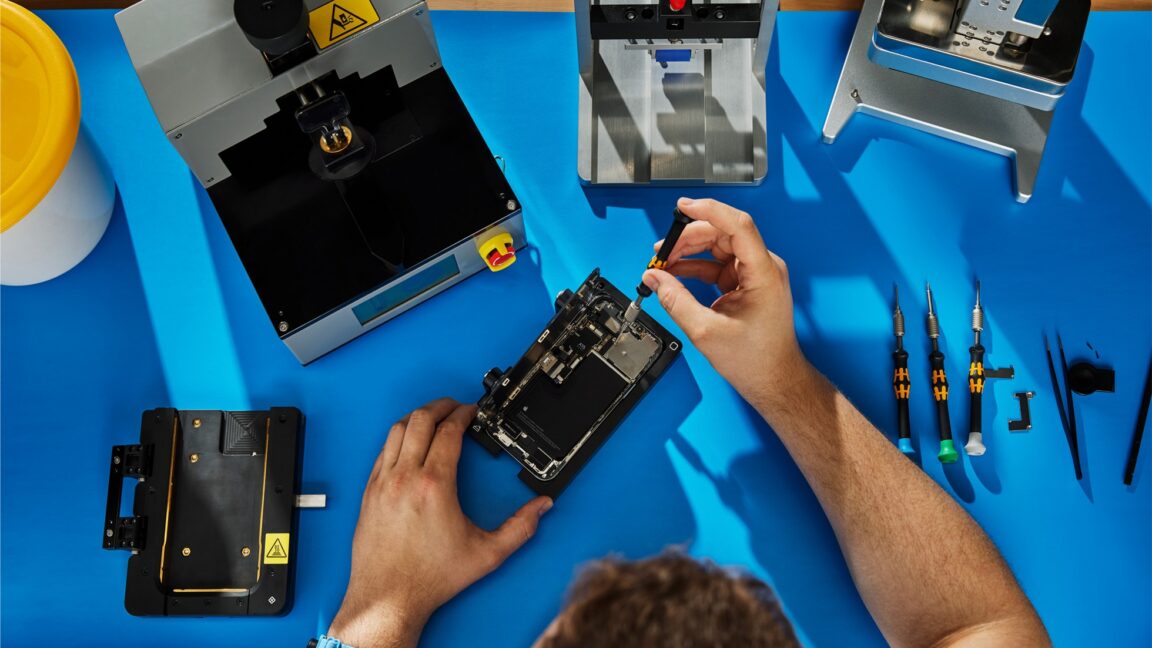
The MacBook Neo is a step in the right direction, though.
Apple earned the lowest grades in a report on laptop and smartphone repairability released today by the consumer advocacy group Public Interest Research Group (PIRG) Education Fund. The report, which looks at how easy devices are to disassemble and how easy it is to find repairability information, gave Apple a C-minus in laptop repairability and a D-minus in cell phone repairability.
For its “Failing the Fix (2026): Grading laptop and cell phone companies on the fixability of their products” report, PIRG analyzed the 10 newest laptops and phones that were available via manufacturers’ French website in January. PIRG uses devices available in France because much of its criteria stems from the French repairability index, a grading system for device repairability that must be displayed on products sold in France. The group, along with other right-to-repair advocates, believes vendors should apply the French requirements to devices sold in other geographies as well.
To calculate laptop vendors’ grades, PIRG used the French index but gave more “weight to the physical ease of disassembling the product” because it believes that “is what consumers generally expect a ‘repair score’ to refer to.” The other French repairability index categories are:
- Availability of repair documentation (manuals and service guides)
- Availability of spare parts
- Affordability of spare parts (“calculated as a percentage of the cost of the whole product,” per the report)
- Product-specific criteria
“Each company grade averages the total French score and the isolated disassembly score from each device and then deducts 0.5 points for each case of membership in TechNet or the [Consumer Technology Association],” the report says, referring to two industry groups opposing right-to-repair legislation in the US.
Explaining the penalty, which affected laptop scores for all examined vendors except for Acer and all examined phone vendors except for Motorola, Nathan Proctor, senior director of US PIRG Education Fund’s Right to Repair campaign, told Ars Technica:
While a company’s membership in these associations doesn’t mean that the company is actively in opposition to Right to Repair, they are funding an organization which is working against this legislation, which we factor in our score.
Vendors also gained 0.25 points “for each piece of right-to-repair legislation supported by the testimony of the manufacturer in the past year,” per the report.
Laptop repairability scores
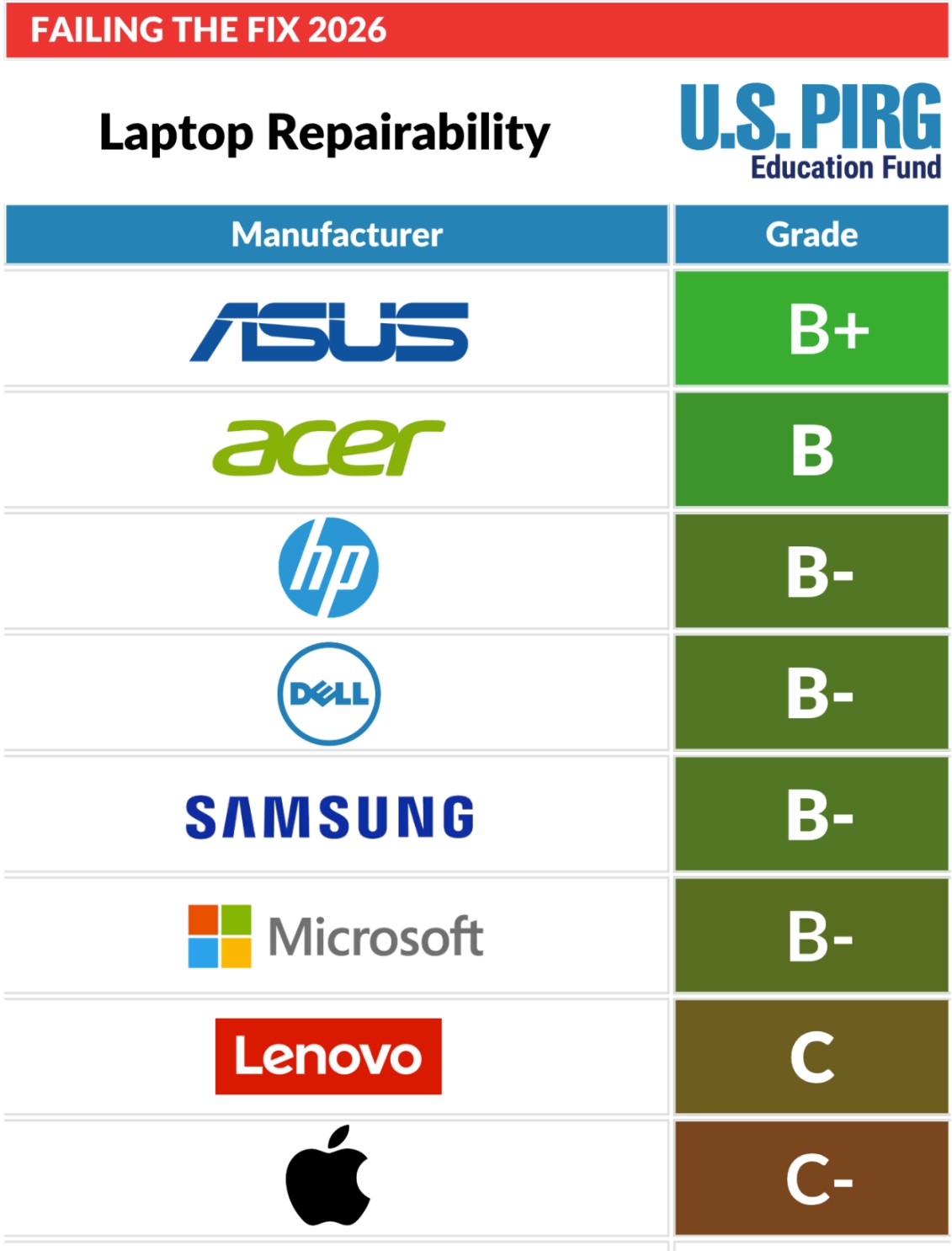
Asus scored better than other companies for the third consecutive year.
Asus scored better than other companies for the third consecutive year. Credit: US PIRG Education Fund
Apple leads the list of laptop repairability losers, largely due to it having low disassembly scores. Apple, along with Dell and Samsung, also lost a full point for being members of TechNet and the CTA.
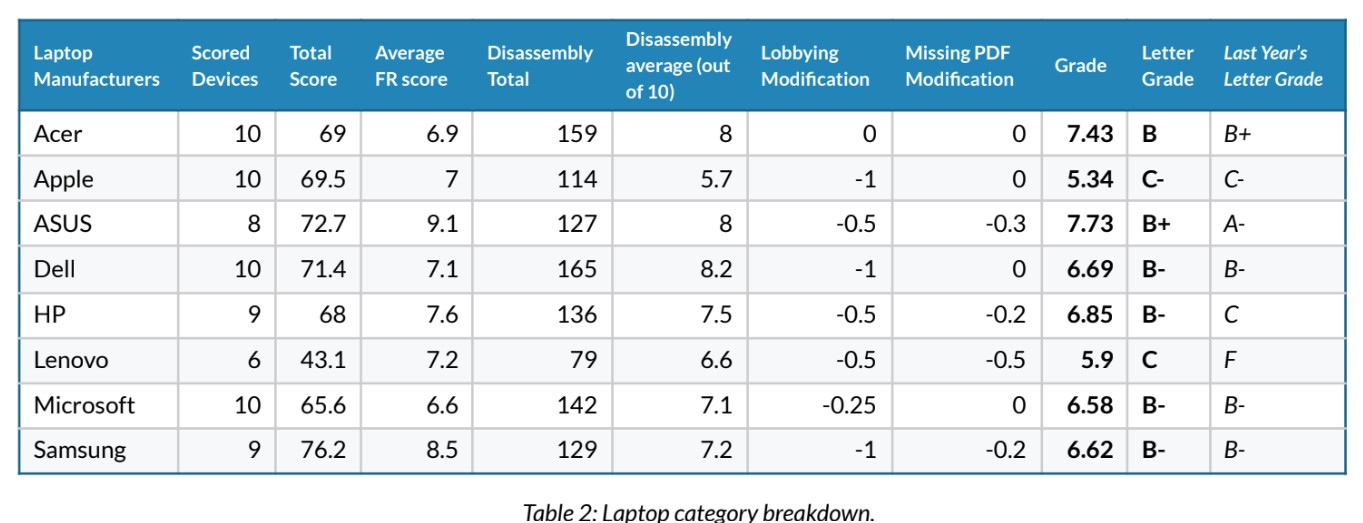
Lenovo had the second-worst grade with a C-minus. Like Apple, Lenovo had low disassembly scores.
It also lost 0.5 points for failing to properly post PDFs explaining the French repair scores for some of its newest laptops sold in the region, as required in France. This is especially noteworthy because Lenovo got an F in last year’s report (you can see our coverage of the 2025 report here) for missing this information on at least 12 laptops.
At the time, Lenovo director of communications David Hamilton provided a statement to Ars saying that the missing information was “due to a backend web compatibility issue that temporarily prevented the display of repairability scores on our Lenovo France website” that was “widely resolved.” However, it appears that over a year later, Lenovo still isn’t providing sufficient information to meet France’s requirements
“While Lenovo has improved somewhat with their compliance with French consumer law by providing more repair score PDFs on their website, we urge the company to resolve this multi-year issue,” this year’s report says.
PIRG’s report concluded that “laptops are pretty stagnant in terms of repairability” across many of the eight most popular laptop brands in the US.
However, Proctor noted to Ars that consumers’ access to parts, tools, and information that vendors have has improved, but improvements around ease of disassembly “take longer to realize.”
He also praised vendors’ efforts to release more repairable designs, such as Apple’s MacBook Neo.
Phone repairability scores
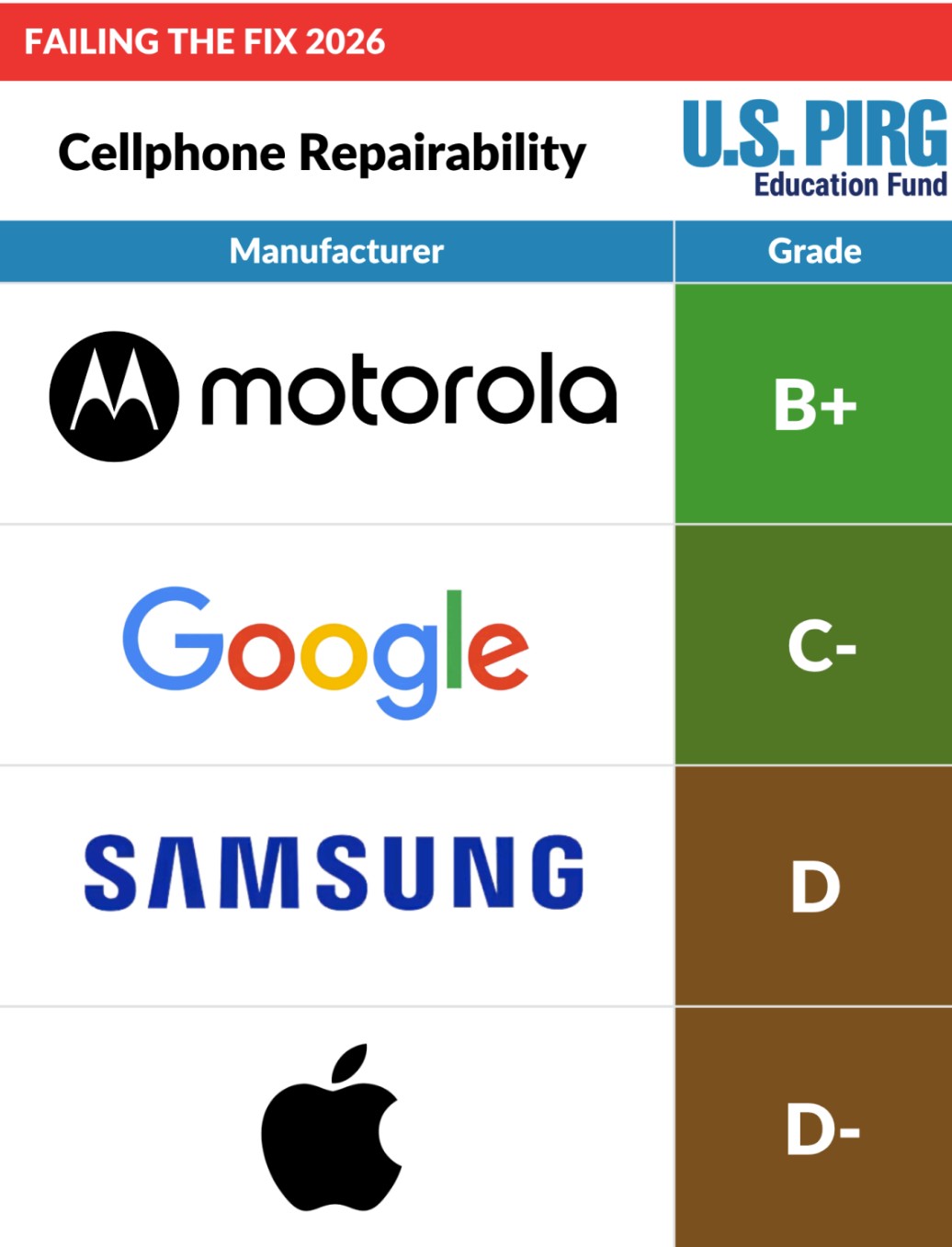
Lenovo’s Motorola brand earned the best grade.
Lenovo’s Motorola brand earned the best grade. Credit: US PIRG Education Fund
PIRG’s scores for phone manufacturers this year are based on the European Product Registry for Energy Labelling (EPREL), a scoring system that the European Commission created in June 2025 for scoring smartphone and tablet repairability. It’s based on six factors:
- Disassembly depth
- Fasteners
- Tools
- Spare part availability
- Software updates
- Repair information
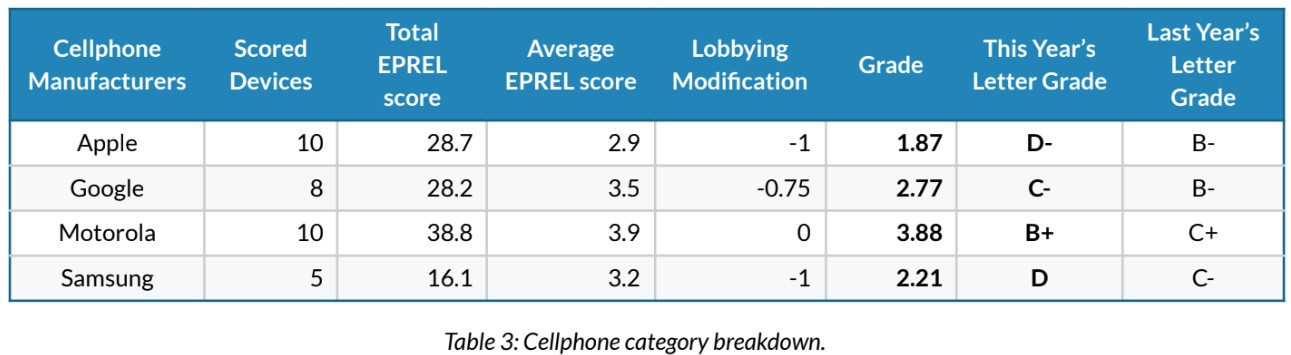
US PIRG used different criteria for this year’s report.
US PIRG used different criteria for this year’s report. Credit: US PIRG Education Fund
PIRG’s report said that Apple and Samsung scored so low under EPREL criteria partially because all of the phones scored are guaranteed to receive updates for five years and not longer.
PIRG noted that Apple made progress in phone repairability by moving away from parts pairing, which is when companies require parts to be verified through encrypted software checks in order to function, and through the introduction of the Repair Assistant. However, the report’s author lamented that third-party Face ID replacements still don’t work. The report adds:
Apple also extended its Activation Lock anti-theft feature to individual parts, which repair advocates warn will strand large numbers of perfectly functional components—locking them out of the repair ecosystem entirely.
Apple isn’t alone: parts pairing and software restrictions remain an industry-wide problem that consumers and independent technicians continue to face across manufacturers.

Scharon is a Senior Technology Reporter at Ars Technica writing news, reviews, and analysis on consumer gadgets and services. She’s been reporting on technology for over 10 years, with bylines at Tom’s Hardware, Channelnomics, and CRN UK.