Order Jamie Glazov’s new book, ‘United in Hate: The Left’s Romance with Tyranny, Terror, and Hamas’: HERE.
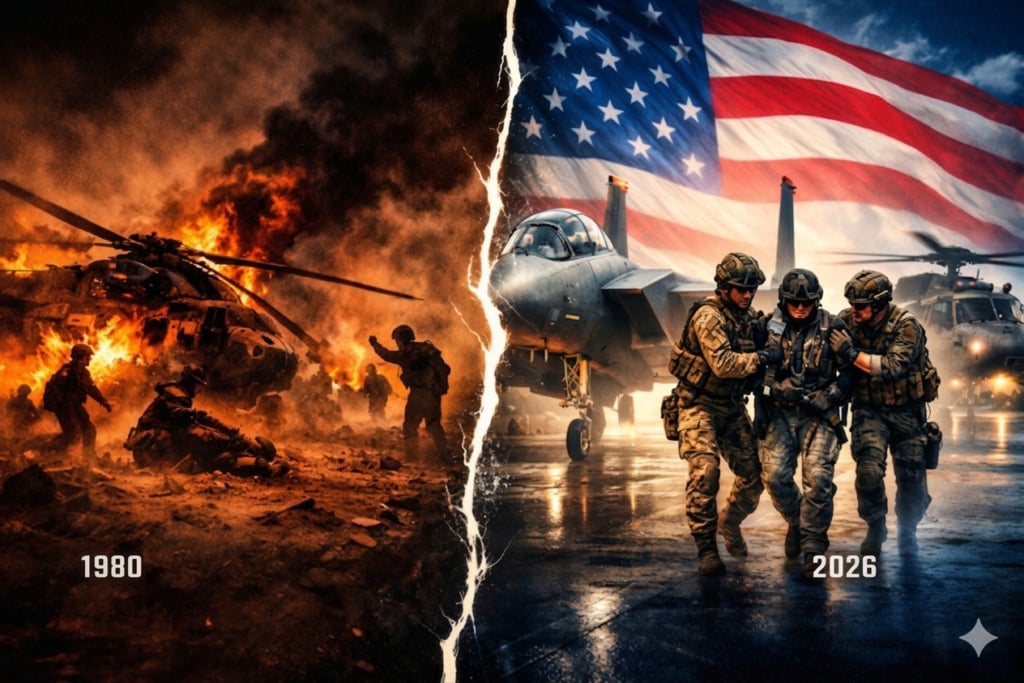
The daring rescue of an American F-15E fighter pilot was a huge success, but in all the excitement, something has gone missing. Back in 1979, Iran’s Islamic regime invaded the US embassy in Tehran – an act of war – and held 52 Americans hostage for 444 days. In Age of Reagan: The Fall of the Old Liberal Order, Steven F. Hayward describes Jimmy Carter’s attempt to rescue the hostages:
Within days of the hostage-taking in November 1979 President Jimmy Carter ordered the Joint Chiefs of Staff to begin exploring options and making a plan for a military rescue. Among other difficulties, the Pentagon didn’t have a planning process for hostage rescue missions, so everything had to be devised from scratch. Even if a tactical plan for overcoming the “students” at the embassy compound could be devised, Tehran was hundreds of miles inland, beyond the round-trip range of American helicopters.
The sheer difficulty and improbability of a rescue assault are what encouraged the Pentagon to believe a surprise raid could be done. A plan was beginning to take shape within three weeks of the hostages’ seizure. A number of factors looked favorable. The U.S. had an intelligence agent inside the embassy compound, an Iranian cook who regularly relayed information to other U.S. agents in Tehran about the number and disposition of guards on the scene. By the spring, the number of armed guards had dropped to about 20—a number that could be easily overcome by highly trained American special forces.
But how to get forces in, and back out with the hostages, remained the crux of the problem. From the start the plan violated the basic military maxims of simplicity and quick entry and exit. The Pentagon planners settled on a three-day, three-stage plan that involved flying a 120-man commando force on eight heavy lift RH-53D “Sea Stallion” helicopters at night to a location outside of Tehran. This would require refueling the helicopters at some point. This involved the first and ultimately the most fateful decision. The natural choice for such a mission would be Air Force pilots, who were trained for long-range flights using terrain-following radar (TFR) and forward-looking infrared systems (FLIR) on RH-53D helicopters, which made precise night-time flying possible. But it was decided to use Marine pilots, typically only trained for short-range helicopter missions, instead. The Marine pilots would fly with night-vision goggles and navigate by dead-reckoning and old-fashioned compass headings. Although the Pentagon never admitted it, the decision to use Marine instead of Air Force pilots seems to have been the result of inter-service rivalry. As the initial plan began to take shape, every branch of the service had a clear role—except for the Marines. But because Navy helicopters were not equipped for, nor Marine pilots trained for, aerial refueling, the plan required a ground refueling stop somewhere deep inside Iran where American fuel tanker planes and helicopters could rendezvous.
Planners selected a site 265 miles southeast of Tehran, and 500 miles inland from the Persian Gulf, near the middle of the Dasht-e-Kavir desert. It was code-named “Watchband,” but would become better known by its designation in the operational plan, “Desert 1.” One story, since disputed, held the CIA built a landing site at this location a few years before (supposedly as a possible escape route for the Shah), and it appeared to be the only suitable location for American C-130 tanker planes to land, even though the site was close to a well-traveled highway. According to the plan, after refueling the eight helicopters would fly on under cover of darkness to a second hideout near Tehran, “Desert 2,” where the commando force would hide out until the next night. Then they were to proceed on several Mercedes trucks, acquired by an advance team that had slipped into Iran weeks before from Turkey and Pakistan, to the embassy. Planners thought the force could be in-and-out with the hostages in less than an hour, whereupon five helicopters would come from their hiding places to collect the hostages and the rescue force. The U.S. was prepared to call in massive air cover if needed. The last part of the plan called for 80 Army Rangers to capture an Iranian airfield southwest of Tehran, where the helicopters would rendezvous with three C-141 airplanes that would take the hostages, the rescue force, and the advance team out of the country. Green Beret Col. Charles Beckwith would lead the mission. Beckwith was known as “Chargin’ Charlie;” at the rendezvous at Desert 1 he greeted the arriving helicopters with, “Welcome to World War III.”
It was an audacious and complicated plan, requiring precise timing and allowing little margin for anything to go wrong. The plan had to be conceived, rehearsed, and launched with maximum secrecy and diversion, chiefly to keep the Soviet Union from observing it with their spy satellites and tipping off Iran. This concern for secrecy led the planners to compartmentalize every phase of preparation, such that each of the military units involved in the plan had its own commander and never rehearsed together. (Despite this security, the mission was nearly blown when pilots training in Arizona blabbed about the mission to impress women they met in a local bar.) Some of the unit commanders met for the first time at Desert 1 in Iran. Although the planners thought that taking the embassy would be the easiest part of the plan, estimating that only one or two hostages might be killed. (There is controversy about these estimates, with reports that the CIA thought half or more would be killed.) Contrary to widespread accounts, President Carter did not hobble with plan with any restrictions as to the amount or kind of force used. Carter did caution that he did not wish to see “wanton killing,” but he understood the score. The stories, popular in the media in the weeks after the mission, that the assault force was going to use some kind of “sleeping gas” to avoid killing Iranians are false; the commando team fully intended to use deadly force. Still, the plan seemed to face long odds; some planners in the Pentagon rated the chance of success as one in four, while some independent military experts put the chances of success as low as 1 in 25. Secretary of State Cyrus Vance opposed the plan entirely, telling Carter that he would resign after the operation whether it succeeded or not. Vance warned Vice President Walter Mondale: “I’ll guarantee you something will go wrong. It never works the way they say it’s going to work. There’s a good chance disaster could occur here.”
Vance didn’t have to wait long after the launch of the mission to be proved correct. Eight helicopters lifted off from the aircraft carrier Nimitz in the Persian Gulf just after nightfall on April 24, while six C-130 tanker planes took off from Masirah island near Oman several hundred miles to the southwest. The helicopters would only have a little more than an hour to refuel at Desert 1 if they were going to reach the Desert 2 hideout before sunrise. Two hours into the flight, a warning light flashed in helicopter #6 indicating a crack in a main rotor blade. The pilot landed to inspect the rotor, and found no visible crack. No knowing that the RH-53D had a history of false warning lights for rotor cracks, the pilot decided to abandon helicopter #6 and continue to Desert 1 on another helicopter.
Three hours into the flight, the seven remaining helicopters flew into a large dust cloud (the Iranians called these “haboobs”) and became disoriented. American meteorologists knew that dust clouds were a common occurrence in the Iranian deserts at this time of year, but the pilots were not briefed about the possibility of dust clouds, nor had the crews trained to fly through dust clouds in the rehearsals for the mission. (The Pentagon had recommended that the mission be launched before the end of March, in part because it knew of the April dust storms, and in part because the longer nighttime hours left more margin for error in the refueling step.) Taken by surprise—one pilot said “It was like flying in a darkened milk bowl”—the helicopters lost formation and began drifting apart. Because the mission was being conducted under strict radio silence, the helicopters could not communicate with one another. As the helicopters floundered in the dust, a second helicopter developed mechanical trouble. The navigational system on helicopter #5 failed, and the pilot, lost in the dust, decided to turn around and head back to the Nimitz. Helicopter #5 had nearly reached the end of the dust cloud; had he known, the pilot said later, he would have pressed on.
The six remaining helicopters straggled into Desert 1 far behind schedule, the last helicopter arriving 85 minutes late. The second leg of the flight to Desert 2 would now take until after daybreak, seriously increasing the risk of the mission. The pilots were shaken by the flight conditions; some expressed reluctance to continue on to Tehran. But there were more immediate problems. There was no central command post; many of the pilots and officers did not know who was in command. The airplane engines were left running during the entire time at Desert 1 so as to eliminate the risk that an engine might fail to restart, which made the site dusty and noisy. A busload of Iranians drove through the landing site and had to be detained. (If the mission had gone forward, these 44 Iranians would have been taken out of the country on a C-130 to avoid compromising the mission, raising the specter that the U.S. would now have hostages of its own.) A second pair of Iranians escaped from the area after their gasoline tanker truck was shot at and blown up.
Then a new mechanical problem was discovered. Helicopter #2 had experienced a hydraulic pump failure and had lost its hydraulic fluid. There were no spare parts; helicopter #2 could not go on. The moment of decision had arrived. Knowing that helicopters are prone to breakdowns on long missions, planners had assumed that one or more would be lost to the mission. The plan required five helicopters for the final stage of the mission in Tehran, but called for six working helicopters reaching Desert 2. In addition to having one spare copter, six were needed to get all of the personnel and their weapons to Desert 2. The Air Force commander on the scene, Col. James Kyle, asked Col. Beckwith: “Charlie, would you consider taking five and going ahead?” Beckwith thought for a moment and replied: “There’s just no way.” It was now 2 a.m. local time in the desert.
Beckwith and Kyle relayed the news to the task force commander in Cairo, who immediately passed it along to Washington. Within minutes Defense Secretary Harold Brown, Brzezinski, and Carter were conferring on the decision. Carter reluctantly agreed with the decision to abort. The abort scenario was never rehearsed, so confusion at Desert 1 deepened as the entire process of loading helicopters with equipment for the Tehran leg of the mission was reversed. Catastrophe struck 45 minutes later when helicopter #3, lifting away from a C-130 tanker to make room for another helicopter to take on fuel, suddenly pitched to the side, its main rotor blade slicing into the airplane behind the cockpit. Both the helicopter and the tanker exploded, killing the five-man crew on the plane and three Marines on the helicopter.
In the panic that followed a last set of blunders was committed. Col. Kyle decided to abandon Desert 1 as fast as possible. Even though plans called for the helicopters to be destroyed in the event they were inoperable, they were left intact at Desert 1—with copies of the complete classified plan for the mission which Iran subsequently recovered from the scene. (Included in the plans was a map of Tehran showing the Ayatollah Khomeini’s residence. Perhaps the commandoes were contemplating taking a hostage of their own?) Iran hastily scattered the hostages from the embassy to several locations in Tehran to make another rescue attempt impossible. It took almost two months for the American advance team in Tehran to make their escape.
Operation Eagle Claw, the rescue mission’s official code name, joined the Son Tay P.O.W. raid and the Mayaguez rescue mission as the third major military fiasco of its kind in the last decade. Was this another symptom of “the Vietnam Syndrome,” of a corrupted command structure that was incompetent at warfare? Could Eagle Claw have worked if planners had used more helicopters or experienced better luck? Skeptics outnumber believers by a wide margin. “The planning and execution were too incompetent to believe,” an Israeli officer told Newsweek. Military analyst Richard A. Gabriel argued that the hostage rescue mission “was an operation so poorly planned and executed that failure was almost guaranteed.” It may not be fair to extend the failure of the rescue mission into a metaphor of declining American prowess, but the perception was undeniable. American elites as well as its allies believed that the declining confidence in America’s military was indissolubly linked to the increasing timidity of U.S. foreign policy. More than a bigger defense budget would be needed to fix this problem.
That’s how it was under Georgia Democrat Jimmy Carter, his Secretary of State Cyrus Vance, and CIA director Stansfield Turner, a “disaster” according to William Barr, who began his career with the agency. Contrast the successful rescue under President Trump, with the US airman back “safe and sound,” and the lesson should be clear. If you go into battle, or attempt a rescue, with anything but the best men and equipment you have two choices: bluff or fold. The downed pilot is surely glad that Trump went with the best. The Iranian regime not so much.

Lloyd Billingsley
Lloyd Billingsley is the author of Yes I Con: United Fakes of America, Barack ‘Em Up: A Literary Investigation, Hollywood Party, and numerous other works.
Reader Interactions
In order to eliminate spam comments that have historically flooded our comments section, comments containing certain keywords will be held in a moderation queue. All comments by legitimate commenters will be manually approved by a member of our team. If your comment is “Awaiting Moderation,” please give us up to 24 hours to manually approve your comment. Please do not re-post the same comment.