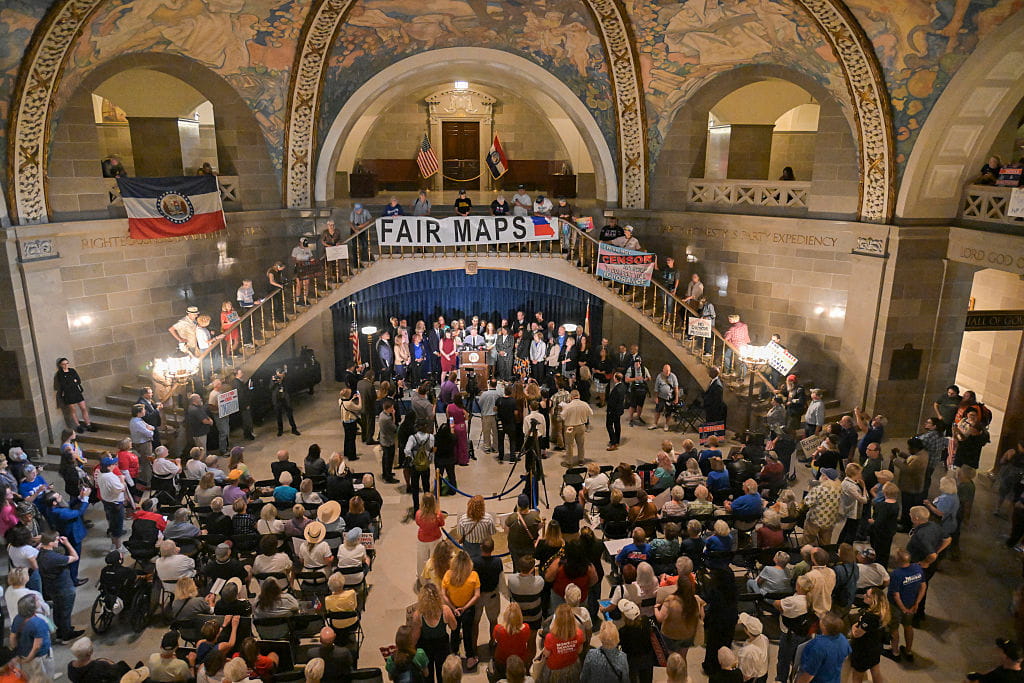
President Donald Trump and Republicans hoping to hold the House after November notched another win in Missouri this week. Cole County Circuit Judge Daniel Green ruled on Wednesday, August 19, that the state’s constitutional referendum rules don’t apply to congressional redistricting enacted by the General Assembly. If his ruling stands, so too will the GOP-friendly new district map, which is expected to give Republicans one more seat in the House. But will it stand? That’s the question – and the Missouri Supreme Court seems eager to answer it.
Missouri Map Madness
Missouri Governor Mike Kehoe, a Republican, called for a special legislative session back in August of last year to generate a new congressional map. The Missouri House and Senate did exactly that, and quickly. By mid-September, the Missouri First Map was passed, dismantling Democratic Rep. Emanuel Cleaver’s Kansas City seat by splitting the metro area across three otherwise rural districts.
The ACLU and the Campaign Legal Center immediately sued, challenging the legality of the mid-decade redistricting. Still, the new map became law. A day after Governor Kehoe signed it, however, a group called People Not Politicians filed paperwork to hold a statewide veto referendum to allow voters to repeal the map on the November 2026 ballot.

Free with the Daily Briefing
85Essays
Unravel the Constitution
Hamilton, Madison & Jay’s complete case for America, free and searchable in the Publius Reader.
Free with the Daily Briefing. Unsubscribe anytime.
In March of 2026, a state circuit court decided in favor of the map, throwing out the ACLU’s gerrymandering suit and ruling that redistricting is inherently political in its nature. In May, the Missouri Supreme Court agreed, leaving a referendum as the only potential way to kill the new map.
And on August 19, Judge Green cut off that avenue, as well. In the ruling, he explained that, while the Missouri Constitution does allow voter referendums to veto state laws, it also leaves redistricting entirely to the General Assembly. As such, Judge Green argued that the ballot referendum doesn’t apply.
The plaintiffs immediately appealed to the Missouri Supreme Court, which had previously expressed an interest in taking up the case quickly – which it did. The Court took up the case on Thursday, August 20. And there’s no wonder they’re in such a hurry; ballots must be printed by September 8.
The Supreme Rule – Order Over Chaos
Now that the issue is before the Missouri Supreme Court, we need to look at the political layout of said court. Of course, there’s no 100% way to predict how any group of judges will rule. However, there is one outcome that seems more likely than the other for two reasons.
First, the court is made up of seven judges, five of whom were appointed by Republican governors. While the two judges seated by Democrats will probably dissent, the five-member conservative majority will most likely affirm the lower court’s ruling, block the referendum, and lock in that 7-1 GOP-friendly map for November.

But there’s another reason to rule in favor of the map: avoiding electoral chaos. Under Missouri law, if the referendum is allowed, the new map immediately reverts to the old one. Should the people vote in favor of said new map, it would then be applicable in future elections, but not this one. And that’s a problem in itself. The primaries earlier this year were based on the new map. So, if it gets tossed, candidates who would have been representing one district could find themselves competing in a different one. The law only requires representatives live in their state – not the district they ran for, necessarily – but it still means confusion and chaos. Voters would find, come election day, their previous votes didn’t matter – and that’s assuming they even show up to the right place, since a map change would put some voters in the “wrong district” when they go to their normal polling locations. Whichever party loses the affected seats would likely bring yet another lawsuit, potentially escalating the issue to the federal level.
There’s a reason this hasn’t happened yet – and for why it probably won’t now. And again, all this must be decided by September 8, the deadline for printing ballots. The issue may still technically be “in the air,” but the end seems all but predetermined.