Last week’s retail sales report provided fresh evidence that the K-shaped economy is buckling, with national average gasoline prices still printing above $4 a gallon and discretionary spending weakening. Consumer stress is now surfacing in the grocery aisle: as beef prices hover near record highs, Americans are beginning to trade down to cheaper proteins.
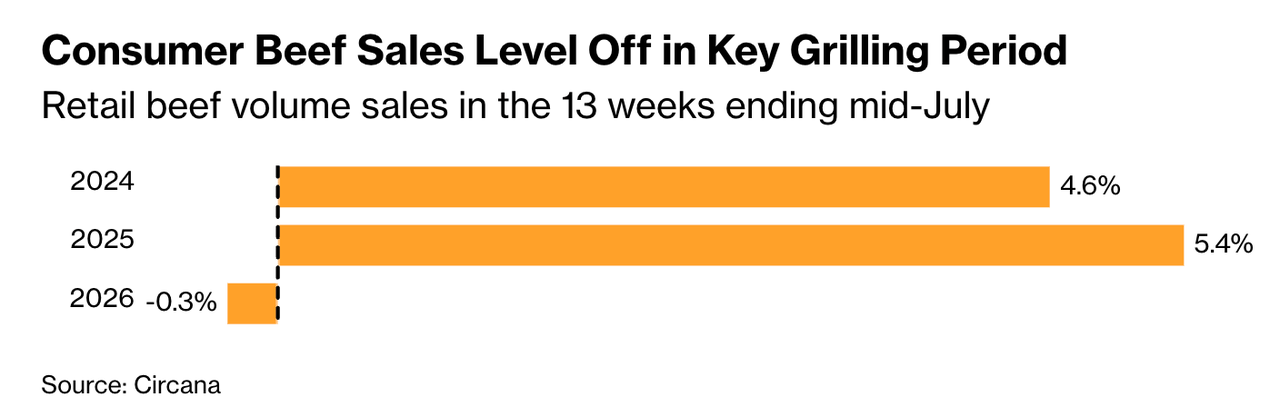
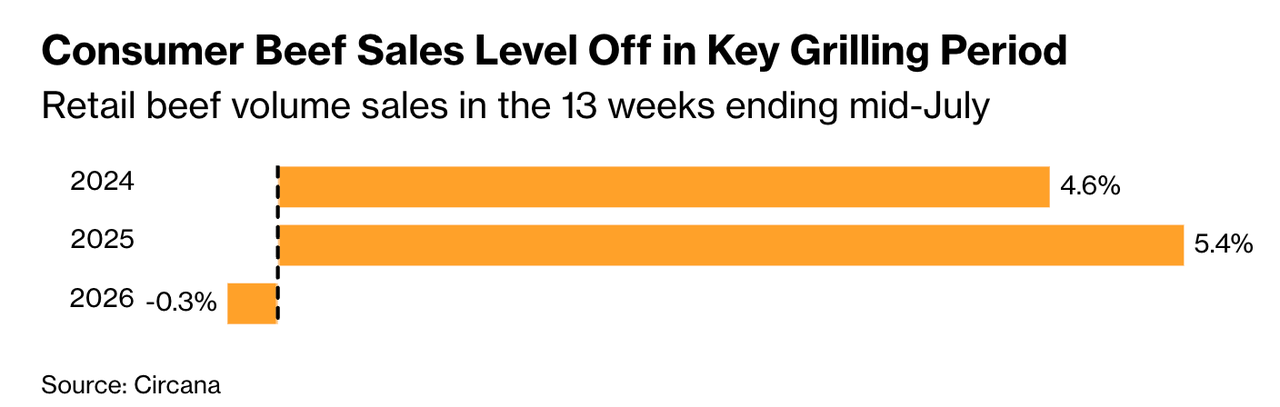
Bloomberg cites new data from Chicago-based market research company Circana, showing that beef sales volumes declined .3% during the 13 weeks through mid-July. Volumes had risen about 5% during the same period in each of the previous two years. The decline is notable because it occurred during the peak grilling season around Memorial Day and July Fourth.
Data from the United States Department of Agriculture (USDA) show that the national average price of ground beef in the supermarket is hovering just below $7 per pound, a record high, as a prolonged cattle shortage shows no signs of abating anytime soon.

The Trump administration has focused on easing elevated beef prices through increased imports, but any meaningful relief will take years. The US cattle herd remains near its lowest level in more than five decades, while imported animals must be raised for months before entering the food supply.
Bank of America analysts recently cited Oklahoma State University agricultural economist Derrell Peel, who warned that the US cattle cycle is unlikely to improve anytime soon and that beef prices are poised to remain elevated through at least next year.
Read:
We noted in late July that one of the most overlooked affordable proteins is pork, which averaged $4.81 per pound in mid-June, compared with $7.95 per pound for ground beef, while pork chops cost roughly one-third as much as beef steak, according to Bloomberg, citing NielsenIQ data.

“Consumers are stretched,” Chris DuBois, an executive vice president at data-analytics firm Circana, told Bloomberg. “It’s not always just about the price of food, there’s the price of life that hits, so that puts some of the pressure on total volume in the store.”
Last week (view report), retail sales in July were a big disappointment, with discretionary categories seeing spending pullbacks. Notably, lower-income spending held up well, while higher-income spending cooled modestly.
July retail sales weakness was driven by a plunge in non-discretionary spending by higher income households https://t.co/TbbJ6WB81K pic.twitter.com/dDUdAOGawX
— zerohedge (@zerohedge) August 14, 2026
With that said, demand destruction levels for beef may finally be hitting, which is a promising sign of early rebalancing. However, consumers will not be thrilled, as they will have to trade down to cheaper proteins such as chicken and pork.