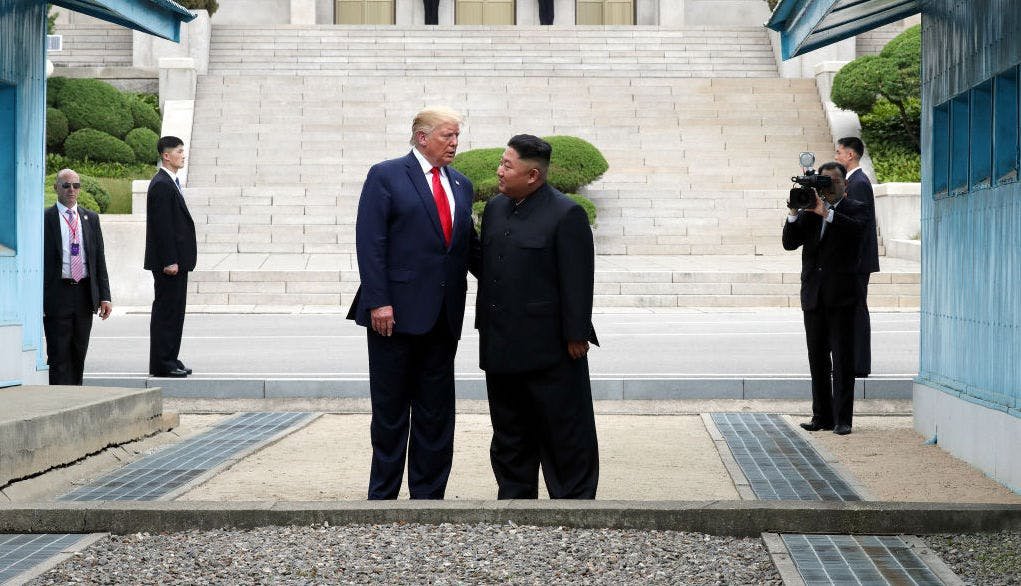
President Donald Trump said Sunday he has directed Defense Secretary Pete Hegseth to “substantially reduce” joint military exercises with South Korea, citing his “very good relationship” with North Korean leader Kim Jong Un and what he said was Seoul’s refusal to help the United States denuclearize Iran.
“Based on my very good relationship with Kim Jong Un, of North Korea, I am not happy with the fact that the United States has, long ago, agreed to participate in Joint Military Exercises with South Korea,” Trump wrote on Truth Social.
Trump said the exercises are costly, “with much of these costs paid for by the United States of America (as usual!),” and send a signal he called “totally inappropriate and hostile” toward North Korea, which he said “has been unthreatening and respectful” throughout his presidency.
North Korea has conducted two ballistic missile tests this month, however, firing a short-range missile on August 6 and another that flew more than 700 kilometers on August 12 local time — Pyongyang’s 11th ballistic missile test of the year by South Korean count. North Korea’s Foreign Ministry on Friday called the coming drills a rehearsal for an aggressive war and threatened unspecified countermeasures.
The announcement came one day before the allies were set to begin Ulchi Freedom Shield, which runs from August 17 to August 27 and involves roughly 18,000 South Korean troops. The allies had already trimmed the exercise before Trump’s post, cutting combined field training events at the battalion level or above to 14 from 17 last year. Trump said it was too late to cancel this year’s drills, but he did not specify whether the reductions apply to the exercise beginning Monday or to future ones, and it was not immediately clear what a scaled-back version would look like.
Trump also linked the decision to South Korea’s posture on Iran, where the United States and Israel have been engaged in a military campaign since late February aimed in part at dismantling Tehran’s nuclear program. “While somewhat unrelated (?), I recently asked the President of South Korea if they would like to join us in the Denuclearization of the Islamic Republic of Iran, and they said, ‘No thanks!’” Trump wrote, referring to President Lee Jae Myung. Seoul has not publicly confirmed the exchange.
South Korea has been a treaty ally since 1953 and hosts roughly 28,500 American troops, including at Camp Humphreys in Pyeongtaek, the largest U.S. military installation overseas.
Trump has long been skeptical of large-scale exercises on the peninsula. After his June 2018 summit with Kim in Singapore, he announced the United States would stop what he called “war games,” describing them as “provocative” and “inappropriate” while the two sides negotiated. He said at the time that the drills cost “a tremendous amount of money,” though the Pentagon later estimated that the Ulchi Freedom Guardian exercise cancelled that summer would have cost about $14 million. The allies scrapped that exercise outright and replaced several other large drills with smaller ones as Trump pursued negotiations with Kim.
Trump has repeatedly emphasized his personal relationship with Kim since returning to office. He posted a photo on Truth Social of the two leaders Saturday, writing that despite their “unfriendly look” in the picture, “there are many where we’re smiling, Kim Jong Un and I get along GREAT!”
The latest decision comes at a particularly notable moment for relations between Seoul and Pyongyang.
South Korean President Lee Jae Myung called Saturday for renewed talks with North Korea and said Seoul would seek to replace the armistice that halted the 1950-1953 Korean War with a formal “peace regime.” Lee also called for safeguards to prevent conflict and said negotiations could explore ways to curb North Korea’s nuclear capabilities.
North Korea, however, has repeatedly rejected Seoul’s overtures while denouncing U.S.-South Korean military exercises as provocations. Kim has also abandoned Pyongyang’s longstanding policy of pursuing reunification with the South and has instead described South Korea as its “most hostile state.”
Trump’s decision therefore introduces another variable into Seoul’s push for a more permanent peace arrangement with Pyongyang, while raising fresh questions about the future scale of the U.S. military presence and exercises on the peninsula.