
To understand Maresca’s City we need to provide some context about Guardiola’s.
Guardiola, by some, is mistakenly thought to be strictly married to a singular approach. While Guardiola had principles he stuck to throughout his career, he did not stick to one system.
These principles included keeping as much of the ball as possible, as far away from his team’s goal and as close to the opponent’s goal. His game was also founded on the basis of positional play.
Domenec Torrent, a long-time assistant of Guardiola’s, offered a nice definition of positional play, describing it as “how you place yourself in relation to others on the field when you have the ball, and where you should be so that you can continue pressing when you lose it”.
The coach implements tactics based on the positions of players in the hope of giving their team an advantage.
The end of Torrent’s definition highlights another key Guardiola principle, the idea of good rest defence, referring to team-mates behind the ball when their team attacks, ready to defend counter-attacks.
Guardiola’s friend and journalist Marti Perarnau spoke to the former City coach about his use of wide wingers during the 2016-17 season.
As noted in Perarnau’s book, The Pep Revolution, Guardiola said: “It’s a difficult process. You can’t just talk to [the wingers] and expect everything to happen.
“My first challenge is to convince [the wingers]. Just stay there on the wing, stay wide. Bide your time, be patient and your moment will come.
“Then, when you do get your chance, think about it, how many opponents am I going to have to get past?
“The answer? Just one.
“We’ve come up with this whole strategy so that you, the winger, only have to dribble past one man and sometimes there will be nobody in your way. On the other hand, if you stop paying attention and drift into the middle, how many will you have to get past? Four!”
Guardiola, of 10 years ago, perfectly describes the logic and strategy behind Maresca’s current system, and one that still works.
Across pre-season, Antoine Semenyo, stationed on the flank, was arguably City’s standout player, receiving the ball with time and space to run at his full-back. These situations commonly resulted in him arriving close to the box, cutting it back for a forward to tap the ball in, behind the opposition’s defence.
For the players behind the winger, the game is simplified into looking to find this repeatable situation.
-
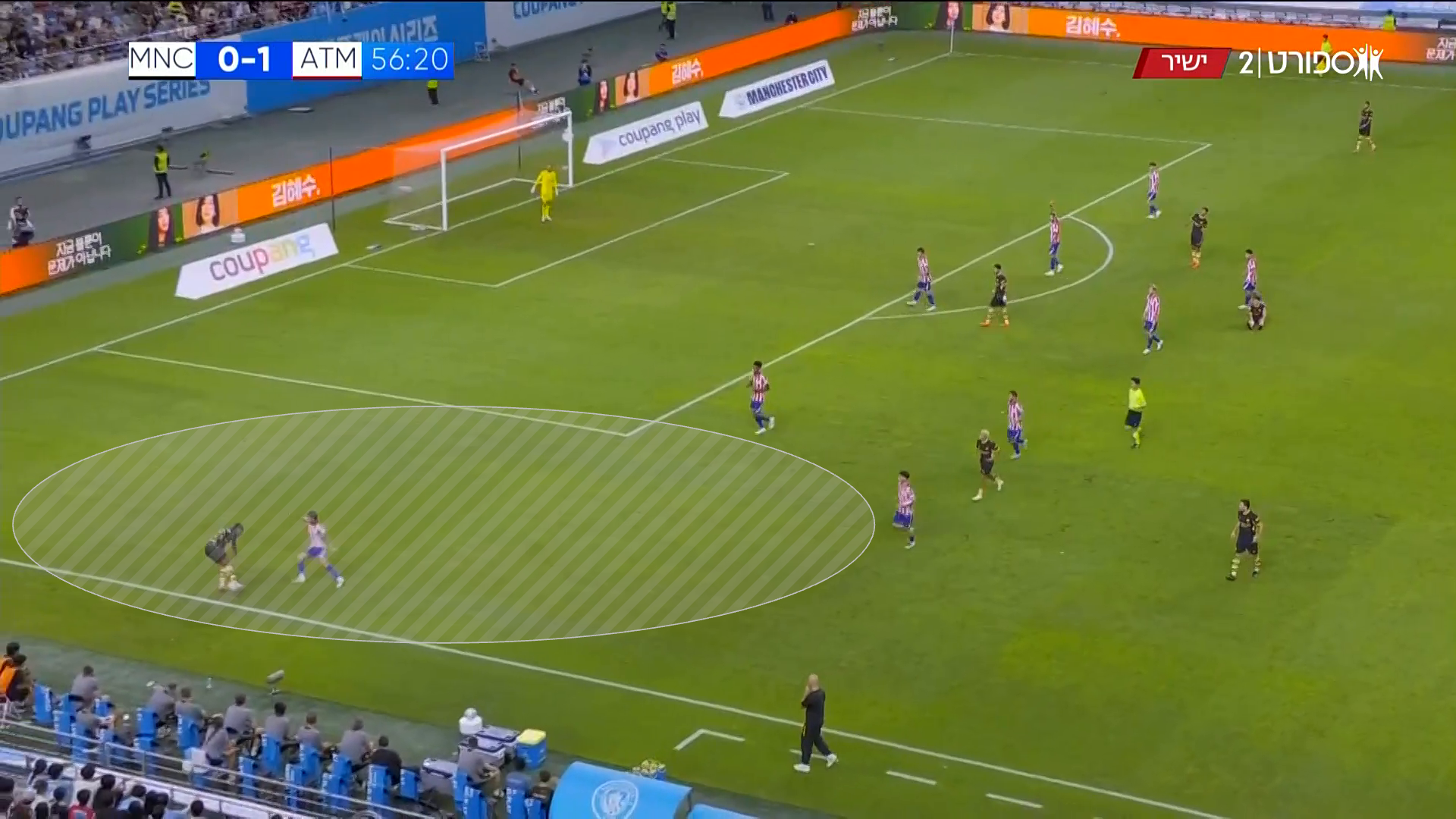
Image caption, City find Semenyo on the flank, isolated against his full-back, in a large amount of space
Slide 1 of 3, Screen grab showing City’s wing play and cut-back for a goal scored against Atletico Madrid in pre-season., City find Semenyo on the flank, isolated against his full-back, in a large amount of space