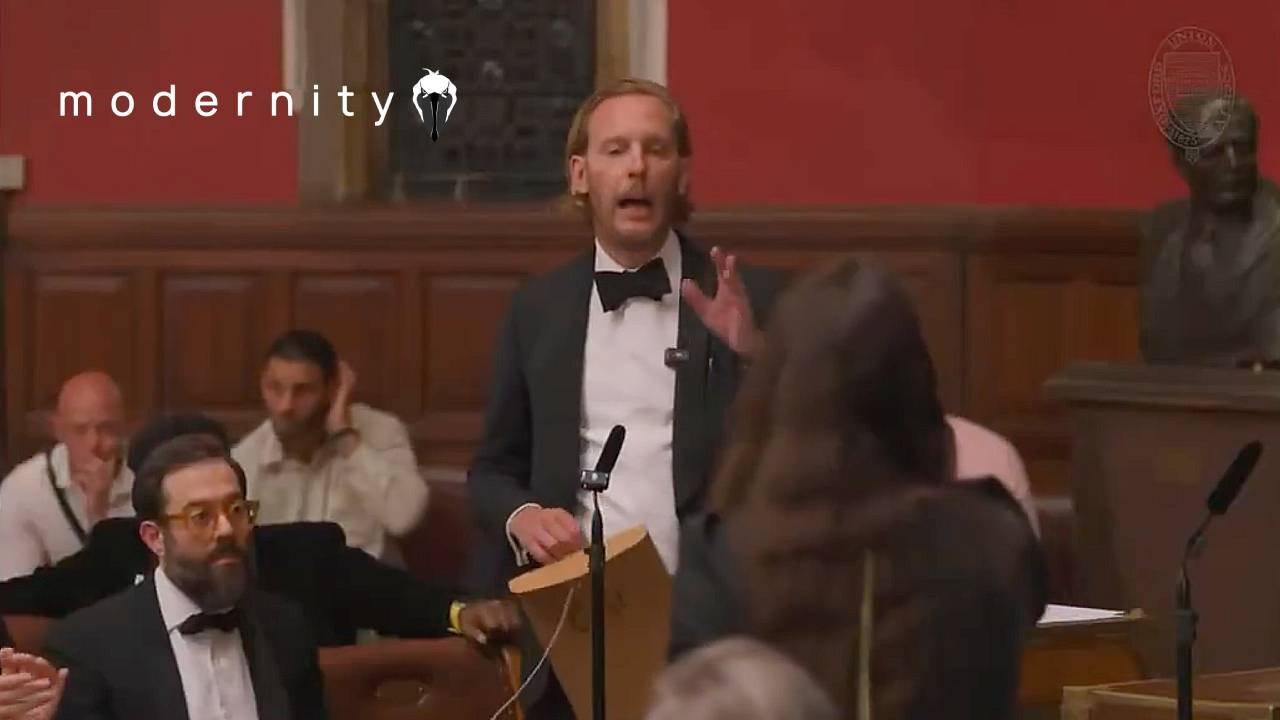
In the heart of the Oxford Union, a supposed bastion of open debate, a single brown paper envelope triggered pure panic.
Commentator Laurence Fox stood to argue that the West is right to be suspicious of Islam. He held up the envelope and indicated it contained a cartoon of the prophet Muhammad. The chamber erupted in frantic attempts to stop him opening it. Rules were suddenly invoked. Relevance was questioned. Respect was demanded.
The Muslim president of the Union interjected that her very presence should have been enough to persuade Fox that Muslims believe in free speech.
Best clip from the Oxford Union in a long time. A speaker suggests that he is about to display a cartoon of Muhammad to prove that Islam has a problem with free speech.
People scramble frantically to stop him: It is against the rules, unnecessary, irrelevant, disrespectful, and… pic.twitter.com/oRJ6MCXQOz
— Champagne Scar (@champagne_scar) August 6, 2026
“My wife asked me not to show this for fear of repercussions for my family,” Fox said. “But I told her that if I did not, I would have submitted to Islam.” He continued that the West should resist Islam “in the strongest terms on free-speech grounds alone.”
Fox opened the envelope and revealed a cartoon of Rees-Mogg. Laughter and applause followed. The fear that had gripped the room evaporated the instant it became clear the image did not depict Muhammad.
In that moment the argument was settled more effectively than any speech could manage.
The debate took place under the motion “This House believes the West is right to be suspicious of Islam.” Speaking for the motion were actor and free-speech campaigner Laurence Fox, Tommy Robinson, and writer Jonathan Sacerdoti. Against them stood Oxford Union president Arwa Elrayess, a 20-year-old Muslim of Palestinian heritage from Gaza, Rees-Mogg, and others. Outside, left-wing protesters tried to block entry. Inside, the atmosphere was already charged.
Fox made free speech the centrepiece of his case. He cited polling showing that 78 percent of British Muslims believe no publication should print pictures of Muhammad, rising higher among some groups. He noted that Britain had long abandoned its own blasphemy laws. Then he produced the envelope.
Jacob Rees-Mogg, speaking against the motion, reached for procedure, recalling that as a former Union librarian he believed props were against the rules. Others in the audience scrambled for any technicality that might prevent the image from appearing. The chair eventually ruled that props were permitted.
Jonathan Sacerdoti, who spoke alongside Fox that night, later described the episode in The Spectator. The opposition and their guests, he wrote, “squirmed in discomfort, terrified at the very suggestion a drawing of Mohamed might soon be unveiled.”
When the real image appeared, the relief was palpable. “It seems we had found the limit of free speech they had all denied existed. That limit was Islam.”
Elrayess had positioned herself as a defender of open debate by inviting the motion and the speakers in the first place. She told the chamber: “Free speech and debate is not something I do despite being a Muslim, it is something I do because of it.”
Yet when the practical test arrived—the possibility of a Muhammad cartoon—the institutional machinery of the Union moved to stop it. The title of president was offered as proof of principle even as the principle itself was being restricted in real time.
Fox’s point lands without further explanation: the taboo is real, the fear is real, and the clever arguments about compatibility evaporate the moment the cartoon is threatened.
This is not an abstract philosophical dispute. Britain has already seen teachers driven into hiding for showing Muhammad cartoons in classrooms. Publications and individuals face credible threats for the same act. The Oxford Union, with its historic claim to be a last redoubt of free speech, demonstrated in real time that the same constraint operates even among those who insist no such constraint exists.
Fox closed his demonstration with a clear declaration. “So it is in that spirit that I will not submit. I show you this as an Englishman who believes in free speech. I will not submit. I will not bow down.” The image he actually showed was of a British politician. The image that produced terror was the one everyone understood could not be shown.

The motion was defeated in the chamber that night. The larger argument was not.
Free speech that collapses the moment it risks offending one particular religious sensitivity is not free speech at all. It is a managed privilege granted on condition of silence.
The Oxford Union’s panicked reaction to a piece of paper proved the case more cleanly than any speech could. The West has every reason to notice when its most elite institutions flinch.
Your support is crucial in helping us defeat mass censorship. Please consider donating via Locals or check out our unique merch. Follow us on X @ModernityNews.