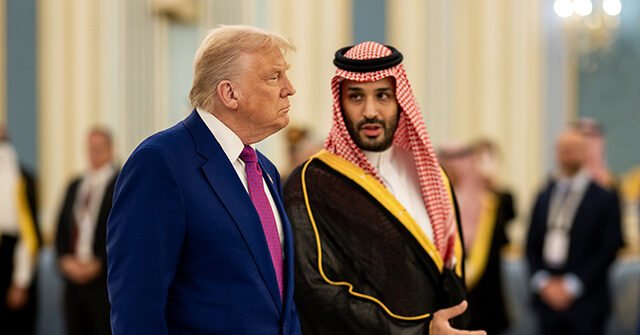
Saudi Crown Prince Mohammed bin Salman (MBS), the de facto chief executive of Saudi Arabia, reportedly urged President Donald Trump to avoid turning the Iran crisis into a “wider conflict whose repercussions would affect regional and international security and stability” when they spoke by telephone on Sunday.
Trump said on Sunday that American forces were “all set to go” for a “massive attack” on Iran, but he called it off at the urging of America’s allies in the Middle East, including Saudi Arabia.
“I said, ‘What would you rather do? Would you rather have us do this or not?’ They said, ‘We would much prefer a deal as opposed to an attack, because you don’t know where these attacks lead,’” Trump said of his conversation with MBS.
According to the state-run Saudi Press Agency (SPA), MBS stressed “the need to prioritize dialogue to reduce escalation and the importance of making every possible effort to achieve calm that paves the way for diplomatic solutions” in his conversation with Trump.
A “person familiar with the call” told Qatar-based Al Jazeera News that MBS was worried that “a major US strike on Iran’s energy infrastructure could trigger Iranian retaliation against Gulf oil and gas facilities.”
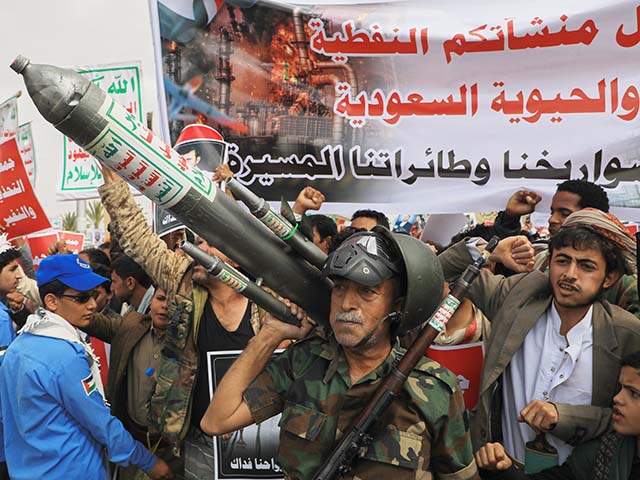
Houthi supporters hold a rally in Sanaa, Yemen, Friday, July 17, 2026, against the Saudi-led coalition. Banner in Arabic reads, “All Saudi oil facilities are targets to our missiles and drones.” (AP Photo/Osamah Abdulrahman)
The Saudis have already been attacked by Iran several times over the past few weeks and have also fended off strikes from Iran’s terrorist proxies in Yemen, the Houthis. Two weeks ago, the Houthis declared a “maritime ban” on Saudi shipping in the Red Sea, potentially blocking an oil shipping route Saudi Arabia was relying upon to bypass Iran’s shutdown of the Strait of Hormuz.
On Friday, Iran’s state-run Tasnim news agency reported that Tehran had prepared a detailed list of targets across the Middle East to attack if the U.S. proceeded with the strikes threatened by Trump.
Iran’s targets purportedly included the Ghawar oil field in Saudi Arabia, which produces about five percent of the world’s oil supply, plus refining facilities in Abqaiq and Khurais, which the Houthis attacked with drones during a previous round of hostilities against Saudi Arabia.
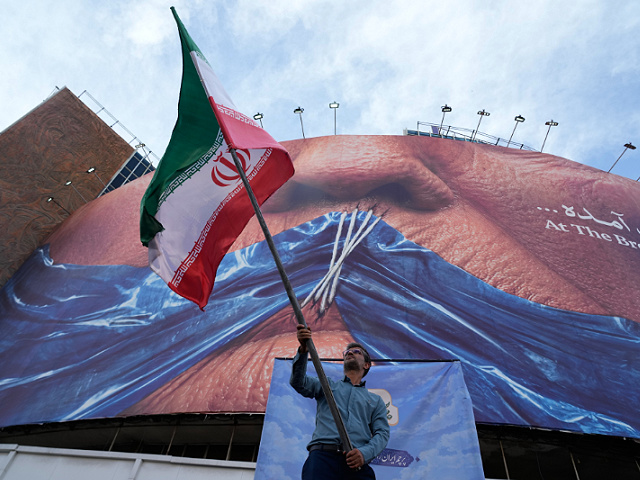
A man waves an Iranian flag for a pro-government campaign under a billboard with graphic showing Strait of Hormuz and sewn lips of U.S. President Donald Trump in a square in downtown Tehran, Wednesday, May 6, 2026. (AP Photo/Vahid Salemi)
According to Tasnim, Iran’s blueprint for revenge also included bombing the Zakum oil field and Ruways refinery in the United Arab Emirates (UAE), the Burgan oil field in Kuwait, the Sitrah refinery in Bahrain, and the Ras Laffan gas field in Qatar – plus Israel’s Leviathan and Tamar gas fields.
“We have prepared a comprehensive plan to respond to any potential American recklessness,” said a senior Iranian security official quoted by Tasnim.
Axios reported on Saturday that Iranian Foreign Minister Abbas Araghchi told his Saudi counterpart that “any hostile action by the U.S. or Israel” would “be met with a decisive and proportionate response from Iran’s powerful armed forces.” The implication was that Araghchi either threatened the Saudis with heavier attacks or convinced the Saudis that a more high-intensity war in Iran would threaten their interests.
Former U.S. defense official Dana Stroul told India’s NDTV that the Saudis are worried about getting drawn into another bloody and expensive stalemate against the Houthis in Yemen, having forged an uneasy truce in 2022 after years of leading a multi-state intervention in the Yemeni civil war that won Riyadh little except grief from the international community over civilian casualties from its airstrikes.
“Saudi Arabia learned the hard way — after years of war — that military force alone was not sufficient to address the Houthi threat from Yemen,” Stroul said.