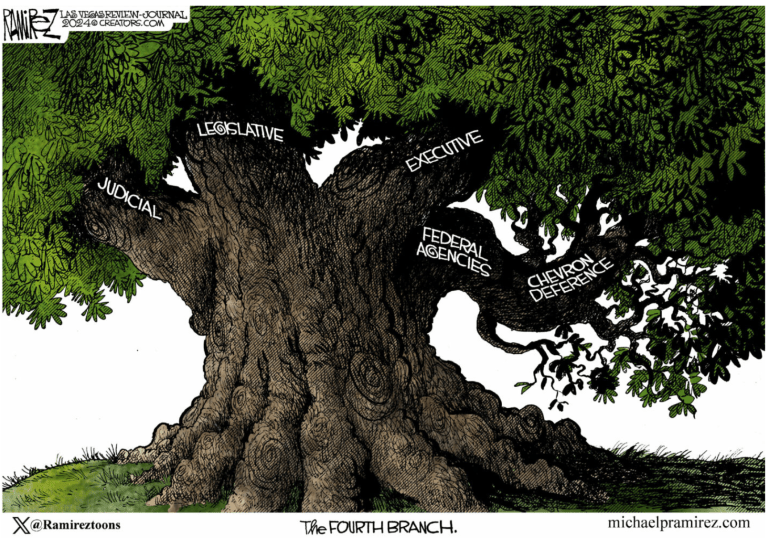
Over the past century, American life has been increasingly shaped by a variety of “alphabet soup” agencies — the SEC (Securities and Exchange Commission), EPA (Environmental Protection Agency), FDA (Food and Drug Administration), to name just a few — whose growing influence has upended the country’s delicate constitutional balance.
Aided by a derelict Congress and a series of past Supreme Court rulings, these administrative state agencies have gone beyond simply enforcing and implementing laws passed by Congress and have instead been accumulating significant executive, legislative, and judicial power.
Small-government conservatives and libertarians have decried this new “fourth branch” of government, arguing that administrative agencies staffed largely by unelected bureaucrats risk undermining our system of representative democracy. And yet, they undoubtedly play an important role in American politics: insulated from political pressure and popular passions, agency officials bring subject-matter expertise to bear on niche questions of public policy far too technical for elected representatives to adequately answer.
How, then, do courts uphold the Constitution’s separation of powers by reining in the administrative state without destabilizing America’s political and economic institutions?
Taking on that question, the Supreme Court has over the past few years chosen to strip administrative state agencies of many of the protections they’ve enjoyed and redistribute their powers among the three constituent branches of government.
To take one example, in the 2022 case, West Virginia v. EPA, the Supreme Court introduced its “Major Questions Doctrine,” holding that on issues of major political and economic significance, agencies may not act absent a clear congressional delegation of power. Applying this doctrine, the court has dealt blows to both Democratic and Republican administrations. In Biden v. Nebraska (2023), the court struck down President Joe Biden’s student loan forgiveness program, while this term, the court held in Learning Resources Inc. v. Trump that President Donald Trump’s sweeping tariffs weren’t authorized by the International Economic Emergency Powers Act.
A majority of the court’s cases concerning the Major Questions Doctrine have been decided along ideological lines, but a closer look at the vote tally in individual cases reveals significant disagreements among the Republican-appointed justices. While they find common ground in their distaste for broad congressional delegation to administrative state agencies, they disagree on how the Major Questions Doctrine may be squared with the president’s inherent, Article II executive power.
While the Democrat-appointed justices — Sonia Sotomayor, Elena Kagan, and Ketanji Brown Jackson — have criticized the doctrine’s “anti-administrative state” stance on issues of domestic policy, Justices Clarence Thomas, Samuel Alito, and Brett Kavanaugh expressed their view in Learning Resources that the Major Questions Doctrine shouldn’t apply in the realm of foreign affairs, arguing instead that Congress should be free to grant “flexibility and discretion to the president to pursue America’s interests” in this area. Writing for the dissenters, Kavanaugh noted the “unwisdom of requiring Congress in this field of governmental power,” referring to foreign affairs, “to lay down narrowly definite standards by which the president is to be governed.”
Justice Thomas went even further in Learning Resources, arguing that Congress may delegate non-core legislative functions — those that don’t implicate life, liberty, or property — to the president, including the power to regulate foreign commerce.
Looking beyond the Major Questions Doctrine cases, Justices Thomas and Alito also voted in favor of the president in both Trump v. Cook and Trump v. Slaughter — the presidential removal power cases concerning the Federal Reserve and the Federal Trade Commission respectively — leading some commentators to suggest that at least two members of the Court are interested in creating an unchecked, “imperial” presidency. If that is true, then their fellow conservative justices have placed two types of obstacles in their way.
First are the philosophical arguments rooted in separation of powers principles, best articulated by Justice Neil Gorsuch. Concurring in Learning Resources, he expressed sympathy for Kavanaugh’s view that the president enjoys broad discretion over foreign affairs, but crucially, identified an outer limit of that power: where the president claims power that is derived from and constitutionally vested in Congress, the Major Questions Doctrine must apply.
Gorsuch also critiqued Thomas’ expansive view of Congressional delegation, pointing out that under his criteria, Congress could effectively delegate away most of its enumerated powers, leaving it a vestigial organ of government.
Building on that argument, Gorsuch penned another concurrence in Trump v. Slaughter, reminding his colleagues that while the Constitution confers upon the president a broad power to remove subordinate executive branch officers at will, the president’s newfound power over the administrative state’s “vast legislative and judicial power” must be checked by a court that consistently enforces the Major Questions Doctrine and devises a robust Non-Delegation Doctrine.
The second set of obstacles is more prudential in nature. Writing for the court in both Cook and Slaughter, Chief Justice John Roberts carved out a Federal Reserve exception to the president’s removal power, holding that the Fed’s long history of independence had to be maintained to allow it to pursue its “mandate of ‘maximum employment, stable prices, and moderate long-term interest rates.’” Kavanaugh joined Roberts in Cook, making a point to emphasize the Federal Reserve’s “critical responsibility for the stability and success of the U.S. and world economies.” To these justices, abstract principles must be squared with the realities of contemporary American politics.
Conservatives will be pleased that the Supreme Court has systematically stripped the modern administrative state of its many powers and protections, but cases from this term suggest that in this new constitutional epoch, there is no theory of presidential and congressional power that unifies the Supreme Court’s conservative supermajority. As different theories vie for primacy, it remains to be seen which one will emerge victorious, and how that will tangibly impact American society.
Nikhil Agarwal is an incoming J.D. candidate at Columbia Law School.
Views expressed by guest contributors to Issues & Insights are their own and don’t necessarily reflect the views of the I&I Editorial Board.
Support Independent Journalism
Issues & Insights was founded by seasoned journalists from the IBD Editorials page. Our mission is to provide timely, fact-based reporting and deeply informed analysis on the news of the day — without fear or favor.
We’re doing this on a voluntary basis because we believe in a free press and because we aren’t afraid to tell the truth, even if it means being targeted by the left.
We are 100% reader supported!!
If you like what you see, please feel free to donate.

And be sure to tell your friends!