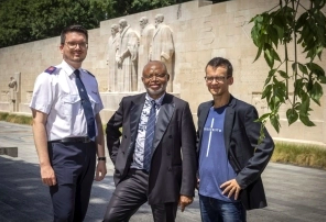
Three evangelical leaders have filed a lawsuit challenging a recent constitutional amendment in Switzerland that bans lawmakers in the Canton of Geneva from wearing visible religious symbols, the Swiss Evangelical Alliance announced on Monday.
Geneva’s cantonal parliament, the Grand Council, narrowly passed the constitutional amendment on Nov. 21, before Geneva citizens officially approved the religious symbol ban with a 51.4 percent majority in a public referendum on June 14.
The new restriction applies to members of Geneva’s cantonal parliament, known as the Grand Council, as well as municipal councils.
Michael Mutzner, director of the Christian Public Affairs Association and a local church president, filed the lawsuit alongside Markus Hofer and Joseph Kabongo. Hofer represents the World Evangelical Alliance at the United Nations as an accredited representative, while Kabongo is a theologian and retired pastor with the Evangelical Party.
Mutzner argued that Christians must defend religious freedom for all faith communities, not just their own.
“Religious freedom is either for all, or, ultimately, for no one,” said Mutzner. “When the rights of one religious community are restricted, the freedoms of all communities become more fragile. It’s a slippery slope. For Christians, this is a matter of loving our neighbor and wanting for others the same freedom we want for ourselves.”
Such rights are also in Christians’ interests, he said.
“History shows that once fundamental freedoms are weakened for one group, they rarely stop there,” he said. “Defending the rights of others today helps safeguard the freedoms of everyone tomorrow.”
According to Mutzner, local measures in Geneva intended to limit Muslim street prayers have already impacted Christian churches. For example, some evangelical churches can no longer hold baptisms in Lake Geneva because authorities reserve the necessary permits exclusively for state-approved religious communities.
Mutzner cited the biblical passage 1 Timothy 2, which urges believers to pray for authorities so that citizens can live peaceful lives. He urged fellow evangelicals to pray for politicians, court wisdom and a society that values freedom, justice and mutual respect.
He also encouraged speaking up peacefully whenever anyone’s fundamental freedoms face a threat, regardless of which religious community suffers the restrictions. Finally, he called on Christians to live out the gospel with humility and love, stating that defending religious freedom protects individual conscience rather than special privileges for Christians.
The Swiss Evangelical Alliance opposed the ban in its statement, arguing that the amendment curtails fundamental rights. The group noted that while it supports a secular state that guarantees neutrality and religious peace, secularism should not suppress religious beliefs in democratic spaces.
Unlike civil servants who directly embody the state, parliamentarians represent the diversity of their voters, the Alliance stated. Forcing elected officials to conceal their religious beliefs severely limits religious freedom and raises serious questions regarding the Swiss Federal Constitution.
The evangelical alliance emphasized that freedom of religion protects believers and non-believers alike. In a pluralistic democracy, citizens must retain the right to elect representatives who openly stand by their religious, philosophical, or political convictions.
The evangelical alliance previously fought a similar restriction in the 2019 Geneva Secularism Act. A court ultimately overturned that restriction following opposition from the group. Ongoing baptism restrictions at Lake Geneva are unacceptable to the alliance. The group noted that the rules force some Christian communities to travel to the neighboring canton of Vaud or to France to hold their services.
Religious freedom must apply in public spaces as long as citizens respect public order and the rights of others, said the group.
The Swiss Evangelical Alliance will closely monitor proceedings before the Constitutional Chamber of the Geneva Court. The group warns that the final decision in Geneva will likely influence similar political efforts across other Swiss cantons.