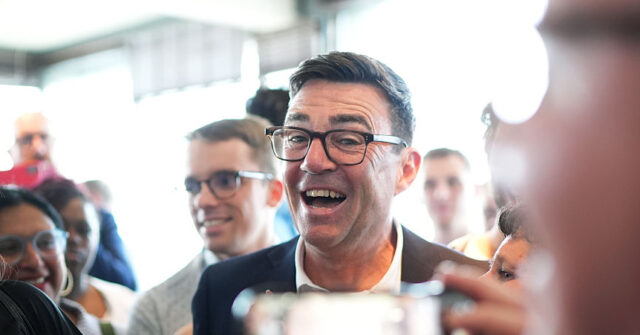
The new British government must “prioritise” funding the three-way treaty nuclear submarines being built with the United States and Australia and not “backload” defence investment to support the “living architecture of a free and secure world”, the U.S. Ambassador told Prime Minister Andy Burnham.
Failure to invest in defence and the very obviously perilous state of Britain’s Armed Forces was one of the largest and longest-running scandals of the Starmer era, and as the failed Prime Minister stands aside for incoming leader Andy Burnham, the Trump administration was quick to remind the new leader to take fast action on overcoming the last administration’s failures.
U.S. Ambassador to the UK Warren Stephens took to The Times of London — Britain’s newspaper of record — to spell out the importance of the United Kingdom not welching on its role in the ‘AUKUS’ submarine programme. A joint endeavour between Australia, the United Kingdom, and the United States, the project intends to considerably improve the presence of Anglophone military power in the Asia-Pacific region.
British and American nuclear submarines are to be permanently based out of Australia, while Australian naval crews are to train with British and American submarines to bring them up to speed, leading to a stopgap sale of second-hand U.S. nuclear submarines to Australia the end of this decade, followed by a new joint Anglo-Australian class of nuclear Submarines.
Ambassador Stephens said, in an article that touched on article only briefly but which otherwise was dominated about the importance of Britain and Australia helping keep the peace in Asia that while there was a financial cost associated with these plans, it brought benefits. In a not particularly veiled attack on the record of the outgoing government, which spent nearly its entire term talking about defence but achieving nothing, and even saw the resignation of its defence minister and highly-placed defence figures going AWOL in frustration, the Ambassador said:
Now more than ever, we must move beyond the rhetoric of partnership and make the sustained investments that transform alliances from agreements on paper into the living architecture of a free and secure world. At the end of the day, the high cost of defence spending is worth it, especially when it ensures your citizens will remain safe, prosperous and secure.
He went on:
This financial investment also must be sustained and renewed so we may enhance the Aukus programme for years to come… Prioritising funding for Aukus will fuel our aggressive approach…
Aukus will ensure our countries are safer, stronger, and more prosperous. The United States is proud to stand alongside Britain and Australia, two of our closest partners, but we must not allow our efforts to be held up by backloaded investment or other spending priorities.
While incoming Labour Prime Minister Andy Burnham has been keener to emphasise voter-friendly policies on his final approach to power and has had little to say on defence, he did write an article earlier this month — again in that journal of the British establishment, The Times — promising to use any future defence investment to buy from domestic businesses, to drive economic growth at home.
The article did not mention Australia, the AUKUS alliance, or submarines once but did at least affirm a commitment by the left-wing leader to NATO, the UK’s nuclear deterrent, and the United States. Expressing that he may, in fact, understand something of the crisis facing Britain in defence in a year where its most critical force the Navy has been revealed as only semi-functional, Burnham wrote: “…it is right that we rebuild our hard power for a new era that is very different to the one in which much of our current military equipment was first designed”.
Defence is just one area in which the United Kingdom severely lags behind not just its allies but also its former self. Others frequently brought up by President Donald Trump and his emissaries are energy policy — particularly the UK’s refusal to make use of its own abundant domestic energy reserves under ‘net zero’ ideology’ — and mass migration. President Trump himself once again reminded the UK over the weekend and particularly the incoming Prime Minister that the answer to many of the country’s cost of living crisis issues lies close at hand, if only the government would be willing to use cheap energy.
Imploring Britain to ‘drill baby drill’ and make use of bountiful North Sea oil, President Trump wrote on Truth Social over the weekend in an optimistic message addressing rumours in the British press that Prime Minister Burnham may actually permit some new oil and gas drilling to say: “It is one of the Greatest Sources of quality Oil on Earth, has hundreds of years of Capacity left, with much not even found yet, and will make the United Kingdom, from a Poverty Stricken Disaster, to one of the Richest Countries anywhere in the World!”.
Observing that Britain presently pays to buy oil from Norway which is also drilled in the North Sea — “How ridiculous is that!” — the President expressed his love for Scotland and emphasised: “Such great potential in the UK, but it all starts with OPENING NORTH SEA OIL.”