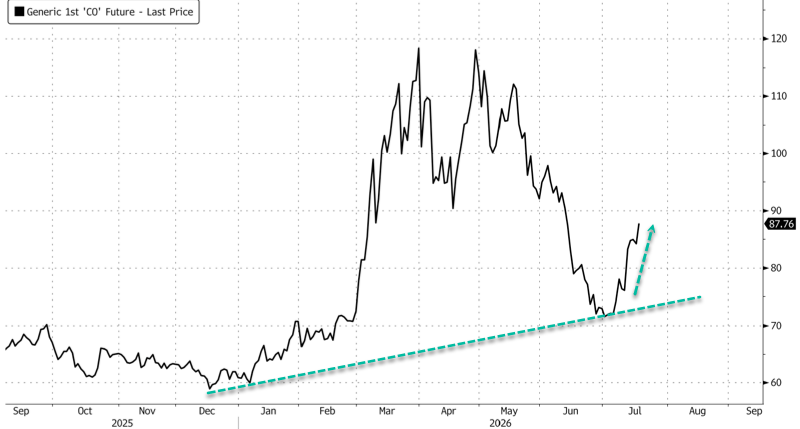
Brent crude futures jumped a little more than 4% to nearly $88 a barrel, putting the crude oil benchmark on track for its biggest weekly gain since April. That move followed an Axios report that said the Trump administration had notified Israel it was deploying additional aerial assets to the region, signaling the US military could expand strikes on Iran as soon as this weekend.

Financial Times spoke with energy traders at the end of the week who warned that slowing tanker traffic through the Strait of Hormuz could trigger a more severe supply crunch than the first round of the US-Iran war because emergency reserves and stockpiles around the world that cushioned the earlier disruption have been mostly depleted.
“We’ve burned through all of the buffers we had. Everything,” said one trader. “All of that’s now gone.
Related:

Bloomberg noted:
Fuel markets strengthened again, with the ICE gasoil crack closing at the highest on record and the Nymex heating oil crack the strongest since March. More narrow Brent put spreads around the low $70s traded in sizable numbers.
Earlier today, the International Energy Agency revealed that member countries released three-quarters of the planned 400 million-barrel emergency reserves announced in March.
Amrita Sen, founder of Energy Aspects, pointed out that heading into the US-Iran war, the global oil market had around 400 million barrels of excess inventories, not including strategic reserves controlled by governments.
“Now we have close to nothing … and market complacency around Hormuz flows is being severely tested,” Sen warned.
Strait crossings hit three week low
Strait of Hormuz traffic continued to weaken on 16 July, with confirmed crossings falling to eight, the lowest level in three weeks. Seven of the eight transits used the Iranian route, highlighting a growing concentration of movements through… pic.twitter.com/YEA63ZGkVJ
— Kpler (@Kpler) July 17, 2026
UBS analyst Henri Patricot wrote in the daily “Hormuz tracker” note that further Hormuz escalation has occurred, Gulf tanker crossings remain limited, and there is a sharp pullback in Gulf loadings:
Further escalation
The conflict in the Middle East is escalating further as Iran reportedly targeted power plants and desalinisation plants in Kuwait. Previous strikes had focused on US military targets. These followed US strikes on bridges and an airport in Iran.
Limited Gulf tanker crossings
Increased attacks continue to weigh heavily on flows via Hormuz. The latest UBS Evidence Lab data (> Access Dataset) show that oil and gas tanker crossings fell to one, with only one product tanker entering the Gulf (Figure 1).

July-to-date crossings have averaged 10, down from the mid-to-high teens recorded in late June and early July, and remain well below the c.50 level seen in February. Oil on water in the Gulf is ticking up again, up ~5Mb in recent days (Figure 10).

The absence of outbound oil and gas flows takes the July average down to 5.4Mboe/d, compared with 3.7Mboe/d in June and 1.3Mboe/d in May (Figure 4).

Capacity entering the Gulf fell to 0.7Mboe/d and has averaged 5.2Mboe/d month to date (Figure 5).

Meanwhile, flows via the Bab al Mandeb Strait have not been disrupted so far and increased further to 9.7Mb/d yesterday, above the July-to-date average of 6.7Mb/d.
A sharp pullback in Gulf loading
Gulf crude loadings ex-Iran fell sharply to 1.0Mb/d yesterday from 6.0Mb/d on Wednesday, with the past-week average at 3.2Mb/d vs 5.1Mb/d in July and 3.4Mb/d in June. Iranian loadings rose to 5.0Mb/d yesterday, lifting the July average to 1.5Mb/d, still below the typical 1.7-1.8Mb/d range, but above June’s 0.8Mb/d (Figure 9).

Crude loadings at ports outside the Strait (Yanbu in Saudi Arabia and Fujairah in the UAE) eased following a sharp rebound, falling to 3.6Mb/d yesterday below the July-to-date average of 5.9Mb/d and June’s 6.9Mb/d. Yanbu declined to 2.7Mb/d, below the month-to-date level of 4.2Mb/d and June’s 4.8Mb/d. Product loadings inside the Gulf remain close to May-June levels (Figure 15).

The normalization pathway of tanker flows appears to have been disrupted as the US and Iran become locked in an escalation spiral, with neither side willing to back down. Any sustained reopening of the Strait of Hormuz has now been postponed.

With or without Tehran’s cooperation, US-allied Gulf countries are in the beginning innings of what we’ve described as a “great energy rewiring” to bypass the Hormuz chokepoint.

Latest:
- Great Rewiring: US Supports Iraq-Syria Oil Pipeline To Erode Tehran’s Hormuz Leverage
- Dubai’s New East Coast Port Signals The Beginning Of End For Iran’s Hormuz Leverage
- “Zero Hormuz Dependency”: UAE Races To Rewire Energy Flows, Bypassing Chokepoint Chaos
- Hormuz Bypasses Maxed Out: Saudi East-West Pipeline Hits Record 7 MMb/d, As UAE Fujairah Crude Loadings Reach Capacity
“Ultimately, the market was pricing an optimistic flow trajectory that now is clearly not on the table, at least . . . not until we get another round of diplomacy,” Natixis Bank analyst Joel Hancock wrote in a note.