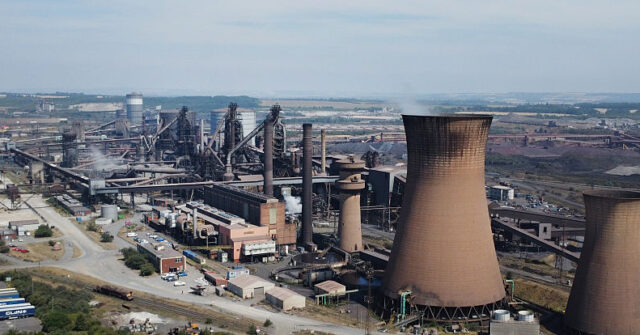
The UK has nationalised British Steel, the final functioning virgin steel-producing mill in the UK, after it was bought by a Chinese Communist Party-linked company that seemed determined to shut it down.
The Scunthorpe steelworks has been nationalised after the assent of the Steel Industry (Nationalisation) Act to law, effectively confiscating British Steel Limited from its Chinese owner Jingye Group. The UK’s Labour government acknowledged taking on the debt-laden and unprofitable steel mill was an “expensive” decision, but said it was one of strategic importance and that it had saved 4,000 jobs.
The government first took control of the Scunthorpe plant last Spring, urgently recalling Parliament to pass emergency legislation to wrestle day-to-day running of the plant from its Chinese owner over the belief they intended to shut down its two blast furnaces. Because the molten slag inside blast furnaces cools and solidifies if they are ever allowed to be turned off, this effectively renders them useless and they can’t be restarted without enormous cost and effort, meaning until the takeover China had life-and-death control over the very little remainder of Britain’s sovereign steel capacity.
It is believed Whitehall has spent the past year seeking a business buyer to take on control of Scunthorpe, but now it will be in public ownership. Remarkably, it is not yet clear whether the Chinese owner Jingye will even be compensated by the government after the expropriation of the steel plant, given British Steel is laden with debts and is unprofitable, so its liabilities may be greater than its assets.
The government said in a statement an “independent evaluation” would make this decision in due course. Jingye has previously demanded £1 billion for the company, against a British government officer of £100 million. The Chinese company’s assertion that it is losing a valuable asset is challenged by the fact the company was apparently willing to let the furnaces go cold and abandon the business last year before the government intervened.
Britain’s Reform UK Party, which is best known for its strident positions on mass migration and government failure but which at times defies expectations on right wing economic policy, declaring that capitalism is over and that governments must now tackle the danger of corporatism, has long advocated for nationalising British Steel to deny China control. Reform Member of Parliament Richard Tice said compensation paid to China should not exceed one Pound Sterling, about a Dollar-thirty.
He said:
I’ve been saying for seven years we need to take British Steel back into public ownership, and invest in it, invest in rebuilding the blast furnaces so they’re good for the next 50 years. So it’s the right decision, it’s taken them a bit too long… the key thing is they only pay a pound in compensation because there are massive liabilities that come with this
As reported by Breitbart News when Jingye first bought British Steel:
the company’s site says that the founder and chairman of the Jingye Group, Li Ganpo, a Communist Party member, was a representative of the 11th National People’s Congress, the top legislative branch of the Chinese Communist Party.
In China, the line between public and private industry is often blurred, particularly when it comes to large scale investments, like Jingye Group’s plan to buy British Steel. Indeed, only individuals in good standing with the Communist Party are allowed to run companies in China and must, by law, cooperate with the Chinese military.
These matters of serious concern have impacted other large deals between Chinese and Western business in strategic industries, as governments have reacted to businesses allegedly indirectly controlled by the Chinese state gaining access to major infrastructure and communications systems.
China has long been accused of “dumping” steel on the world market, by subsidising domestic steel industries and exporting steel at “at below production costs”. The UK estimates that Chinese producers actually lose $34 per ton of steel produced.
Chinese dumping led the Trump administration to place a 25 per cent tariff on steel and aluminium from China, a move that has led to an increase in manufacturing jobs, particularly in communities that had been negatively impacted by decades of free trade.
While Britain’s Labour government has indeed moved to match Reform’s calls to nationalise, there is no agreement between the two parties on what comes next. Britain’s Labour party is utterly captured by net-zero philosophy and intends to shut down the blast furnaces anyway — albeit at a later date — because they are polluting, intending to replace them later with electric arc furnaces.
While these produce fewer emissions, they require a huge amount of electricity to function and can’t yet produce true, virgin, high grade steel and are more typically used to produce lower grade recycled steel. Reform, on the other hand, have not only proposed modernising the blast furnaces to keep Britain producing high quality steel for decades, but would even re-open coal mines to power them and reduce dependence on imports.
The Conservative Party moved to criticise Labour’s long-term steel plans today given how government policy prevents Britain from creating abundant, cheap, sovereign electricity. Andrew Griffith, the Tory business spokesman, said: “you can’t fix steel without ditching Labour’s ruinously high energy costs.”
The steel plant nationalisation is just the latest by the government to secure strategic national assets against being bought by foreign concerns or lost to market forces. This week, the government bought a fuel terminal in the west of Scotland to secure it for the use of the Royal Navy and the previous Conservative government nationalised a specialist forging business in Sheffield.
One of Britain’s oldest businesses and tracing its roots to the very dawn of the Industrial Revolution, Sheffield Forgemasters was struggling to compete against Chinese steel dumping on the global market but was nevertheless essential to British military projects including building nuclear submarines and artillery barrels.