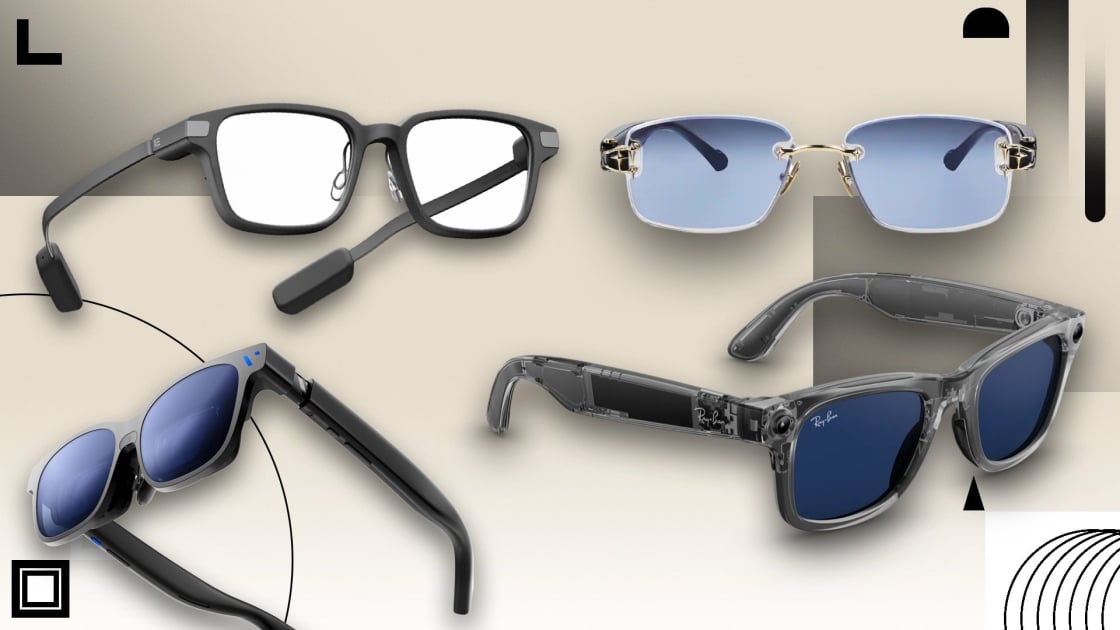
Smart glasses are exactly what they sound like: eyewear with built-in technology designed to do more than a traditional pair of glasses. The challenge is that the term “smart glasses” covers a surprisingly broad range of products. Some models include built-in speakers for audio, while others don’t. Some feature displays or augmented reality capabilities, while others rely entirely on audio. Some include cameras, AI assistants, or other connected features, and some offer none of these.
That wide range of capabilities makes the category difficult to define. Unlike phones or laptops, smart glasses don’t have a clear set of standards or categories that manufacturers consistently follow. There’s no universal definition of what features a pair of smart glasses should include, which means devices with dramatically different capabilities can all fall under the same label.
I’ve used every major type of smart glasses currently available, from simple audio-focused frames to more advanced AR-style devices. That experience makes it easier to explain how these products actually differ in everyday use—not just how their specifications compare on paper.
It All Comes Down to Features
Smart glasses can have any number of different capabilities, and that’s where to start when both identifying and shopping for them. So, let’s run through all of the different things smart glasses can do before we start putting them into buckets.
AI: The Core Interface for Most Smart Glasses
AI is the primary way most smart glasses are intended to interact. You don’t need to touch your phone or the glasses themselves, just activate the AI assistant with a wake word and talk to it. Nearly all smart glasses have some form of AI assistant, like Meta AI on Ray-Ban Meta models or Gemini on Samsung’s upcoming Android XR glasses with Warby Parker and Gentle Monster. Some glasses let you choose your AI assistant model, like the Rokid Glasses.
If you don’t want to engage with the AI assistant on these glasses, you usually don’t have to. Between companion apps on your phone and the physical controls on the glasses themselves, you can still use most individual functions like playing music, making calls, and taking photos without saying a word. But the AI is there if you want to ask a question.
Audio: The Most Common Smart Glasses Feature
This is the most common feature in smart glasses. With only a few exceptions, almost every pair you can buy will have speakers built into the temples that work as earphones, letting you hear anything from music to AI-powered translations. They’re almost always paired with pinhole microphones for using voice assistants or making calls.
Speakers on glasses can sound very clear in quiet environments, but they can’t compete with good in-ear earphones. Because there’s open air between the speakers and your ears, they can’t convey lower frequencies well, and anything you’re listening to can be easily heard by anyone who’s close.
Cameras: Capture, Context, and Privacy Trade-Offs

The Ray-Ban Meta Gen 2 glasses, with a capture light and camera in the top corners (Credit: Andrew Gebhart)
Many smart glasses feature built-in cameras for a variety of uses. The most obvious and direct purpose is to take photos and videos without having to touch your phone. This is handy for sharing what you’re doing on social media, but it’s a double-edged sword: Some people have been using camera-equipped smart glasses to creep on women and record them without their consent.
Cameras also expand the functionality of any AI assistant built into smart glasses. They can use machine vision to analyze whatever you’re looking at to help you identify a flower or translate a menu. Of course, as with surreptitious snapshots, using AI to scan everything around you can raise privacy concerns.

Photos taken with the Ray-Ban Meta Gen 2 (Credit: Andrew Gebhart)
Finally, on certain prism display glasses, cameras enable or enhance head-tracking features, serving a similar purpose as the outward-facing cameras on mixed reality headsets like the Apple Vision Pro and the Meta Quest 3.
Displays: The Most Confusing Smart Glasses Feature

The Meta Ray-Ban Display’s waveguide screen in action (Credit: Will Greenwald)
This is where smart glasses can get very confusing. Only some smart glasses have an in-lens display, and there isn’t any universally agreed-upon language to distinguish them from models that don’t. Even worse, there are two distinct display types for smart glasses, each representing wildly different use cases.
All smart glasses with a display use micro-projectors built into the frames that project an image through the lens and into the eye. The difference is how the lens redirects that image, and that determines the type of display and the type of glasses. I’ll go into more detail below, when I discuss the types of smart glasses, but for now, be aware that there are generally two types of smart glasses displays: waveguide and prism.
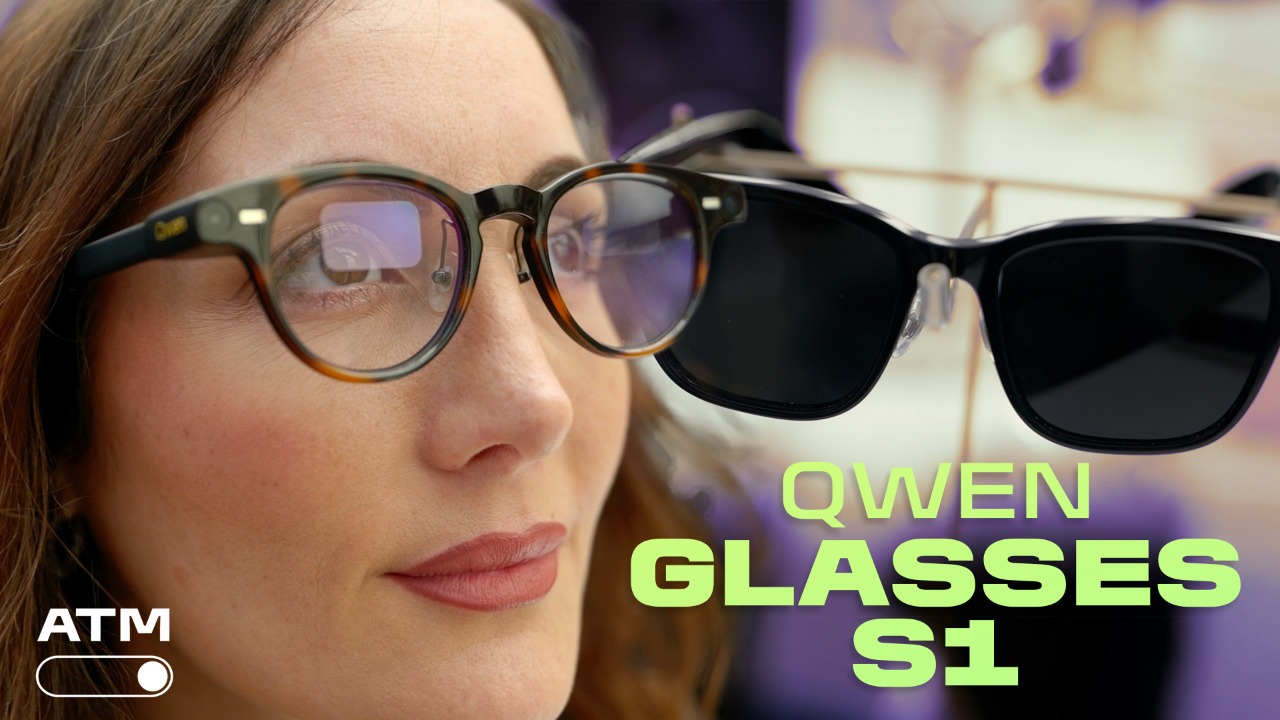

Meta, who? These Qwen smart display glasses will amaze you | All Things Mobile
Electrochromic Lenses: Instant Tint and Color Control

The Chamelo Music Shield glasses offer adjustable tint (Credit: Will Greenwald)
Electrochromic lenses are a rare feature on smart glasses, but they can be a lot of fun. They’re lenses that use a special film that can darken, lighten, or even change color when an electric current passes through them. Think of them as the push-button version of Transitions and other photochromic lenses that change when exposed to sunlight, only they dim and clear up instantly instead of over several minutes. Some can even change colors.
The Main Types of Smart Glasses
Now that you know what smart glasses can potentially do, let’s talk about the different kinds. There are no universal terms for smart glasses, whether they have AI, audio, displays, or any other features, but we can safely put them into four buckets. Or rather, three buckets with one encompassing a smaller subcategory. Those include: AI glasses (with waveguide glasses as a subcategory), prism display glasses, and all other smart glasses. That last bucket is largely comprised of generic, single-purpose models meant for audio, fashion, or photography, with no AI.
AI Glasses: Virtual Assistance on Demand

The Ray-Ban Meta Gen 2 glasses look completely normal but feature a camera lens in the upper left corner (Credit: Andrew Gebhart)
Most smart glasses you hear about and see in the wild today are generally called AI smart glasses. They’re audio-only, offering voice access to an AI assistant. The AI is up to the manufacturer, as is how much control you have over them: Meta smart glasses use Meta AI, Amazon’s Echo Frames use Alexa, Samsung’s upcoming Android XR-powered smart glasses have Gemini, and AI glasses from other companies like Rokid and Solos tend to use ChatGPT, Alibaba’s Qwen, or an in-house combination of multiple LLM models, sometimes with the ability to choose from multiple models yourself.
The Best AI Smart Glasses


Music playback and phone call capabilities are almost always universal features on AI glasses, and built-in cameras for both capturing content and interacting with machine-vision AI features are very common.
These glasses connect wirelessly to your phone over Bluetooth. They generally have to always be online to provide any information, but you can usually treat them like headphones and listen to downloaded music or podcasts even if your phone isn’t connected to the internet.
Waveguide Display Glasses: Seeing Information in Your Lens

The camera-free, speaker-free Even Realities G2 glasses have a waveguide display that’s barely visible to anyone but the wearer (the slight rectangular glint in the lenses) (Credit: Will Greenwald)
Technically speaking, waveguide display glasses are a subset of AI glasses. In fact, Meta refers to both the Meta Ray-Ban and Meta Ray-Ban Display as “AI glasses.” That’s because they’re basically AI glasses with a waveguide display built into the lenses. They wirelessly connect to your phone and provide voice-based assistance, like audio-only AI glasses, but you can get your answers in text, maps, diagrams, and sometimes even photos. The display really is a game-changer for smart glasses, which is why I tend to put them in their own category.
The Best Waveguide Smart Glasses


Waveguide displays use etched patterns on flat, transparent lenses to guide projections into your eyes. These waveguide lenses are often the only ones built into the frames, which lets smart glasses in this category be almost as thin and light as eyewear without a display. And, because you can easily see through the lenses, they’re safe to wear while moving around, offering a completely unimpeded view of your surroundings. The trade-off is that waveguide displays are generally low-resolution and have a relatively narrow field of view, and are often monochrome green rather than full color. The Even Realities G2’s display is all-green, 640 by 350 pixels, and 27.5 degrees, while the Meta Ray-Ban Display is full color and 600 by 600 pixels, but only has a 20-degree field of view.

The view through the lens of the Captify Pro, providing live captions to movies, TV, and conversations (Credit: Will Greenwald, RedLetterMedia)
Whether you’re in another country or simply hard of hearing, live captions and subtitles are incredibly useful. Most waveguide smart glasses can listen to any speech around you and display it as text, even translating it from other languages into your own. Those features are so helpful that Captify Pro is designed exclusively for AI transcription and translation, without providing a full AI assistant.
Depending on the model, waveguide display glasses can also show general information, such as weather reports and stock charts, and display notifications so you can identify incoming calls or messages without looking at your phone or smartwatch. I found push notifications for Slack on the Even Realities G2 to be really convenient when I covered CES, and the much more limited third-party app support on the Meta Ray-Ban Display is a big reason I was much less enthused by it, and didn’t bring it to Vegas.
These glasses can also have navigation features, sometimes even with maps. I’ve always wanted a video game-like mini-map in the corner of my view when walking around, and the Meta Ray-Ban Display’s navigation function is the closest I’ve gotten to it.

The Even Realities G2’s navigation view (Credit: Will Greenwald)
Visual feedback adds a lot of additional use cases that audio-only AI glasses simply don’t have, to the point that some, like the Captify Pro and Even Realities G2, don’t even have audio output and only respond to you through the in-lens screen. Those two models also purposefully don’t have cameras, either.
For all this potential, waveguide display smart glasses are still in their early stages, and every model I’ve reviewed has been too limited, awkward to use, or buggy to recommend without major caveats. I’m optimistic that Android XR will enable future waveguide smart glasses to offer much more consistent and reliable features, but none have been officially announced yet.
Prism Display Glasses: A Portable Private Screen

The Viture Beast, showing the large prism lenses behind the outward-facing lenses (Credit: Will Greenwald)
Now, this is the type of smart glasses that I’ve come to swear by. They’re by far the bulkiest and most cumbersome smart glasses, but they’re also the simplest to use, and their utility for both entertainment and work can’t be overstated. They’re often (incorrectly) described by their manufacturers as augmented reality (AR) glasses, but the better term for them is prism display glasses.
Prism display smart glasses use chunky prism lenses mounted behind thinner exterior lenses to bounce the projected image into your eyes. This design enables a sharp, full-color picture with a very wide field of view, comparable with viewing a big-screen TV from a couch or a movie theater screen from a few rows back. The prism display on the Viture Beast is 1,920 by 1,200 pixels with a 58-degree field of view. That’s the equivalent of a 174-inch screen viewed from 13 feet away. In other words, you put them on and get your own private large-screen display.
There are some major trade-offs that put prism display smart glasses in a very different camp from waveguide display and audio-only AI smart glasses. They’re significantly bulkier, and the prism lens can obscure your vision even when the display is turned off, so you shouldn’t really be walking across the street with them on your face.
The Best Prism Smart Glasses


Prism display glasses also require a wired connection to work. They connect to a phone, tablet, computer, or any other compatible device via DisplayPort over USB-C, delivering all audio, video, and power. They act like a USB monitor, projecting the device’s video output onto your eyes and playing its audio through your ears.
These are wearable displays more than anything else, and since they rely entirely on their connected device, they don’t have any AI features on their own. They usually have a simple interface for adjusting settings, but that’s about it for direct interactivity. This is why these so-called AR glasses aren’t really AR: They don’t actually augment anything based on the world around you, and only serve as private screens for your device of choice.
Basic prism display glasses like the RayNeo Air 4 Pro and Viture Luma simply show a screen in front of your face that moves with you as you turn your head, which is fine enough on its own. However, more advanced prism display glasses like the Viture Beast and the XReal One Pro and 1S incorporate built-in head tracking, enabling multiple picture modes that can make them much more immersive and useful. Those glasses can set the virtual screen in front of you relative to where you’re sitting, so it stays in place even as you move your head. They can also keep the display locked in front of your eyes, but make the picture trail behind slightly and move more smoothly to prevent motion sickness. My favorite head-tracking feature is an ultrawide mode that turns a 16:9 or 16:10 display into a 21:9 or 32:9 ultrawide display when connected to a computer. I need at least two monitors or an ultrawide monitor (at home, I use both) to get much work done, and prism display glasses with an ultrawide mode let me do that anywhere.
High-end prism display smart glasses often also feature electrochromic lenses. Their exterior lenses (not the prisms that redirect the projected display) can darken to block out distractions and greatly improve the contrast and vividness of whatever you’re watching.
The “Other” Category: Purpose-Built Smart Glasses

The Chamelo Aura, showing four different tint colors (Credit: Will Greenwald)
There are several smart glasses that don’t fit into the typical categories of AI glasses, waveguide display glasses, or prism display glasses.
Some smart glasses, like ones made by Chamelo, focus almost exclusively on electrochromic lenses and eschew most other features. They’re stylish and striking, since you can lighten, dim, or change the colors of the lenses with a tap, but not much else. The Chamelo Dusk and Music Shield can dim at your command and also play music, while the Chamelo Aura is a unique color-changing model with no other functions. The Aura doesn’t even connect to your phone in any way; the lenses are controlled by a touch-sensitive button on the frame, and that’s it.
The Best of the Rest
Also in this “other” category are the many cheap, generic smart glasses online or at various discount stores that only play music and/or take photos and videos. Some even have basic AI features, but we haven’t confirmed how well they work, if at all. I don’t really review these, and they should always be approached with an attitude that you get what you pay for. If you see smart glasses for less than $100, expect mediocre sound quality, photos, or videos.
The Future of Smart Glasses
Looking ahead, smart glasses are clearly moving toward a convergence of standalone computing, spatial awareness, and more capable mixed-reality interfaces. Devices like XReal’s Aura hint at this shift, combining prism-based displays with cameras, 6DOF tracking, and an external Android XR-powered controller to create something closer to a lightweight mixed-reality system than a traditional accessory. If this approach matures, it could bridge the gap between today’s phone-tethered glasses and full headsets like the Apple Vision Pro or Samsung Galaxy XR—delivering many of the same interaction models in a form factor that’s far easier to wear, carry, and live with.

Snap’s Specs (Credit: Kimberly Gedeon)
At the same time, competing glasses like Snap’s new waveguide-based Specs show a parallel path focused more directly on augmented reality, with in-lens visuals and environmental understanding built in. They’re technically impressive and point toward true AR glasses, but they still face major hurdles in terms of price ($2,195), design (they look kind of goofy), and everyday usability.
Ultimately, smart glasses are steadily evolving beyond niche accessories into more independent computing devices. Whether prism-based models with rich interfaces or waveguide AR glasses ultimately lead the way, the category is clearly heading toward a future where digital information blends more naturally into everyday vision—without needing a headset or a phone screen to mediate it.
About Our Expert

Will Greenwald
Principal Writer, Consumer Electronics
Experience
I’m PCMag’s home theater and AR/VR expert, and your go-to source of information and recommendations for game consoles and accessories, smart displays, smart glasses, smart speakers, soundbars, TVs, and VR headsets. I’m an ISF-certified TV calibrator and THX-certified home theater technician, I’ve served as a CES Innovation Awards judge, and while Bandai hasn’t officially certified me, I’m also proficient at building Gundam plastic models up to MG-class. I also enjoy genre fiction writing, and my urban fantasy novel, Alex Norton, Paranormal Technical Support, is currently available on Amazon.