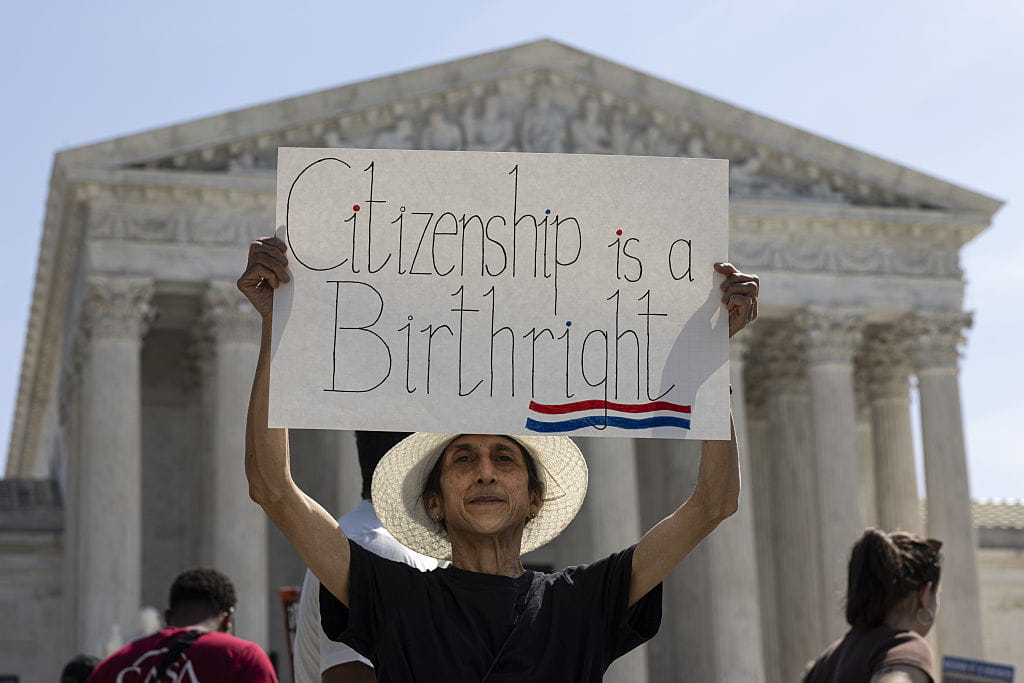
On June 30, the Supreme Court struck down President Donald Trump’s executive order attempting to abolish birthright citizenship, calling it unconstitutional. Trump signed the executive order in January 2025 to end automatic citizenship for babies born in the United States to parents who are in the country illegally or temporarily. It was supposed to go into effect 30 days later, but several federal judges blocked the administration from enforcing the order while challenges to it moved through the lower courts. Trump then asked the Supreme Court to weigh in, and now it has, delivering a narrow 5-4 ruling, just one vote away from repealing the Fourteenth Amendment. So, with the decision behind us, what changed?
What Does the Supreme Court Ruling on Citizenship Mean?
The issue in the birthright citizenship case, Trump v. Barbara, was “whether the Constitution guarantees citizenship to children born in the United States of parents who are unlawfully or temporarily present in the country.” The Fourteenth Amendment, ratified in 1868, holds that “persons born or naturalized in the United States, and subject to the jurisdiction thereof, are citizens of the United States and of the State wherein they reside.”
The Federalist Papers
Unravel the Constitution
Hamilton, Madison & Jay’s complete case for America, free and searchable in the Publius Reader.
- All 85 essays, full original text
- Search and jump to any paper
- Read on your phone or desktop
Join the free Daily Briefing and your reading link arrives in your inbox.
Free with the Daily Briefing. Unsubscribe anytime.
Writing for the majority, Chief Justice John Roberts said that “children born of parents unlawfully or temporarily present in the United States … satisfy both elements of the Citizenship Clause.” Therefore, “under the Constitution,” he said, “they are citizens at birth.”
In a dissenting opinion, Justice Samuel Alito called the ruling “one of the most important decisions in the history of the Court” – and “a serious mistake.”
Justice Clarence Thomas penned a 91-page dissent, saying the majority’s account was “not historically accurate,” claiming it “adds to the sad history of the Fourteenth Amendment, which was designed and understood to secure equal rights for the freed blacks.” This is the primary argument made by people advocating for limitations to birthright citizenship.

Perhaps the most significant words, however, came from Justice Brett Kavanaugh. He agreed with the result that the Court reached – but not its reasoning. In his view, Trump’s executive order did not violate the Fourteenth Amendment, but it did “contravene a federal statute.” He then highlighted a potential legislative path for Congress to pursue changes to birthright citizenship, observing it “could amend” the federal law “or otherwise enact new legislation establishing exceptions to birthright citizenship for children born to foreign citizens unlawfully or temporarily in the country.”
So what does the Supreme Court ruling on citizenship mean? For now, the Fourteenth Amendment remains intact, and the immediate legal fight is over. But the Trump administration and some Republicans are already exploring other avenues to limit birthright citizenship, including congressional action. Of course, that means Congress would have to work together and pass a bill – a rare feat – so the chances are slim.
Dig Deeper Into the Themes Discussed in This Article!
Liberty Vault: The Constitution of the United States
About the Author

Corey is a recovering bartender, and a freelance editor. He specializes in memoirs and novels but has a smorgasbord of experience in non-fiction works. In a former life, he ghostwrote several romance novels, which he denies. A cabin far away from sirens and motorcycles would be his ideal home. Instead, he lives near a construction site in New Hampshire.