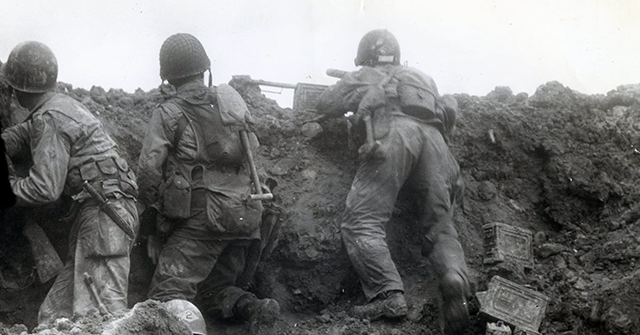
Taking the guns atop Pointe Du Hoc was a suicide mission.
For weeks, Allied planes dropped thousands of bombs on Pointe du Hoc to destroy six mighty guns that threatened the D-Day invasion. On D-Day, Allied ships bombarded the guns to silence them. The bombs missed their targets; however, the mission would be accomplished largely by one man through his intrepid actions. Individuals can shape and bend history
On D-Day, Allied planners had called for 225 Rangers, including Dog Company, to land on a tiny beach, scale the ten-story-high cliffs under a torrent of enemy fire, and destroy the most dangerous gun battery threatening the American sector of the invasion.
Allied headquarters projected that Ranger casualties would exceed seventy percent. Body bags for most of the battalion were prepared. One intelligence officer remarked, “It can’t be done. Three old women with brooms could keep the Rangers from climbing that cliff.” In fact, only about 90 of the 225 would remain standing.
Atop Pointe du Hoc, the Germans had constructed a massive fortress. They considered the position largely impregnable to seaborne attack, thanks to the ninety-foot cliffs. Nevertheless, they had placed artillery shells suspended by wires—precursors to today’s IEDs (improvised explosive devices)—along the cliff faces as an added defense against seaborne assault. German machine guns and anti-aircraft guns could also hit the beach at the base of the cliffs, where any attacking craft would be forced to land. The fortifications made land-borne and parachute attacks similarly difficult: heavy minefields, machine gun nests, bunkers, and barbed wire rendered an overland attack without armor practically impossible. The only possible Allied route of attack was a frontal assault.
Pointe du Hoc’s formidable defenses protected six 155 mm artillery pieces, each with a potential range of 25,000 yards (14 miles), trained on the American landing beaches. Destroying them would be “the most dangerous mission of D-Day,” and it was critical to the success of the invasion.
On June 6, 1944, around 7:15 a.m., the Rangers disgorged from their landing craft, many into water over their heads as they made their way to the rocky beach at the base of the cliffs. From the top of the cliff, the German soldiers relentlessly fired on the incoming Americans. Capable of firing between 1200 and 1500 rounds per minute, the MG-42s struck the gravel around Rangers. “I thought I was kicking up pebbles and dirt. But they were actually bullets that were hitting the sand and kicking up the dirt around me,” one Ranger remembered.
Some of the men, like Sigurd Sundby from Dog Company, struggled with the ascent. “The rope was wet and kind of muddy; my hands just couldn’t hold. They were like grease, and I came sliding back down. I wrapped my foot around the rope and slowed myself up as much as I could, but my hands still burned.”
First Sergeant Leonard Lomell, Dog Company’s senior enlisted man, took a machine gun bullet in his side, but continued to ascend. Adrenaline coursed through his body, allowing him to ignore the searing pain.
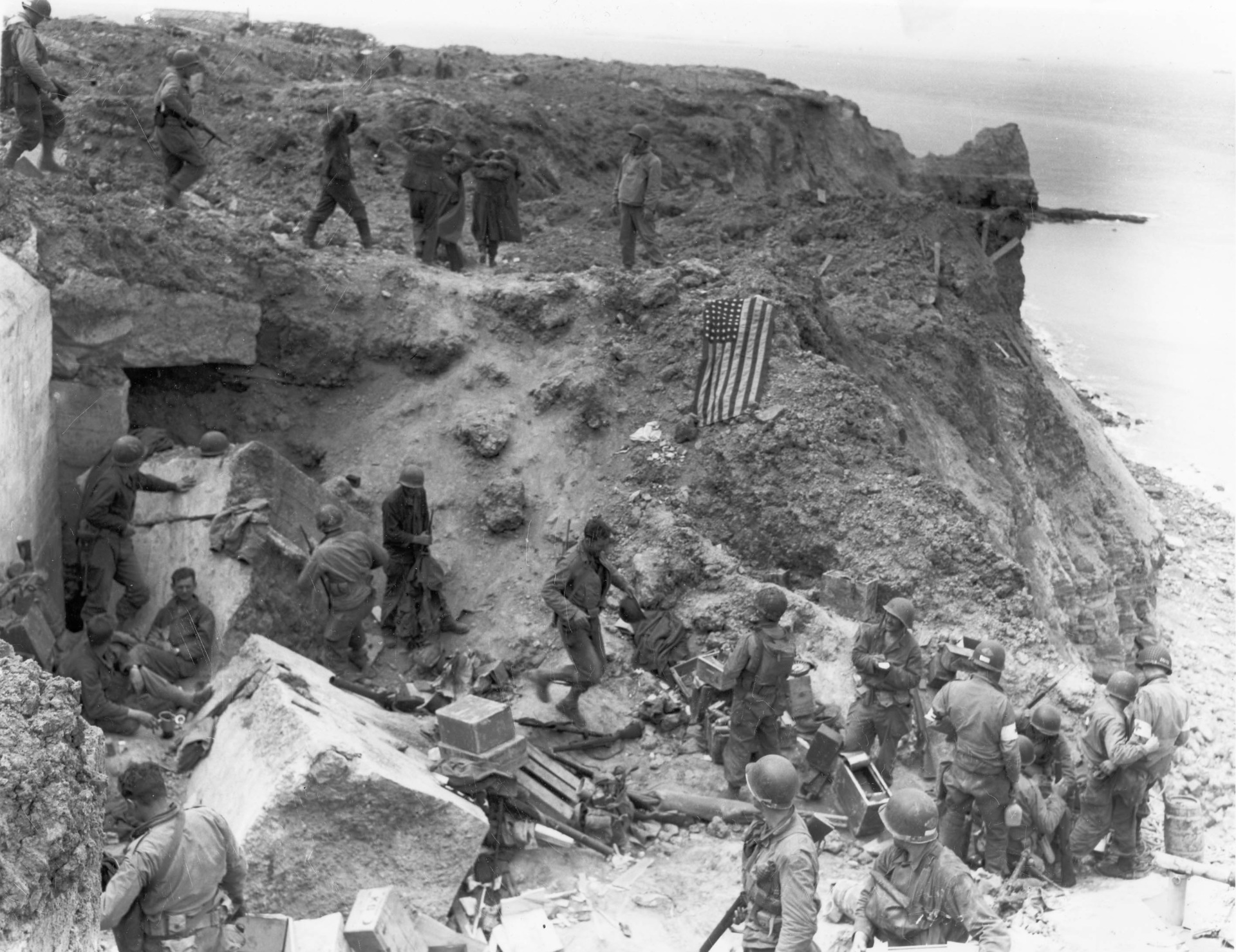
Pointe du Hoc after the D-Day invasion, Normandy, France. (U.S. Army Signal Corps)
Climbing next to the first sergeant was 2nd Platoon’s radio operator, Sergeant Robert Fruhling. Lomell could hear the ominous sound of crumbling rock as the cliff face gave way beneath each foothold. Running out of strength from making the treacherous hand-over-hand ascent while avoiding enemy fire, the wounded Lomell strained to lift his body the last few feet. When at last he crested Pointe du Hoc, he looked down and spotted Fruhling, who was now near the summit, but barely hanging on. Fruhling cried out for help.
Unable to reach the radioman, Lomell provided covering fire from his Thompson and shouted, “Hold on. I can’t help you!” Lomell spotted Sergeant Leonard Rubin and called out for him to help the struggling Ranger. Just as Fruhling was slipping down the rope, Rubin grabbed him by the nape of his neck and, with a mighty swing, hoisted him over the top of the Pointe.
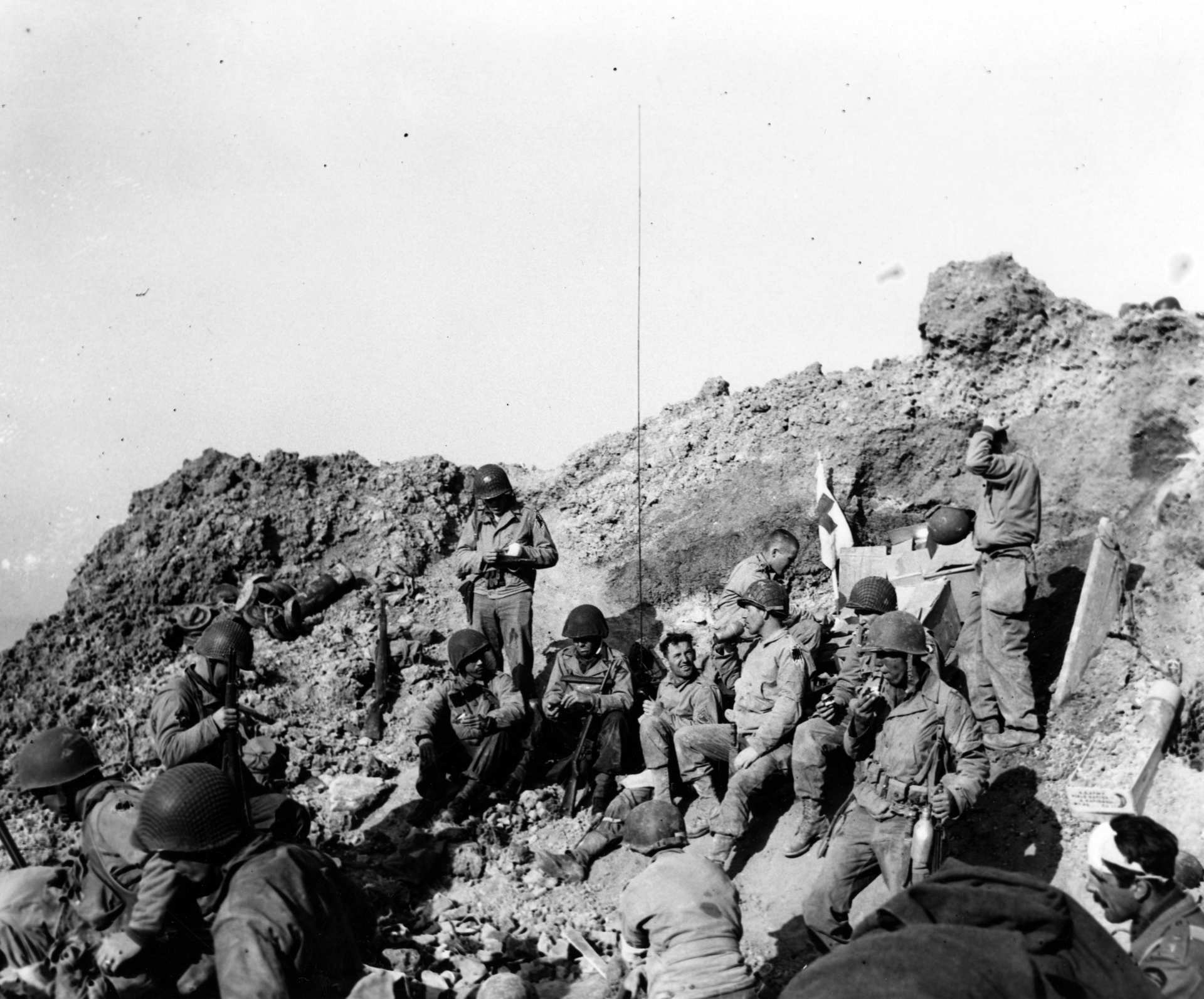
U.S. Army Rangers rest atop the cliffs at Pointe du Hoc, which they stormed in support of Omaha Beach landings on D-Day, June 6, 1944. (Official U.S. Navy Photograph/ National Archives)
Scaling the cliff under machine guns and grenades was just the beginning of their day. Lomell and his men fought through a maze of bunkers, machine guns blazed, and a German anti-aircraft gun roared and sent a wall of projectiles down upon the advancing Rangers.
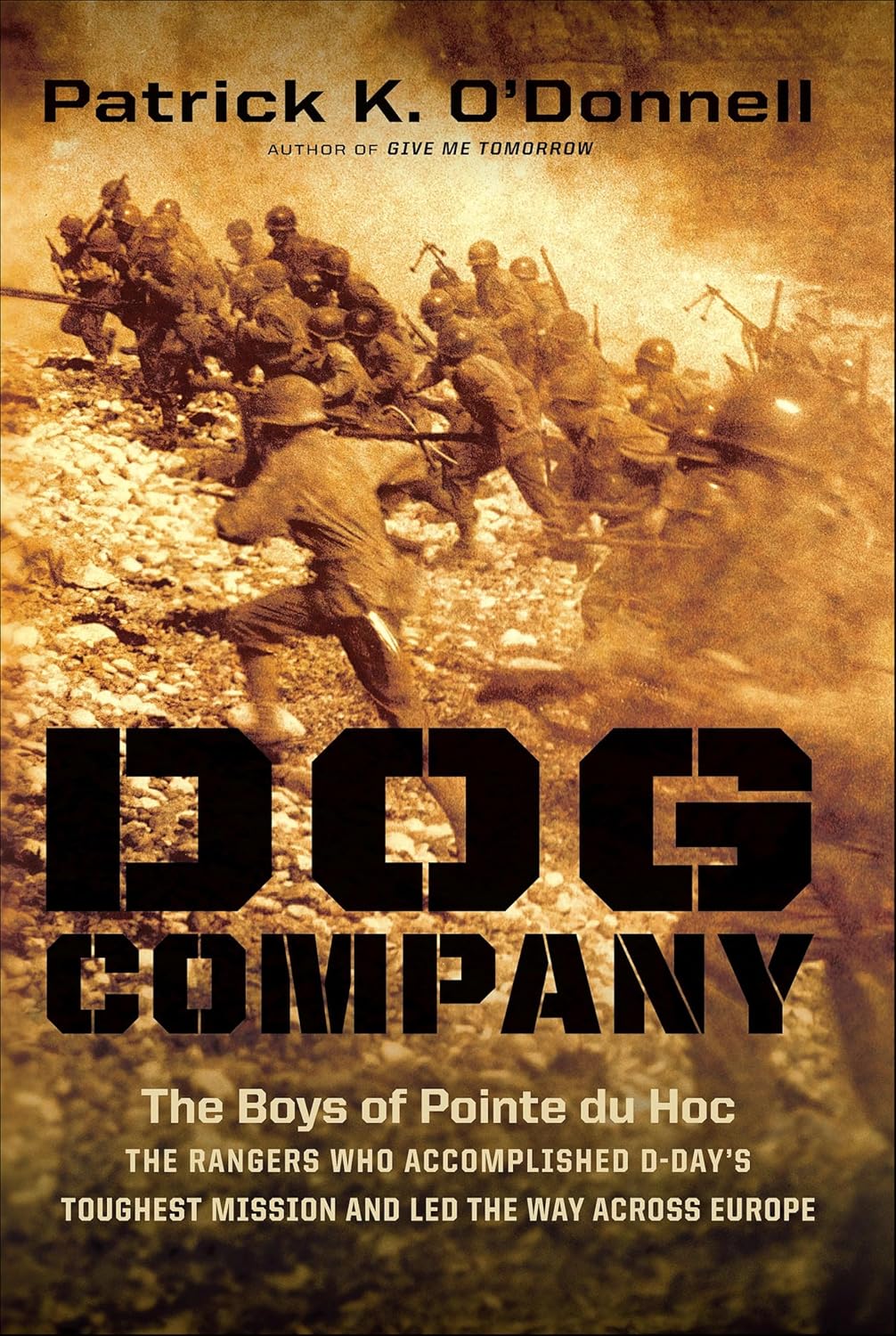
The incredible, previously untold story of the Rangers of Dog Company is told in my bestselling book: Dog Company: The Boys of Pointe du Hoc—The Rangers Who Accomplished D-Day’s Toughest Mission and Led the Way Across Europe.
Atop the Pointe, Lomell found that the guns they had come to destroy were not in their casements. Acting on their own initiative, Lomell and Sgt. Jack Kuhn found tire tracks made by the German guns and followed them. After fighting through several German strongpoints, they located five of the guns in an apple orchard hidden under camouflage netting. Using their thermite grenades, Lomell disabled the deadly weapons, two men accomplishing a mission that hundreds of Allied bombers and scores of heavy naval guns of Allied warships failed to achieve.
The surviving Rangers then tackled their secondary mission. They set up a roadblock across the road atop the Pointe that connected Omaha and Utah Beaches. On the night of June 6-7, hundreds of Germans counterattacked in force, overrunning portions of the Ranger position and nearly retaking the Pointe in an epic assault. But the Rangers held. Eventually, they linked up with troops who had fought their way off Omaha Beach. Through personal initiative and courage, a small group of men proved that they could shape history.
Most of the Rangers in this article were my close friends. Only a few heroes of Dog Company remain. Unlike the counterfeit heroes of Hollywood and current pop culture who incessantly crave attention for faux achievements and insignificant acts, this WWII generation of American rock stars is quietly fading before our eyes.
We are living through some of the most dangerous times in history; as one historian put it, the “past is present.” During WWII, the West agreed on what was good and evil. Today, we stand at the edge of a precipice. Courage remains a priceless commodity. But the challenge is a new one—to stand for truth, human dignity, and liberty. Like at Pointe Du Hoc where a small group did the impossible and changed history by their individual courage, we need a new generation to step up.
Patrick K. O’Donnell is a bestselling, critically acclaimed military historian and a leading authority on American elite and special operations units. The author of fourteen books, including Revolutionary Snipers: Washington’s Frontier Commandos Whose Marksmanship Forged a New Way of War and Helped Win the Revolution, The Unvanquished, The Indispensables, The Unknowns, and Washington’s Immortals, he is a senior fellow at Mount Vernon and has received numerous national awards. O’Donnell served as a combat historian with a Marine rifle platoon during the Battle of Fallujah. He is a director and the historian for The OSS Society and is a professional speaker who frequently lectures on America’s conflicts, espionage, special operations, and the Revolutionary War. He has provided historical consulting for DreamWorks’ award-winning miniseries Band of Brothers and for documentaries produced by the BBC, the History Channel, and Discovery. Follow his work at PatrickODonnell.com and @combathistorian.