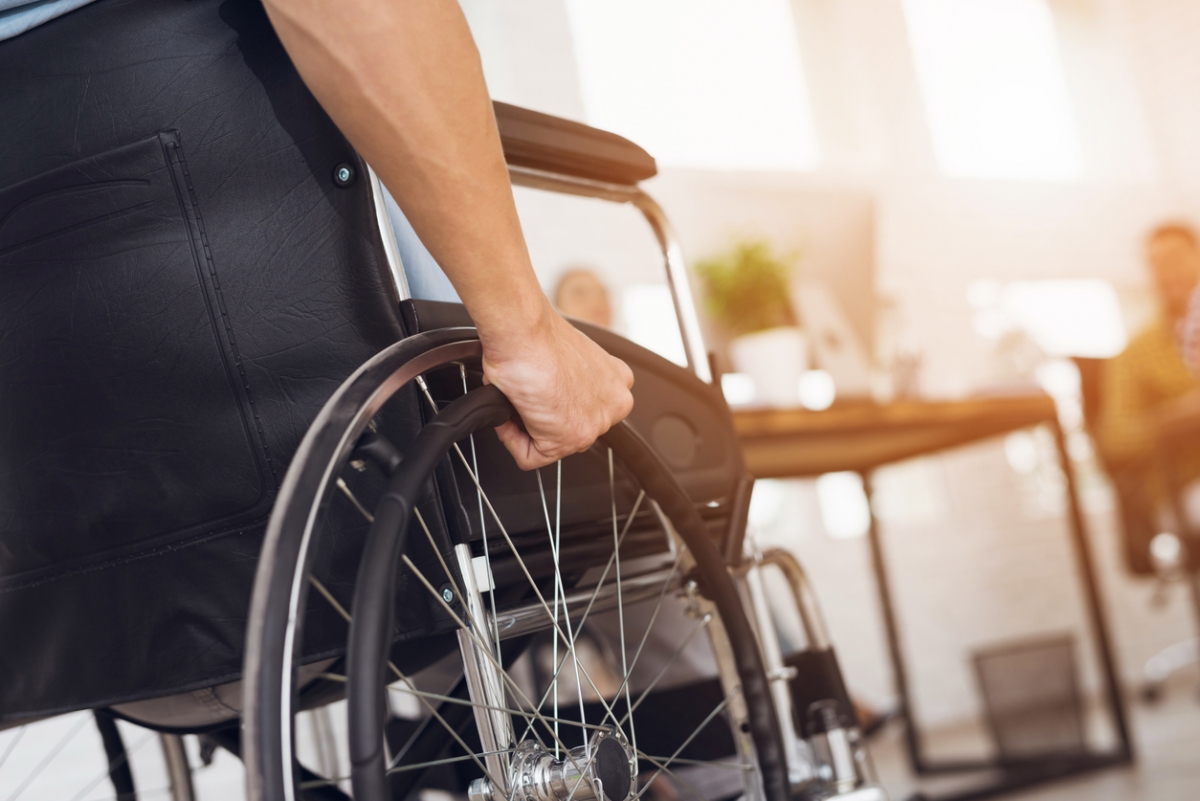

Disability is not a marginal subject in Christian theology, nor an optional area of pastoral care. It sits close to the centre of the Gospel narrative, shaping how the Church understands bodies, belonging, and the presence of God in human life.
In the Gospels, encounters between Jesus and disabled people are not incidental moments of compassion, but revelations of what the Kingdom of God looks like when it confronts exclusion. Those who were blind, paralysed, chronically ill, or socially isolated are not simply made well in a medical sense; they are restored to sight, movement, speech, and, crucially, to community and participation.
“The blind receive sight, the lame walk.” (Luke 7:22, NIV)
This wider understanding of healing matters in a culture that often narrows it to cure. Modern frameworks tend to locate disability within the language of deficit, impairment, and correction. Such language, while often clinically necessary, can carry theological weight when it is uncritically absorbed into Christian imagination. It can imply that wholeness is only achieved when difference is removed. The Gospels resist that logic. They consistently point towards restoration as inclusion, dignity, and reintegration into shared life, rather than the erasure of human difference.
Within this biblical vision, the body of Christ described by St Paul becomes more than a metaphor. It becomes a demanding testament of practical faith: that life in Christ is not shaped by uniform ability, but by interdependence in which weakness and strength are not ranked but held together.
“The eye cannot say to the hand, ‘I don’t need you!’” (1 Corinthians 12:21, NIV)
“If one part suffers, every part suffers with it.” (1 Corinthians 12:26, NIV)
Many churches are already seeking to live this out with care and intentionality, and there are encouraging examples of communities where accessibility, awareness, and inclusion are taken seriously as part of discipleship. At the same time, there remains a wider journey for the Church as a whole in learning what this means in practice, particularly as it relates to the everyday life of worship and fellowship.
In contemporary society, disabled people are not always excluded in immediately visible ways. Legal protections, accessibility standards, and medical advances have significantly altered the landscape. Yet exclusion has not disappeared; it has often become quieter and more complex. It is embedded in expectations of productivity, independence, and constant availability that define much of modern life. These assumptions can leave disabled people subtly out of place, even when no explicit barrier is stated.
This is particularly evident in relation to invisible disabilities. Conditions such as autism, trauma-related disorders, chronic pain, depression, and anxiety do not always present in ways that are readily recognised. As a result, those who live with them often carry the additional burden of explanation. They are required not only to navigate their condition, but to make it legible to environments not designed with their experience in mind. The absence of visible markers can lead to misunderstanding, minimisation, or assumptions of inconsistency, all of which compound the difficulty of daily life.
Church communities are not immune to these dynamics. Even where there is genuine desire to be welcoming, patterns of church life can still assume a narrow range of cognitive, emotional, and physical capacities. The pace of services, the sensory environment of worship, the expectations placed on social interaction, and the implicit norms around participation can all contribute to forms of exclusion that are not always immediately recognised. And yet many churches are also learning, adapting, and making thoughtful changes that reflect a growing awareness of these realities, often shaped directly by the lived experience of disabled Christians within their own congregations.
What becomes crucial in addressing this is not only structural adjustment, though that remains important, but sustained relationship. Disability is too often spoken about in abstract terms, as a set of needs to be met or barriers to be removed. Yet sustained contact resists abstraction. It brings clarity where categories can blur, and restores the particularity of people who are too easily reduced to labels or policy language.
“I praise you because I am fearfully and wonderfully made.” (Psalm 139:14, NIV)
Even personal experience can, in small ways, reshape perception. A recent knee injury, which required hospital treatment and X-rays and is still in the process of healing, has brought a renewed awareness of how quickly everyday movement can change. Simple tasks have required more attention, and familiar spaces have sometimes felt less straightforward than before.
In that period, I found myself noticing more sharply those navigating mobility challenges in daily life – people using crutches or wheelchairs, or moving with visible strain through public spaces. These were not unfamiliar sights, yet my awareness of them changed, offering a humbling shift in perspective. What had previously been a passing observation became something more sustained and more humanly present.
That shift did not create expertise or full understanding, but it did unsettle something important: the ease with which other people’s limitations can remain peripheral to one’s own awareness. Even temporary limitation can expose how quickly normality is assumed, and how easily the realities of others are overlooked until they are reflected, however imperfectly, in one’s own experience.
In such moments, assumptions begin to soften. The tendency to generalise about disability gives way to attentiveness to individual lives, rhythms, and forms of flourishing that do not conform to standard expectations. This is not simply a matter of pastoral sensitivity but of ecclesial honesty. A Church that seeks to know its people in their lived reality begins to reflect more closely the body of Christ it proclaims.
At the same time, Christian language around healing requires careful handling. Throughout Christian history, healing has sometimes been framed in ways that unintentionally position disabled existence as a condition awaiting resolution. Yet the Gospel accounts do not support a simplistic equation between healing and normalisation. They present instead a more complex movement towards restoration of dignity, agency, and belonging. In some cases, physical transformation is described; in others, the emphasis rests on faith, recognition, and reintegration into community life. What is consistent is not the removal of difference, but the arrival of a new form of life in relation to God and others.
To approach disability within this framework is to resist the assumption that value is tied to conformity. It is to recognise that human embodiment is diverse, and that this diversity is not incidental to creation but integral to it. Within such a vision, dependency is not a failure of humanity but one of its defining characteristics. Every life involves forms of reliance, whether visible or not, and the Church is called to be a community that names and honours this reality rather than concealing it beneath ideals of autonomy.
“The body is not made up of one part but of many.” (1 Corinthians 12:14, NIV)
The historical treatment of disabled people makes this theological reflection all the more urgent. Across centuries, disabled people have been excluded from education, work, family life, and religious participation. At times, they have been treated as objects of pity, at other times as problems to be managed, and in some cases as spiritually suspect. Even where explicit exclusion has diminished, its legacy can persist in cultural attitudes that still associate worth with productivity or independence.
Invisible disabilities intensify these patterns in distinct ways. Because they do not always fit visible categories, they can be met with doubt or misunderstanding. The effort required to be believed, to be taken seriously, or to have needs recognised can become a significant emotional and spiritual burden in itself. Within Christian communities, where ideals of perseverance and service are often emphasised, there is a particular need for care that does not inadvertently turn struggle into a test of faithfulness or legitimacy.
Disability Awareness Month offers the Church an opportunity to engage these realities with honesty rather than sentimentality. It draws attention not only to challenges but to the presence, gifts, and theological significance of disabled people within the life of society and the Church. It invites a deeper awareness that inclusion is not a matter of adaptation at the edges of ecclesial life, but of transformation at its centre.
A more faithful engagement with disability does not diminish the Church’s mission. It clarifies it. The mission of Christ is not directed towards abstract ideals of perfection, but towards the reconciliation of human life with God and with one another. In that reconciliation, there is room for every form of embodiment, every mode of perception, every way of being present in the world. The Church that learns to recognise this more fully begins to reflect, however imperfectly, the breadth of the Kingdom it proclaims.
Duncan Williams is outreach director for the Christian Free Press and has worked for Son Christian Media here in the UK and Recovery Network Radio in the United States. He is an ordained minister and a long-term member of Christians in Media. He provides content and syndicated news for regional publisher www.inyourarea.co.uk