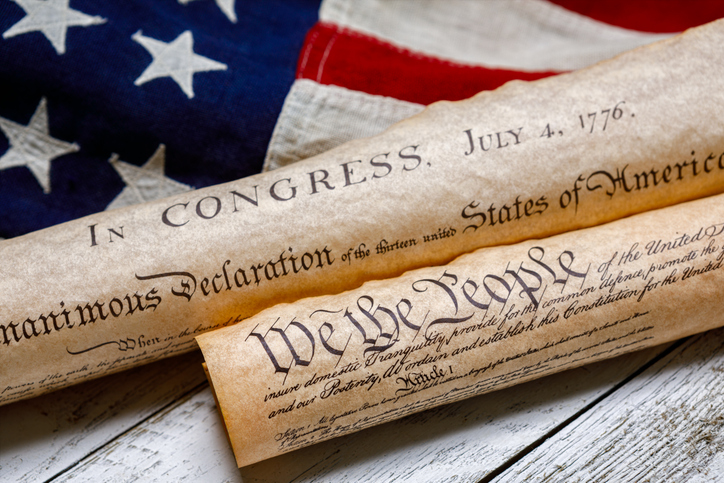
This year is the 250th anniversary of a momentous event in the history of North America and the world. The celebration is of the American Declaration of Independence, July 4, 1776. Well, to be a bit picky there are three dates that could vie for this formal point of departure from British rule.
On July 2, 1776, the Continental Congress voted for independence (the ‘Lee Resolution’). One of the so-called ‘Founding Fathers’ – John Adams – thought this would become the great national anniversary. On July 4, 1776, Congress approved the final text of the Declaration. On August 2, 1776, most delegates to the Congress signed the engrossed parchment copy that survives today; a few signed later.
But it’s July 4 that is the standout date and it is that which forms the basis of the current commemorations.
Words with great power
Within its opening words are ones that ring with almost prophetic authority, power and purpose:
“We hold these truths to be self-evident, that all men are created equal, that they are endowed by their Creator with certain unalienable Rights, that among these are Life, Liberty and the pursuit of Happiness.”
A sentence earlier in the preamble had asserted the right of the American colonies to break free from British rule and “assume among the powers of the earth, the separate and equal station to which the Laws of Nature and of Nature’s God entitle them.”
A – contested – place in history
At the time, people thought that it was a momentous event and that they were making history in a dramatic way; and with huge impact on themselves and their national community:
“The Second Day of July 1776, will be the most memorable Epoch, in the History of America.” (John Adams, writing to Abigail Adams on July 3, 1776, regarding the passing of the ‘Lee Resolution’.)
“We must all hang together, or, most assuredly, we shall all hang separately.” (This is attributed to Benjamin Franklin, who reportedly said it at the signing, recognising the huge risk being taken by the signatories as they sought to break free from British rule.)
“The Declaration of Independence … [was] an expression of the American mind.” (From Thomas Jefferson, looking back in 1825. The wording may be apocryphal.)
Later, in the 1850s, Abraham Lincoln saw it as the key to understanding US political character and legitimacy. It was, he wrote, “the ring-bolt to the chain of your nation’s destiny” and “The principles contained in that instrument are saving principles.”
Others were rather more reserved as they assessed its lofty ambitions. The confident claims could be contested. The African American Frederick Douglass posed a disturbing question in 1852: “What, to the American slave, is your Fourth of July?” This reminded everyone that the inspiring words that “all men are created equal” and “are endowed by their Creator with certain unalienable Rights” – which include “Life, Liberty and the pursuit of Happiness” – did not apply to Black slaves. It took a bloody civil war (1861-65) to achieve that – and Black equality continued to be contested.
It did not apply to Native Americans either who, in 1776, still occupied most of the North American continent. That land ownership was about to change! Women were excluded – which was par for the course at the time, though even then there were some who noted the omission of a lot of free American citizens from the rights being confidently claimed.
A Christian nation?
As well as the alarming fact that there were huge numbers of people living in North America in 1776 who did not come into the category of “all men” because they were – for one reason or another – not accorded the full value of human dignity, is the question of what kind of spiritual nation was coming into being.
Some later Americans were confident that what had come into being in 1776 was a Christian nation. Woodrow Wilson (US president 1913-21) stated that “America was born a Christian nation.” Ronald Reagan (US president 1981-89) claimed that “America was founded by people who believe that God was their rock of safety.” Current President Donald Trump, in a 2017 speech to the Values Voter Summit, pledged to defend “our Judeo-Christian values” and has closely aligned himself with the values held by US Christian nationalists. There are reports that a draft of the 2020 State of the Union speech contained the sentence “America has always been a Christian nation” and (if true) reveals, at least, how someone close to the Trump presidency was feeling.
Conservative evangelical Christians (or the evangelical right) would concur. Pat Robertson, it is reported, once put it this way: “The founding document of the United States of America acknowledges the Lordship of Jesus Christ because we are a Christian nation.” It should be noted that this quote is hard to source in its original form (though frequently quoted) but seems very much in line with his general outlook; and many on the evangelical right would say ‘Amen’ to these words.
Robertson (1930–2023) was one of the most influential American evangelical leaders of the late 20th century. He founded the Christian Broadcasting Network in 1960, hosted The 700 Club, ran for the Republican presidential nomination in 1988, and later founded the Christian Coalition, which became a major force in Republican politics.
We might ask: do these statements mean (a) the 18th-century founders created a Christian nation, (b) America was founded as culturally Christian, (c) America derived its principles from Christianity, or (d) America should be regarded as (made into?) a Christian nation?
These are four very different things, and the last one is particularly explosive in a multi-faith, multi-cultural, secular democracy, if political power is going to be deployed to achieve it.
A recurring idea expressed at recent US prayer rallies and religious-right gatherings has been that America should be ‘rededicated’ to God (which suggests it once was) and that the nation possesses Christian foundations that ought to be publicly (re)affirmed.
Arguably, a striking thing that emerges from analysis of the most recent written and spoken evidence is that many leading US evangelicals no longer use the straightforward 19th – and early-20th-century formula ‘America is a Christian nation.’ Instead, they tend to speak of America as having Christian foundations, Christian heritage, Judeo-Christian values, or having a need to return to its Christian roots. Those formulations are often politically more effective and historically easier to defend than the older slogan.
Among many of these contemporary US Christian leaders, there seems to have been a shift from descriptive claims (‘America is a Christian nation’) to normative claims (‘America should return to its Christian roots’). However, they still assume that what was formed in 1776 was, in some sense, a Christian political community, to which the modern US should return.
History, though, is a little more complex …
A complex faith journey …
There is no doubt that Christian faith made a huge contribution to the founding of what became the United States. From the Mayflower settlement of 1620 onwards, the ‘Bible Commonwealths’ of New England had Christian faith at the heart of their community character. That is why the founding of Plymouth, Massachusetts (1620) and the Winthrop Fleet arriving in Boston (in 1630) makes for a more satisfying US origin story than the violent, testosterone-driven, nature of the founding of Jamestown, Virginia, in 1607.
This had an enduring legacy, but a lot happened between 1620 and 1776. The godly experiment in semi-theocratic government was brought to heel by the British crown. In 1684, the Massachusetts Bay charter was annulled. Then, from 1686, the various colonies of New England were unified as the Dominion of New England. Theocracy was brought under royal authority and curtailed. In 1689, power was briefly wrested back to these colonies but, in 1691, King William III issued another charter which unequivocally unified the colonies under royal authority. This area was styled the Province of Massachusetts Bay.
More fundamental for Puritan politics than a name and boundary change was the decision imposed on the province which extended voting rights to non-Puritans. This was a gamechanger. The move effectively put an end to the godly semi-theocracies.
However, Christian faith continued to decide the overall mood music of the 18th-century colonies. Consequently, it was more than simple Enlightenment rationalism that drove the formation of the Declaration of Independence when it was approved by the Continental Congress in 1776. There was a local, and Puritan-derived, element to it too that was rooted in the concept of covenanting communities, entered into by mutual consent, which possessed a confidence that they were an inspiring ‘city upon a hill’ for the world to see.
Despite this, the Founding Fathers were still very much products of the 18th-century Enlightenment. When it came to religious beliefs, most fell somewhere on a spectrum between orthodox Christianity and Enlightenment rationalism, with (in some cases) a touch of Deism (belief in a non-interventionist Creator). Hence, the references to God in the Declaration of Independence are tellingly non-confessional: “Creator,” “Nature’s God.” Benjamin Franklin made just one – but highly significant – edit to the Declaration’s famous beginning. As a result of this, “self-evident” replaced the original phrase “sacred and undeniable.”
Consequently, it rooted the Declaration in the Enlightenment concept of natural law, rather than religious faith.
Other evidence supports this:
The Treaty of Tripoli was concluded between the USA and Tripolitania and took effect in 1797. Article 11 of this treaty made a statement that would cause shock and alarm among evangelical Christians in the 21st century. It unequivocally states:
“The government of the United States of America is not in any sense founded on the Christian Religion.”
As far back as 1802, Thomas Jefferson had spoken of “a wall of separation between Church and State.” This clear principle is contained in the First Amendment to the Constitution of the United States, of 1791. This states that “Congress shall make no law respecting an establishment of religion, or prohibiting the free exercise thereof.”
In other words, the government cannot restrict individuals from practising their religion, nor can it force them to participate in religious activities. Citizens are free to hold whatever religious faith they choose to (or no religious faith at all). Article Six of the US Constitution also specifies that “no religious Test shall ever be required as a Qualification to any Office or public Trust under the United States.” It is sometimes forgotten that ‘freedom from imposed religious faith and practice’ is the other side of the coin to ‘freedom of religious faith and practice.’ It is in such an outlook that the concept of modern secular democracy is rooted. It is that originalist concept that is now being stress-tested by 21st-century US evangelicals, who claim to be returning the USA to its foundational roots.
Incidentally, Thomas Jefferson – Deist-leaning and sceptical regarding divine intervention – did not declare any Thanksgivings during his presidency (1801-09). And Thanksgiving itself was an evolving tradition through the 19th century. In 1817, New York State was the first to announce an annual Thanksgiving holiday. Other states followed, although there was no unanimity regarding the day(s) chosen. And these later developments moved away from the formal and solemn events that 17th-century New Englanders would have recognised as a ‘Thanksgiving’ and more towards one of community and family celebration and festivities.
Things became more complex in the USA during the 19th century because many in positions of power felt that – whatever the Founding Fathers actually said, did or stood for – Christian faith (and that usually meant Protestant faith) should enjoy a privileged position.
Legal judgments in cases such as ‘The People v. Ruggles’ (1811) and ‘Church of the Holy Trinity v. United States’ (1892) revealed that the person of Christ and Christianity enjoyed a legal protection unlike that extended to other faiths. This seems a long way from the Treaty of Tripoli and the vague theologies of some of the Founding Fathers and the wording of the Declaration of Independence. Time had moved on and, as usual, people seek justification in history, even when history is, in reality, rather messy. The USA is, to all intents and purposes, a secular republic but at the same time Christianity (usually in its Protestant form) has had a huge input into political conversations and decision-making.
By the 1890s, because of the ‘Great Awakenings’ (revivals) of the 19th century, most American Protestants were part of what one can describe as ‘evangelical’ denominations. Right-leaning evangelical Protestants have been involved in politics for much of the 20th century and their activities are not simply a modern phenomenon, although it is during the past thirty-five years that they have come to increasing prominence. As far back as the 1940s, ‘50s and ‘60s, anxieties about the perceived threat of communism and changing patterns of social behaviour had caused many with this outlook to gravitate towards the Republican Party as a way of defending what they would have described as the ‘Protestant-based moral order.’
In this period of development, opposition to Catholic influence also drove the movement to a significant extent. This declined in the 1970s and ‘80s, as common cause was found on matters of sexual ethics and concerns regarding the moral freedoms of the 1960s and the rise of secularism. These were the origins of the modern ‘culture wars.’ Accelerating political campaigning occurred within the US evangelical community, declaring that the USA has a Christian nature, and rooting this in claims about its foundation. This has become sharper even as evangelical numbers have fallen as a percentage of the US population in the last decade.
Happy 250th Birthday, USA!
The American Declaration of Independence, of 1776, was a truly historic event. The world was different after it. Its contribution to the development of democracy, political and personal freedom and a politically engaged citizenry was enormous; as was the challenge it posed to the established order as seen in contemporary 18th-century states. US freedoms and US confidence are rooted in it. It was a key point on a trajectory that would lead to superpower status.
However, as the celebrations take place, it is also worth remembering those, in 1776, who were excluded from its inspiring claims, because the USA was as complex and contested at its birth as it is on its 250th birthday. And we need to be rather more candid about the complex faith-history of the USA, from 1776 to 2026. A birthday is a time for looking backward, as well as looking forward. And the past is often more complex than we like to imagine!
Happy 250th Birthday, USA!
Martyn Whittock is an historian, columnist, commentator, and Licensed Lay Minister in the Church of England. He is the author, or co-author, of fifty-eight books, on a wide range of historical and theological themes. His recent books include Trump and the Puritans. How the Evangelical Religious Right Put Donald Trump in the White House (2020), along with many op-eds on US politics and, especially, the Christian input into US culture.