
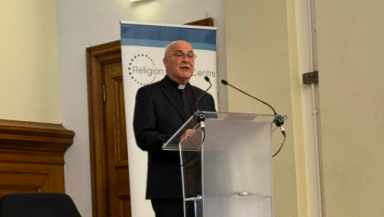
The Archbishop of York has warned that widespread religious illiteracy is leaving Britain less able to understand global events, its own history and the communities that make up modern society, calling for faith to be represented more accurately across the media.
Delivering the keynote address at the Religion Media Festival on Monday, Archbishop Stephen Cottrell argued that religion should not be treated as a niche subject but recognised as an essential part of public life.
Focusing on the theme ‘Protecting the place of religion in the media in a digital age’, he said better religious literacy would help combat stereotypes, improve community cohesion and rebuild trust in public institutions.
“Representation in the media matters because faith matters, because values matter, but also to demystify and familiarise those who have no religious affiliation, so that everyone, of whatever faith or none, can see themselves represented and that faith can be understood, represented and explained,” he said.
The Archbishop said an understanding of religion was indispensable for interpreting the modern world, from Britain’s culture, literature and legal traditions to contemporary international conflicts.
He argued that religious literacy enables people to engage with one another from “places of knowledge rather than assumption or prejudice,” helping to strengthen relationships across increasingly diverse communities.
Archbishop Cottrell expressed concern that specialist religious journalism has steadily declined, with dedicated religion correspondents disappearing from many news organisations and religious coverage increasingly reduced to worship content or narrowly defined faith programming.
As a result, he said, the public is often left without the knowledge needed to understand the religious dimensions of major world events.
He cited the conflicts in the Middle East and Ukraine as examples of issues that cannot be fully understood without recognising their religious and historical contexts.
According to the Archbishop, inadequate coverage contributes to stereotyping and misunderstanding, which can fuel hostility towards religious communities and reinforce false narratives circulating online.
Alongside concerns about religion reporting, Archbishop Cottrell highlighted a broader crisis of public trust, noting that confidence in news media has fallen sharply over the past decade.
He argued that rebuilding trust requires people to feel represented and included, adding that this was particularly important in an increasingly digital media environment where misinformation, unregulated social media content and algorithm-driven echo chambers can distort public understanding.
The Archbishop defended the continuing importance of public service broadcasting, saying that its role extends beyond entertainment to informing and educating the public about the beliefs, values and traditions that shape society.
He argued that the values many people desire for society – including honesty, truthfulness, kindness and love of neighbour – are rooted in faith traditions and should remain part of public life.
“The values are not an ‘add on’ or a ‘take away’ but arise from and are held by the narratives, beliefs and practices which make up the Christian life,” he said.
Archbishop Cottrell suggested broadcasters should give greater attention to reflecting Britain’s diverse religious communities and explaining the role faith plays across national life rather than limiting coverage to explicitly religious programming.
Drawing on his recent Lord’s Prayer tour across northern England, which has included visits to schools and cathedrals, he said there was a need to explain the Christian faith more publicly so that people could better understand how it has shaped Britain’s history, culture and laws.
He said explaining faith publicly was not only important for believers but also for anyone seeking to understand the country’s shared heritage.
The Archbishop welcomed examples of religious programming that encourage wider understanding, including the BBC’s recent series on pilgrimage, which brought together people from different faith backgrounds to explore both spiritual practice and religious diversity.
He pointed to national occasions such as Remembrance services, royal funerals and coronations, arguing that these events contain significant religious elements that increasingly require explanation for modern audiences.
While recognising that digital platforms allow faith communities to communicate directly with the public, Archbishop Cottrell warned that they also amplify misinformation, anonymous abuse and increasingly polarised debate.
He called for stronger regulation of the digital space and said the rapid development of artificial intelligence made ethical oversight more important than ever.
Faith, he argued, has an important role to play in ensuring new technologies continue to respect human dignity and moral responsibility rather than replacing human judgement, echoing concerns raised by Pope Leo and the Archbishop of Canterbury, Sarah Mullally.
Concluding his address, Archbishop Cottrell said: “Therefore, in supporting the continuation of the public service broadcasting sector I don’t so much want to ask the questions whether, for instance, is the licence fee is value for money, but whether public service broadcasting in all its different forms, gives us ‘values for money’ – and that the promotion of those values includes and understands the value of faith and the values that come from faith, helping us to understand the world; to understand each other; to understand ourselves and building a kinder and more coherent society.”

