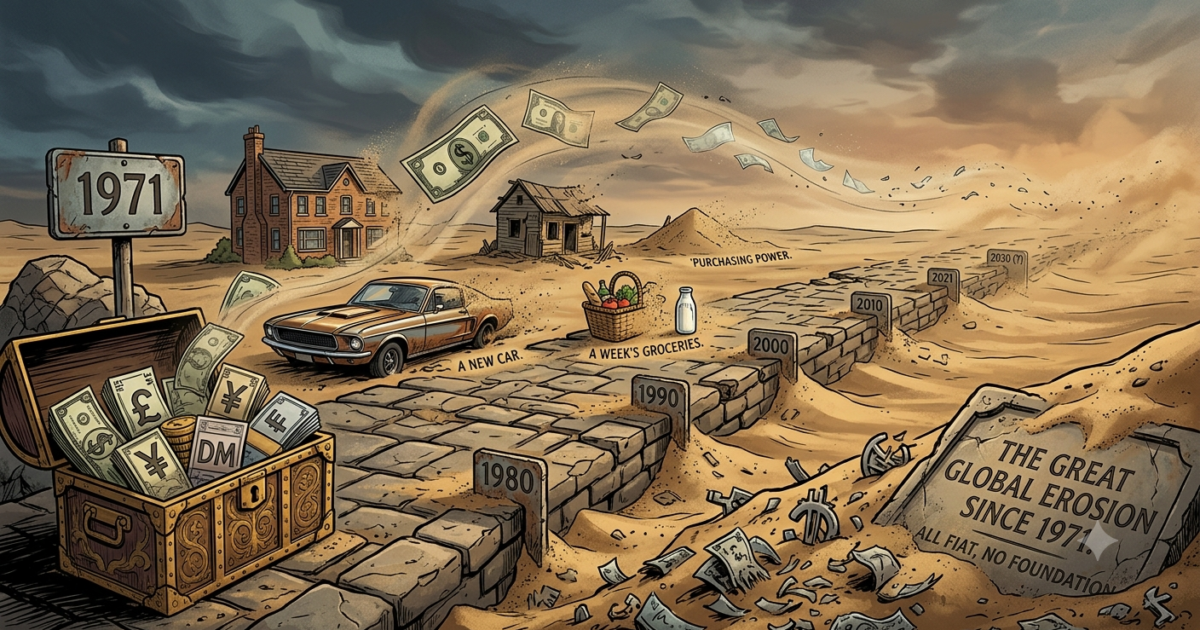


People predicting the collapse of the dollar often point to inflation and argue that the U.S. dollar has lost much of its purchasing power since 1971, when the United States went off the gold standard. That loss of purchasing power is absolutely true and quantifiable. Based on Bureau of Labor Statistics CPI data, $100 in 1971 is equivalent in purchasing power to about $822 today, a cumulative loss of roughly 87%.
Inflation, while not good, does not necessarily mean that people are poorer. Inflation means that each dollar purchases less than it did in the past. However, people have dramatically more dollars today than they did in 1971. Nominal wages are dramatically higher today than in 1971. After adjusting for inflation, today’s average hourly wage has about the same purchasing power it did in 1978, but falls short of 1971 levels.
The decline in the dollar’s purchasing power is therefore real, but it does not by itself prove that the dollar is destined to collapse. A collapsing currency produces hyperinflation and a flight out of the currency. Zimbabwe’s inflation peaked at an estimated 89.7 sextillion percent annually in November 2008, with the Reserve Bank of Zimbabwe issuing a $100 trillion note that could barely cover a bus fare. The government legalized foreign currencies, primarily the U.S. dollar, South African rand, and Botswana pula, for transactions, though successive versions of the Zimbabwean dollar continued to exist in various forms alongside them.
Venezuela’s peak annual inflation reached 1.37 million percent in 2018, according to the IMF, and the country had not recovered to anything resembling monetary stability before President Maduro was removed from office by the United States military.
The U.S. case is nowhere near this. Not only does the dollar persist, but it also remains the world’s preferred currency for trade settlement, foreign exchange reserves, and currency trading, and for good reason, because every major currency has experienced inflation and loss of purchasing power since 1971.
The British pound has lost roughly 95% of its purchasing power between 1971 and today, with £100 in 1971 equivalent to about £1,835 now, according to the Office for National Statistics’ composite price index data. Italy is even worse. The lira, which was Italy’s currency until 2002, depreciated so severely through the 1970s and 1980s oil-shock decades that prices in Italy today are roughly 20 times higher than in the late 1960s.
The euro, which replaced the lira, has itself lost purchasing power: €100 in 1997, the year the ECB’s Harmonized Index of Consumer Prices series begins, is equivalent to about €184 today, a loss of 46% in under three decades.
The ruble is the most extreme case among major economies, though a direct 1971 comparison is not possible because the Soviet ruble and the post-1992 Russian Federation ruble are effectively different currencies. From 1993 alone, the ruble lost over 99.9% of its purchasing power, per OECD and World Bank data.
In addition to the gold standard exit, U.S. debt is frequently cited as evidence of dollar decline, which is only partly valid. The underlying assumption that other countries carry little or no debt is false.
Japan’s government debt stands at 230% of GDP, making it the most indebted nation. The U.S. ranks 11th globally at 125%. China’s overall non-financial debt reached 312% of GDP in 2024, placing it among the most indebted countries in the world.
Countries with lower government debt-to-GDP ratios than the U.S. experienced similar declines in their currencies while paying substantially lower wages. This means their citizens are poorer than Americans despite their governments practicing greater fiscal austerity.
The UK’s government debt stood at 94.3% of GDP in 2025. The UNECE puts the UK’s average gross wage at roughly $57,260 annually, compared with a U.S. figure of approximately $82,900.
South Korea’s government debt was 46.8% of GDP in 2024. That is less than half the U.S. ratio. Yet the average gross wage in South Korea was $40,320, less than half the U.S. figure.
Canada’s government net debt-to-GDP ratio stood at 110% in 2024-25. Yet the Canadian dollar has lost roughly 87% of its purchasing power since 1971. Canada’s gross average wages came to roughly $60,680.
Germany is the most instructive example. Even Germany, the country most celebrated for monetary discipline and whose Bundesbank is often considered the gold standard of central banking, saw the Deutsche mark lose roughly 76% of its purchasing power between 1971 and 2002, when it was absorbed into the euro. Germany’s government debt stood at 63.5% of GDP in 2025, making it one of the least-indebted G7 economies. Despite that record, Germany still has the highest average wages among the major eurozone economies. Yet even those wages, at $69,433 annually, remain well below the U.S. figure of $82,933.
In short, while the U.S. government’s legendary debt is not good and inflation has taken a bite out of purchasing power, all countries have inflation, and all currencies have lost significant value over the past 50 years. The U.S. dollar is no closer to collapse than the euro, the pound, or any other major currency. On the contrary, the dollar remains the world’s currency of choice.
America remains the world’s largest economy by GDP and the eighth-richest country by GDP per capita, while maintaining one of the lowest inflation rates and unemployment rates among major economies.
The post Not Just the Dollar: Every Major Currency Has Lost Most of Its Value Since 1971 appeared first on The Gateway Pundit.