
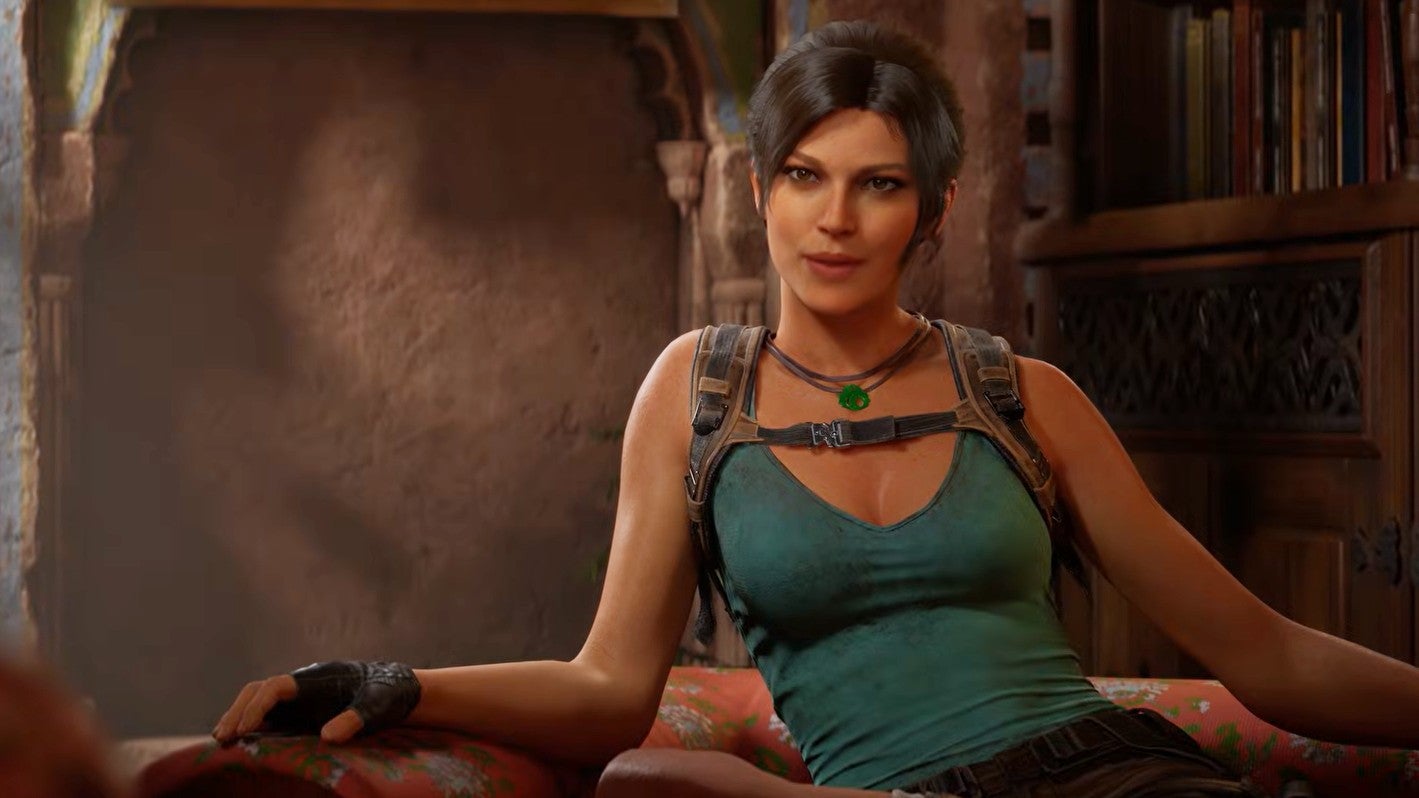
Tomb Raider: Legacy of Atlantis made headlines last week not just for its release date trailer, but also for the developers’ use of AI during the game’s creation.
Soon after that aforementioned trailer aired, it transpired that Crystal Dynamics and Flying Wild Hog had used AI during the game’s development. At this time, a representative told Eurogamer that the studios leverage AI tools to “help our teams iterate on ideas faster and more efficiently, while ensuring that all finished content in the final product is human-crafted”.

Now, Crystal Dynamics director of experience Jeff Adams has shared additional information regarding how the studios are actually using AI tools for Tomb Raider: Legacy of Atlantis, with the developer stating the tech is being used to create placeholder assets to assist with visualisation. This, Adams said, enables the team to “get to [the] right answers faster”.
“Let me give you an example of what that looks like. So, say in early level development, we have an idea for an object, but we’re not sure whether or not we want to take the dev time to build it. We can use a generative AI tool to help us visualise that object in the world,” Adams explained to Game Informer. “If it works, we’ll then move it to our traditional pipeline. From there, the team will concept it, they’ll build it, and we’ll make sure that all the finished content in the final game is human-crafted.” Adams added it is “really important for us that our team has the tools to make the highest quality experience possible,” stating “our fans deserve nothing less than that”.
When Game Informer asked for further clarification on how this actually works in practice, a PR intervened, stating this was all Crystal Dynamics had to say on the topic of AI for now. However, when Tomb Raider: Legacy of Atlantis releases next year, the studio will “probably be more comfortable” talking about it.
“We just want to make it as easy as possible for us to make high-quality game experiences,” Adams said in closing. “That’s really the important thing.”

There is currently a debate as to whether or not studios should disclose when AI has been used during the development of a game. In November of last year, Epic Games boss Tim Sweeney said it made “no sense” for developers to disclose AI use any more, and we may as well ask them what kind of shampoo they use. Others are less convinced, and disagree that AI will become so commonplace that disclosing its use will become a moot point. Meanwhile, the likes of Aloy actress Ashly Burch appreciates AI may have its uses, but it should never replace human creativity.
As for Tomb Raider, while once slated for release in 2026, Legacy of Atlantis will now arrive next year, on 12th February. It will be available on PlayStation 5, Xbox Series X/S, Switch 2 and PC via Steam.
Our Chris recently went hands-on with Legacy of Atlantis, calling it “strangely double-A”, but not without its charm. “I would maybe just gently temper your expectations for this one,” he wrote in Eurogamer’s preview. “Tomb Raider: Legacy of Atlantis is breezy and enjoyable enough, its new voiceover for Lara Craft is pleasantly posh, its design dappled with moments that feel lovably old-school. But a prestige, properly modern remake this is not.”
Mentioned in this article


