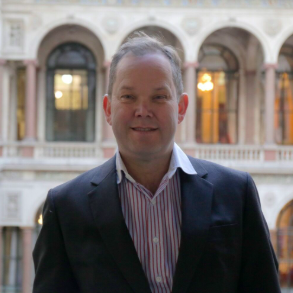
Ian Proud suffered from PTSD for many years after working in the aftermath of the 2004 Boxing Day tsunami and his faith journey was a massive part of that recovery process. Still affected by the experience over two decades later, he decided to channel all of his emotions into a new novel, Searching. He shares more below.
Why did you write Searching?
As part of my diplomatic role as the government’s Head of the Political Section in Thailand I found myself overseeing on-the-ground response to the 2004 tsunami. I still think about it often and have wanted to write a book about the international reaction to the events since it happened. The experience haunts me and I still have to grapple with the residual effects of PTSD.
The creative process has been intensely emotional and therapeutic. But I was also motivated by a desire to commemorate those who endured that terrible experience, and to celebrate Thailand and its wonderful people.
Tell us a little bit about yourself. What led you to the diplomatic service, how did you get there?
I grew up in a working-class family in Germany before returning to the UK when I was nine. My dad was in the British Army and my mum a home-maker. I had an amazing childhood in Germany with camping holidays in Bavaria and Italy. However, I was a scrawny kid and got bullied quite a bit after we returned to England.
I dropped out of education at eighteen and started work as a junior clerical trainee for Hampshire County Council. After a series of quick promotions into a position with Hampshire police, I was sponsored to take a part-time degree, which I passed with a first. By the time I was thirty, I was leading a team of a hundred people in Southampton.
When I saw a brochure for the Civil Service Fast Stream programme in 1998, I sparked on the Diplomatic Service, having grown up overseas and loving politics. But as a working-class person who struggled at school, I didn’t think I had a chance. Back then, the Foreign Office only took on twenty graduate entrants and competition was fierce. I gave it a go, and after a gruelling nine-month process I was selected – one of the best days of my life.
What was your position in the British government in Thailand in 2004?
I was the Head of the Political Section, covering the full swathe of political and security issues from Myanmar refugees, southern terrorism, trans-national crime, and the complexity of Thailand’s political system. I also managed UK relations with Laos as we didn’t have an Embassy there at the time.
Please tell us a bit about the immediate response to the disaster.
I arrived in Phuket with the Ambassador David Fall and Khun Amnat from the embassy’s Thai staff at around midnight on Boxing Day 2004 after a nine-hour drive. We set up a makeshift office in an empty shop and worked through the night. Come the morning confirmed deaths were already in the thousands and the UK government had a scant staff of thirteen in southern Thailand, with no planned reinforcements coming to help.
I’d been awake for forty hours and after a brief sleep deployed to Krabi on 28th December as scores of injured tourists were in the hospital there. The work was relentless, the pressure unlike anything I’d experienced, and the emotional toll brutal. So many colleagues had mental health breakdowns during that time, including my PA and a Thai member of my team. The US therapist they sent to help us soon withdrew with emotional exhaustion.
I returned to Bangkok on 8th January, having worked flat-out for thirteen days. I recall feelings of weird impassivity as the plane took off and I saw the destruction of the coastline, then terrible guilt at leaving my colleagues and friends to it. I flew back to the disaster area after a couple of days.
Can you explain what effect that experience has had on your life? Have you come to terms with it?
I met and tried to help so many people grappling with their incalculable loss and it still breaks my heart. At the same time, I was trying to lead a team of people who’d never experienced anything so traumatic, set a positive example, keep their spirits up and keep an eye out for their health, while our efforts were criticised at every turn by the press. I suppose the bloody-minded part of me was determined not to show any weakness. That’s why I was the first to deploy to, and the last to leave, the disaster area.
I didn’t have the time to engage with my sadness. I also didn’t want my family back home to worry that I was falling apart inside. So, I put a brave face on and when I got back to Bangkok I didn’t talk about it, fell into an acceptance that I should just bury my emotions and drank and smoked my depression down still lower.
The passing of time has undoubtedly allowed me to develop feelings of pride about what so many colleagues did. I’ve come to terms with having done as much as I could have done. But I have never been able to get my mind around the sheer extremes of emotional anguish victims and bereaved relatives must have felt in the teeth of sudden and devastating loss, and that remains a trigger for my anxiety. Writing the book has allowed me to confront those feelings head on.
How did your training help you negotiate your way through the days following the disaster?
I didn’t have any training for something of that magnitude. It was unprecedented. However, I have always been able to remain calm in a crisis and project that onto the people I work with. So, I concentrated on my core priorities – locating people, reconnecting them with relatives, relocating them back to Bangkok and onwards, and gathering as much information about the missing.
Fundamentally, there is nothing complicated about crisis work, however harrowing. It’s about having the right numbers of staff, with the right skills to deploy in sufficient numbers to meet the challenge at hand. And keeping a close eye on everyone, to manage mental health risks.
The tsunami response was a failure of a system that was ill-prepared and staff in London who were disconnected. I determined not to let that happen again in any crisis I was responding to. I held the Embassy in Moscow together after the Salisbury nerve agent attack, earning plaudits from the UK police. By the time I left the Diplomatic Service I was one of the most experienced crisis managers in the Foreign Office.
There was criticism of the government response to the tsunami. Did you feel let down by it?
I felt terribly let down by the government. And I understood completely why British citizens felt angry. Our actions as an organisation relentlessly gave the impression that we didn’t care about the plight of Britons who had suffered so terribly. That was our responsibility as an organisation. That was our duty as diplomats. We were lions led by lambs.
London showed a complete lack of grip. Several colleagues told me they had phoned the Office begging to fly out to Thailand and had not received a call back. When I arrived in Krabi, I phoned in a request to send a British Military C-130 cargo plane. The answer came back that I’d need to write a ‘business case’ and the plane was never dispatched. It was two whole weeks before a rapid deployment team arrived from London. The press took a very negative position, suggesting diplomats had been sipping pink gin at cocktail parties in Bangkok.
I’d struggled for emotional stability in my life after the tsunami. I was incredibly lonely, and towards the end of my time in the post, I hit a scandal triggered by an innocent blog I wrote about life in Thailand. The piece was seized upon by expats, responding with lurid fake stories. Disgruntled Brits were attacking me unfairly, journalists piled in and London shifted the blame onto the Embassy. It was deeply scarring and an emotional re-run of how the Office had thrown me under the bus after the tsunami itself.
How have you dealt with PTSD?
The biggest challenge with PTSD is the self-imposed exile and not wanting to be seen to be struggling. Even today, I go to great lengths to hide my self-sabotaging behaviours. It’s about a fear of showing vulnerability and making yourself feel even worse than you already do.
Family time is intensely healing. I feel most centred when I’m with [my wife] Katharine and the kids. It’s just like being in the best team in which, in our different ways, we support each other, such that there’s less time for me to dwell on the past and get lost in negative thoughts and behaviours.
I kind of want my kids to see the me they have helped to heal, and I am scared about them having a glimpse of what I went through. I still need to work on that.
Finding opportunities for calm is key. While I’m not a Buddhist, I found visiting temples a tremendous spiritual outlet and opportunity to clear my mind. In the book, the character Monty takes Hatty on a boat trip along the Chao Phraya river to the Temple of Dawn and the Temple of the Reclining Buddha. It is a journey I have made countless times. Sadly if I’m anxious or over-thinking something, I’m often just a few steps away from getting drunk so I find it helpful to set a conscious plan for the day – ‘I’m not going to drink anything today’ – then I can park the thought, and it takes the stress away.
Please can you tell us how faith has helped as part of your healing process.
In my darkest moments during the tsunami response and after, I was often conscious of an inner quiet voice of calm. Even if I didn’t understand at the time the significance of that voice, I now believe it to have been the Holy Spirit. I hadn’t been particularly religious prior to that.
My personal journey in faith started to make sense when I met Katharine and from an early stage our love felt guided by God. Prior to going to Afghanistan, I bought two pocket Bibles (which we still possess), giving one to her and carrying the other around Helmand Province. I’d listen to religious songs like “Miracle” by Darlene Zschech during helicopter rides over the desert and attend the tented church on the base for Sunday services. After our marriage, I was confirmed in the Anglican Church. Faith is just a part of our identity as a family, even down to our family rituals, like having a simple dinner of flat bread and red wine (with a few extras) on the floor on Good Friday.
Could you tell us a bit about your relationships with the people you met in Thailand. Do you keep in contact with people you were involved with during that time?
Many of my dearest friends are Thais, including those I worked with at the Embassy; last time I visited, I was delighted to see Khun Amnat still there. I also remain close to the former Deputy Commissioner of the Royal Thai Police, and even though he’s long retired, we meet every time I visit. I’m very close with his Private Secretary from that time – now a Colonel in Special Branch – and her husband, an Air Force General.
What made you decide to write fiction rather than a factual account?
I considered writing a memoir, but as I was still a serving diplomat, this would have required me to resign and, despite everything, I still felt a great commitment to public service. Given my love of old-fashioned romance, creating a tender love story set around the tsunami has helped me to work through some of my feelings from that time.
What has this tragedy taught you about human nature and our response to tragic events?
Events like the tsunami are so tragic because they take away, through death or despair, people who form part of our mental health ecosystems. They steal our emotional certainty and stability.
Humans are essentially social beings, they gain strength and support from being around others. So human connection, expressed through kindness and compassion forms a huge part of how people come together and respond in the most terrible times.
Amidst all the death and grief, I witnessed the best of humanity. Race, religion, gender, sexuality, upbringing – none of that matters when people are thrown together in the most harrowing circumstances. People talk and try to help each other in any way that they might not in peace time. Real, lifelong bonds of friendship are forged.
The experience has had a profound impact on your life. Many died and people lost loved ones. What have you learned about the way individuals carry survivor guilt?
I didn’t deserve to feel sad as I hadn’t lost anyone and was doing my job. In writing Searching I gave myself permission to feel sad and for that to be okay. Of course, sad is so much easier to manage with family around you as loneliness, in my experience, isn’t a great teammate.
The biggest insight I learned from colleagues who suffered breakdowns after the tsunami was the pressure they placed on themselves to make bereaved relatives feel better. Their inability to alleviate another person’s pain produced feelings of helplessness which they couldn’t escape from.
Hence, my maxim in crisis work is that our challenge is not to make the situation any worse than it already is. Acts of kindness and practical assistance to affected persons can only help them get what help they need when they need it but can’t make them feel better. Callous, insensitive handling can make things a hell of a lot worse for them.
What would you like readers to learn from Searching?
I hope readers are reminded that the best curative in life is love and human connection.
If you meet a traumatised person, an act of kindness and compassion will matter more than you realise, and they’ll never forget it.
Even if you find them distant, the real person is probably still inside, desperate to feel well again and discover the life and love they yearn for. Your kindness will offer them an emotional lifeline.
Searching is out now on paperback priced £13.99.