Ed Thomas,UK editor,
Patrick Clahaneand
Rebecca Wearn
Illegal mini-marts, barbers and vape shops could be shut for up to a year under new powers announced by the government, following lengthy investigative reporting by BBC News into organised crime on British high streets.
We have exposed drug gangs, child sexual exploitation, money laundering and immigration crime linked to shops selling illegal cigarettes, vapes and drugs.
As the law stands in England and Wales, authorities can only close a shop for three months, with an option to extend closure to six months using anti-social behaviour legislation. The government’s planned change will double the potential closure time.
Making the announcement, Home Secretary Shabana Mahmood praised the BBC’s reporting, saying that people felt high streets were being taken over by “organised crime [and] immigration criminality”. The government was “not prepared to tolerate it”, she said.
This type of criminality “makes people lose faith, not just in their local area but in democracy, in what our country is, and we can’t let that happen”, she added.
The Home Office says the extended closures will give investigators more time to gather evidence, pursue prosecutions and identify business owners, while preventing rogue operators from simply reopening and resuming illegal activity.
The news has been welcomed by Trading Standards officers, who have repeatedly told us they lack the necessary powers to tackle the problem.
“Closure orders are a key enforcement tool… for tackling ‘dodgy shops'” says John Herriman, chief executive of the Chartered Trading Standards Institute (CTSI).
There is “almost universal support” from his profession for the new measures, he adds.
Other Trading Standards officers told us it would become less financially viable for unscrupulous business owners to simply sit out closure orders, and it would force landlords to pay more attention to who they are renting to.
‘Open criminality’
For nine months, we have repeatedly asked the home secretary for an interview to discuss what we had found.
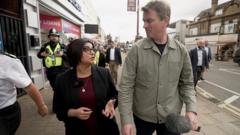
Last week, we were invited to join Mahmood on police raids of mini-marts on Soho Road in the Handsworth area of Birmingham – a high street bordering her own constituency.
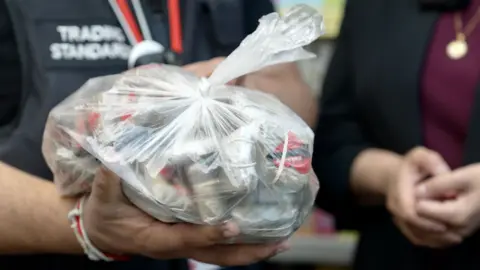
At one shop, police and Trading Standards officers found illegal cigarettes and snuff (finely ground tobacco). A shopworker was arrested after a makeshift weapon – a plank with a nail – was found under the counter.
The shopworker, who said he was a student from Afghanistan, admitted that he thought selling illegal cigarettes was wrong.
When asked why he was selling them, he replied: “Perhaps you should ask the manager, he’s the owner.” However, the owner was not about, he said.

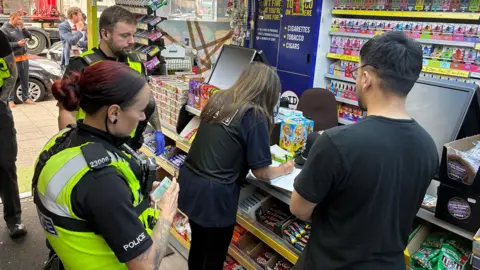
Soho Road has recently been the focus of Operation Fearless, a West Midlands Police initiative to tackle street-level crime.
“In all the areas I’ve worked in… it’s by far the worst here,” one of the officers involved, PC Victoria Gaunt, told us.
She said police had found shops selling prescription drugs, cocaine, heroin and cannabis. “You name it, you can probably buy it,” she told us, and added that she would not feel safe in the area if she was not wearing her uniform and stab vest.
She also said she had seen “people walking around with machetes, chasing people” and witnessed “a huge increase in prostitution and exploitation of girls”.
A BBC undercover reporter also visited about a dozen businesses on Soho Road and found counterfeit packs of cigarettes on sale for as little as £3. The average cost of a genuine pack is between £16.50 and £19.50.
Shopworkers also told the reporter there was open drug dealing on the street.
The home secretary told us she understood public feeling and said she and her family were also frustrated at seeing “people who are getting away with breaking our laws, getting away with open criminality”.
‘Broken system’
Over the course of 14 months, BBC News has exposed the shocking reality of organised crime taking over high streets in England and Wales.
In the following months, we were shown shops with secret underground tunnels supplying sacks of illegal cigarettes, we exposed asylum seekers buying and selling shops for cash, and exposed a Kurdish organised-crime gang operating the length of Great Britain.
In March this year, we revealed how a senior council worker had repeatedly shared with local authorities reports of children as young as 11 being sexually abused in mini-marts.
The home secretary said late last year that the BBC’s evidence, gathered up until then, proved “the system was broken” and announced an “urgent” investigation led by the NCA, Immigration Enforcement, HMRC and police forces from across England and Wales.
Asked if the government’s intervention was too little, too late, Mahmood told the BBC she believed the latest measures represented a “game-changing national crackdown”.
The Home Office says the new extended closure orders should become law by the end of this year, after it lays secondary legislation. The new powers will then come into force in early 2027.
The government says it will be briefing authorities in Northern Ireland and Scotland of the changes to closure orders in England and Wales, as they have different enforcement legislation in place for shutting shops.

Additional reporting: Steve Fildes and Phill Edwards