The writer of the Letter to the Hebrews reminds Christians that they are surrounded by a great “cloud of witnesses.” (NRSV) That “cloud” has continued to grow in size since then. In this monthly column we will be thinking about some of the people and events, over the past 2000 years, that have helped make up this “cloud.” People and events that have helped build the community of the Christian Church as it exists today.
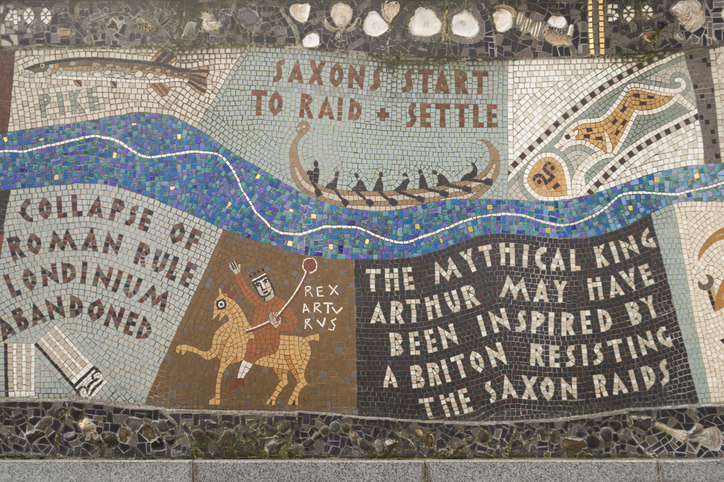
It is a frequent feature of Christian history that believers seek to understand their contemporary world by drawing parallels with biblical history. This can lead to some very ‘creative’ (and selective) interactions with the Bible; usually with Old Testament events. One remarkable example led to the creation of the figure of (King) Arthur.
In the centuries following the collapse of Roman rule in Britain, in the early 5th century, native British writers struggled to explain the catastrophe. They faced some difficult questions. Why had once-Roman Britain fragmented? Why had pagan Germanic-speaking peoples (Anglo-Saxons or Early English) come to dominate much of the (once-Christian) eastern and southern parts of the island? And what did this mean for the native Britons, who were the ancestors of the medieval Welsh? Early medieval authors answered these questions as much through theology as through military and social reflection. Arguably more so. History, they believed, revealed the will of God and they sought to interpret events by comparison with a biblical framework.
Biblical models used as weapons in Early Medieval Britain
Three major stages can be traced in this developing interpretation of the turbulent events in Early Medieval Britain.
Firstly, a 6th-century British writer, named Gildas, argued that God had sent the Anglo-Saxons (he called them ‘Saxons’) to punish the Britons for their sins in the same way that biblical Israel had suffered exile and conquest.
Secondly, the 8th-century English (Anglo-Saxon) historian Bede adopted and expanded this argument, turning it into a providential justification for English conquest and settlement. That the original argument came from a British writer – condemning what he saw as British sins – gave Bede a very useful tool to deploy on behalf of the English conquerors.
Finally, later British writers (in societies that we should describe as Early Welsh) reacted against this English interpretation. In the 9th-century Historia Brittonum and the 10th-century Annales Cambriae, they reshaped the shadowy legendary (almost mythical) figure of a 5th/6th-century hero named Arthur into a divinely favoured war leader – a British Joshua resisting pagan invaders (ie the Early English). In doing so, they asserted that the Britons (now, more properly, the Welsh) remained under God’s protection and this offered encouragement for contemporary Welsh resistance to aggressive English power.
Sin, judgement and defeat. Phase 1: Gildas and denunciation of the British
Gildas – who wrote in the early 6th century – produced one of the most influential works in British history. This was titled De Excidio et Conquestu Britanniae (On the Ruin and Conquest of Britain). His work was not intended as a sober chronicle. Rather, it was a sermon of moral denunciation that was modelled on Old Testament patterns. In it Gildas sought to explain the disasters that had overtaken Christian Britain after Rome’s withdrawal, and he did so in explicitly biblical terms. Gildas argued that, like the Israelites of the Old Testament, the Britons had sinned grievously and therefore suffered divine punishment.
He portrayed Britain as prosperous but morally corrupt and politically divided. British kings, he argued, were tyrannical, the clergy were negligent, and society consumed by greed and violence. He claimed that “Britain has kings, but they are tyrants; she has judges, but unrighteous ones.” The language deliberately echoed prophetic denunciations from the Old Testament. For Gildas, British political collapse was fundamentally caused by a spiritual collapse.
According to his account, the Britons invited English mercenaries (who he called “Saxons”) into Britain to defend against northern enemies such as the Picts, and the Scots from Ireland. But these mercenaries soon rebelled and devastated the land. Gildas presented this catastrophe as divine judgement. He wrote that “the fire of vengeance, justly kindled by former crimes, spread from sea to sea.” The Old Testament parallel was explicitly made:
“In these assaults, therefore, not unlike that of the Assyrian upon Judea, was fulfilled
in our case what the prophet describes in words of lamentation.”
The destruction of Britain resembled the punishments inflicted by God on sinful peoples in the Old Testament. The key theological point was underscored by Gildas’ insistence that the conflicts occurred because of God’s actions. He wrote:
“Sometimes our countrymen, sometimes the enemy, won the field, to the end that
our Lord might in this land try after his accustomed manner these his Israelites,
whether they loved him or not.”
The English (Saxons) functioned in this narrative as instruments of divine wrath, much like the Assyrians or Babylonians in the Old Testament. To Gildas, the destruction caused by English violence demonstrated God’s judgement against the British.
Despite this bleak outlook, Gildas’ interpretation also contained hope. Divine punishment could be averted by a return to righteousness. After a period of suffering, Gildas described how the Britons rallied under a leader named Ambrosius Aurelianus and eventually won a great victory at the Battle of Mount Badon (location much contested today). This was evidence that repentance would restore divine favour. Consequently, his outlook moved from punishment to possible redemption.
Sin, judgement and defeat. Phase 2: Bede and the victory of the English
Two centuries later, the English Northumbrian monk, Bede, adopted Gildas’ framework but transformed its implications as it was a ‘stick’ that could be used to further ‘beat’ the British enemy. Writing in 731, Bede composed the Historia Ecclesiastica Gentis Anglorum (Ecclesiastical History of the English People), which became one of the foundational works of English national identity. Bede relied heavily on Gildas for information about post-Roman Britain. However, whereas Gildas lamented the disasters afflicting the Britons, Bede enthusiastically interpreted them as part of God’s providential plan for English domination.
Bede repeated Gildas’ claim that the Britons’ sins caused their downfall and divine punishment. Yet Bede pushed the argument further by portraying the English settlement as both legitimate and spiritually meaningful. The conquest was not merely punishment, it was replacement. This left little room for accommodation with the British, who had been framed (in the narrative of Bede) as similar to the Amalekites of the Old Testament.
For Bede, this was clear in that the English, once pagan marauders, became (in his view) God’s chosen people in Britain (a type of new Israel) after accepting Christianity. The Britons, by contrast, Bede criticised for failing to evangelise the hated invaders as he claimed that they “never preached the faith to the Saxons or Angles who inhabited Britain with them.”
Gildas’ narrative of ‘Britons-as-sinful-Israel’ had given way to Bede’s ‘English as a new Israel, a chosen people.’ Both were on overdrive to apply biblical models. Through conversion, the English (according to Bede) become integrated into sacred history. The older British Christian tradition survived, in Bede’s narrative, largely as a failed and flawed predecessor, rejected by God. Bede’s historiography created a moral justification for English domination of the island. Victory and territorial possession reflected divine approval. This outlook would run and run! It also had a rather unexpected by-product …
Sin, judgement and defeat. Phase 3: Arthur reinvented as a Joshua-figure
Welsh writers in the 9th century responded to this interpretation (that had been promulgated by both Gildas and Bede) by reclaiming the British past and redefining the meaning of resistance. The most important example of this is found in the Historia Brittonum (History of the Britons), traditionally associated with a writer named Nennius, but clearly compiled by several authors c.830. This work directly countered English historical triumphalism.
The Historia Brittonum preserves traditions about a much earlier – and heroic – war leader named Arthur, who had appeared only fleetingly in earlier Welsh poetry. Modern historians disagree over whether this earlier figure was: (a) a real resistance leader of the 5th/6th centuries, (b) a composite figure formed from different real warriors, (c) a mythological figure, (d) an amalgamation of these. What is clear is that traditions about him survived in scattered fragments, often presenting him as a larger-than-life figure. The Historia Brittonum famously declares:
“Arthur, with all the kings and military force of Britain, fought against the Saxons.
And though there were many more noble than himself, yet he was twelve times
chosen their commander [dux bellorum], and was as often conqueror.”
The latter point was probably made because he failed to appear in early Welsh royal genealogies. In this construct the British preacher (St Patrick) appeared as a Moses-figure, and Arthur as a Joshua-figure drawn from the biblical account of the conquest of Canaan. The text lists twelve battles fought by Arthur. At one battle the compiler(s) claimed:
“Arthur bore the image of the Holy Virgin, mother of God, upon his shoulders, and
through the power of our Lord Jesus Christ, and the holy Mary, put the Saxons to
flight.”
And at the final battle, the Battle of Badon, it was asserted that:
“Nine hundred and forty fell by his hand alone, no one but the Lord affording him
assistance. In all these engagements the Britons were successful. For no strength
can avail against the will of the Almighty.”
Suddenly it is the British who appear as the ‘True Israel.’ Consequently, the Historia Brittonum reverses the theological assumptions integral to both Gildas and Bede. The Britons are no longer portrayed primarily as sinners abandoned by God. Instead, they appear as defenders of Christian Britain against pagan aggression. The later conversion of the English is side-stepped!
This Arthurian reinterpretation had immediate political importance. By the 9th century, Welsh kingdoms faced renewed pressure from powerful English kingdoms: first from Mercia and later from Wessex. The memory of Arthur offered ideological encouragement. If God had once supported British resistance – as demonstrated by the victories of Arthur – he might do so again.
The reimagining culminated in the 10th-century Annales Cambriae (Welsh Annals). One of the annals states:
“The Battle of Badon, in which Arthur carried the Cross of our Lord Jesus Christ for
three days and three nights on his shoulders [probably shield] and the Britons
were the victors.”
Arthur is presented as a holy warrior bearing Christ’s symbol into battle. The emphasis on three days and nights evokes scriptural numerical ideas regarding holiness and, particularly, Christ’s resurrection ‘on the third day.’
However, later failures had to be explained and the Annales Cambriae record Arthur’s death at the Battle of Camlann – a tragic civil war.
Together, the Historia Brittonum and the Annales Cambriae answered Bede’s English providential narrative (and Gildas’ complaints) with a narrative of their own. And Arthur was the product.
Using (abusing?) biblical models
The contrast between Gildas, Bede, and the Welsh chroniclers reveals how deeply Early Medieval history writing was shaped by theology and politics. All sought biblical models but – struggling to find New Testament justifications for military conquest and violent resistance – they seized on Old Testament accounts and adapted and deployed them as ways to frame their contemporary experiences and justify their position and outlook.
Gildas interpreted English invasions as divine punishment for British sin; Bede adopted this and developed it into a providential justification for English dominance; Welsh writers later responded by reinventing Arthur as a champion whose victories embodied divine support for British resistance.
The result was to so supercharge scattered legendary traditions about Arthur that they provided the foundation for another surge of interest in him from the 12th century onwards. That later period would leave us with Camelot, the Holy Grail, Merlin, Guinevere, and a ‘once and future king’ that were the result of creative fusions of many traditions (including medieval chivalric ideas about courtly love) that would produce a medieval best seller. But it was one that bore little resemblance to the earlier compositions. The emerging figure of ‘Emperor’ Arthur would even be used in the later 12th and 13th centuries as justification for English domination of the British Isles. That was certainly not what the earlier Welsh compilers had in mind!
For the public-domain online translations quoted in this piece, see:
Gildas: https://en.wikisource.org/wiki/Six_Old_English_Chronicles/The_Works_of_Gildas
Historia Brittonum (History of the Britons): https://avalon.law.yale.edu/medieval/nenius.asp
Annales Cambriae (Welsh Annals): https://d.lib.rochester.edu/camelot/text/boyer-battle-of-mt-badon-overview.html
Martyn Whittock is a historian and a Licensed Lay Minister in the Church of England. The author, or co-author, of fifty-eight books, his work covers a wide range of historical and theological themes. In addition, as a commentator and columnist, he has written for several print and online news platforms and is frequently interviewed on TV and radio news and discussion programmes exploring the interaction of faith and politics. He is particularly interested in the ‘deep stories,’ that modern nations use to define themselves. His recent books exploring this are: Trump and the Puritans (2020), American Vikings (2023) and Vikings in the East: From Vladimir the Great to Vladimir Putin, the Origins of a Contested Legacy in Russia and Ukraine (2025). He has also written, and co-written, books exploring Early English (ie Anglo-Saxon) history.