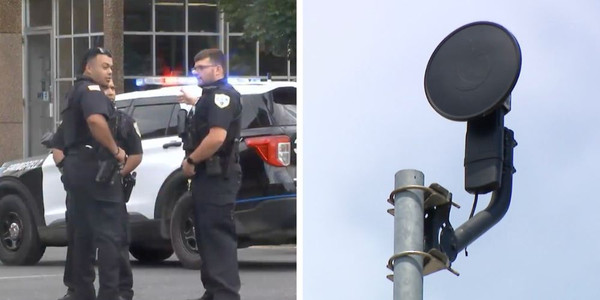
Those who voted to remove the surveillance system shared concerns that it leads to over-policing of minority communities.
The Cambridge City Council in Massachusetts voted on Monday to end the use of police surveillance technology that was deployed in the city for more than a decade to detect gun violence, with residents sparking concerns regarding over-policing in non-white communities.
The council approved the move to do away with the software following public comment and nearly an hour of deliberation. The measure had originally appeared on last week’s agenda but was delayed after Vice Mayor Burhan Azeem cited heightened emotion following a recent shooting on Memorial Drive that left two victims and a gunman hospitalized.
The order removes ShotSpotter, a system that uses acoustic sensors to alert law enforcement when loud sounds consistent with gunfire are detected. The technology was first deployed by the Cambridge Police Department in 2014.
Concerns were raised that although the system only activates alerts above a certain decibel level, the sensors operate continuously and could potentially record conversations, according to Cambridge Day.
“We shouldn’t frame safety only through surveillance or policing. We have to be expansive,” said Councillor Ayah Al-Zubi, chairman of the public safety committee.
The vote came despite requests from city manager Yi-An Huang and acting police commissioner Pauline Wells to keep the system in place. Huang said it was not a “perfect tool” but that it was effective.
“When you look at the data a slightly different way, this is actually allowing [police] to respond more quickly, and that’s what we’ve been hearing from our police leadership,” Huang said.
Under the order approved by the council, the city manager and police department have 90 days to turn off and physically remove the sensors.
During public comment, residents expressed concerns about surveillance and privacy. But they also shared concerns that the program would lead to over-policing of minority communities.
Voice recordings played during the meeting included comments from Cambridge residents who said they were afraid to speak publicly because they lived in households that included illegal immigrants. Concerns were further raised that the microphones could be “listening in on immigrant communities.”