For Nintendo Switch 2 owners, today we’re going over the best SD cards you can get for the system.
In today’s world, digital gaming is more common than ever. It’s super easy to download a game from the Nintendo eShop without even having to leave your house – and on Switch, it was fairly easy, as big microSD cards weren’t terribly expensive. That said, the Nintendo Switch 2 only uses microSD Express cards, which are completely different – and as you may have guessed, much more expensive. There aren’t a ton of viable options on the market right now, and none of them are particularly cheap. That said, not only will we go over the best microSD cards for Nintendo Switch 2, but also some tips to help save on storage space.
Before Nintendo Switch 2, barely any devices were compatible with microSD Express cards. Even now, you’d be hard-pressed to find another system that requires these cards. In the future, tablets and smartphones will almost certainly switch over to these as well, though at the time of writing that hasn’t happened yet. Compared to a regular old SD card, microSD Express cards have a much faster write speed, which means games can load more data all at once and at a much faster speed.
Though we don’t have any official confirmation, microSD Express compatibility is likely required to make certain Nintendo Switch 2 exclusives maintain their performance. They also provide a boost to loading times on Nintendo Switch 1, by extension. So one reason these cards are more expensive is because they’re much more powerful and efficient than a regular SD card, plus they’re also much newer. Only Nintendo Switch 2 really supports them at the moment, so they’re also produced in much smaller volumes.
The other reason microSD Express cards are so expensive is the same reason all video game consoles and computer parts are so expensive – AI data centers want as much memory as possible, and purchase a large majority of the available parts at a discount before consumers can ever get their hands on them. In other words, AI is creating a much higher demand than there is supply. For that reason, prices on microSD Express cards unfortunately aren’t likely to go down anytime soon, and the same goes for other video game consoles and computer parts as well. Hopefully that changes one day!
The best microSD Express cards to buy
In terms of the best SD card for Nintendo Switch 2, there are a few brands of microSD Express cards you’ll want to stick to: Samsung, Lexar, and SanDisk. Generally speaking, it’s not a very good idea to buy off-brand storage devices, as they’re more prone to fail – and you don’t want your microSD Express card failing if it has Pokemon save data on it, because if it dies and all your data becomes unreadable, you can’t get that back due to the lack of cloud saves on most main Pokemon games.
On-brand microSD Express cards are solid, as well as the GameStop-brand ones sold exclusively at their store. At the time of writing, 1 TB is the biggest storage space you can get on a microSD Express card. And unfortunately, they’re ridiculously expensive – at the time of writing, Lexar’s 1 TB card has risen to $350, up from $200 in March 2025. Other 1 TB microSD Express cards appear to be off-brand ones, which are not guaranteed to be reliable for Nintendo Switch 2.
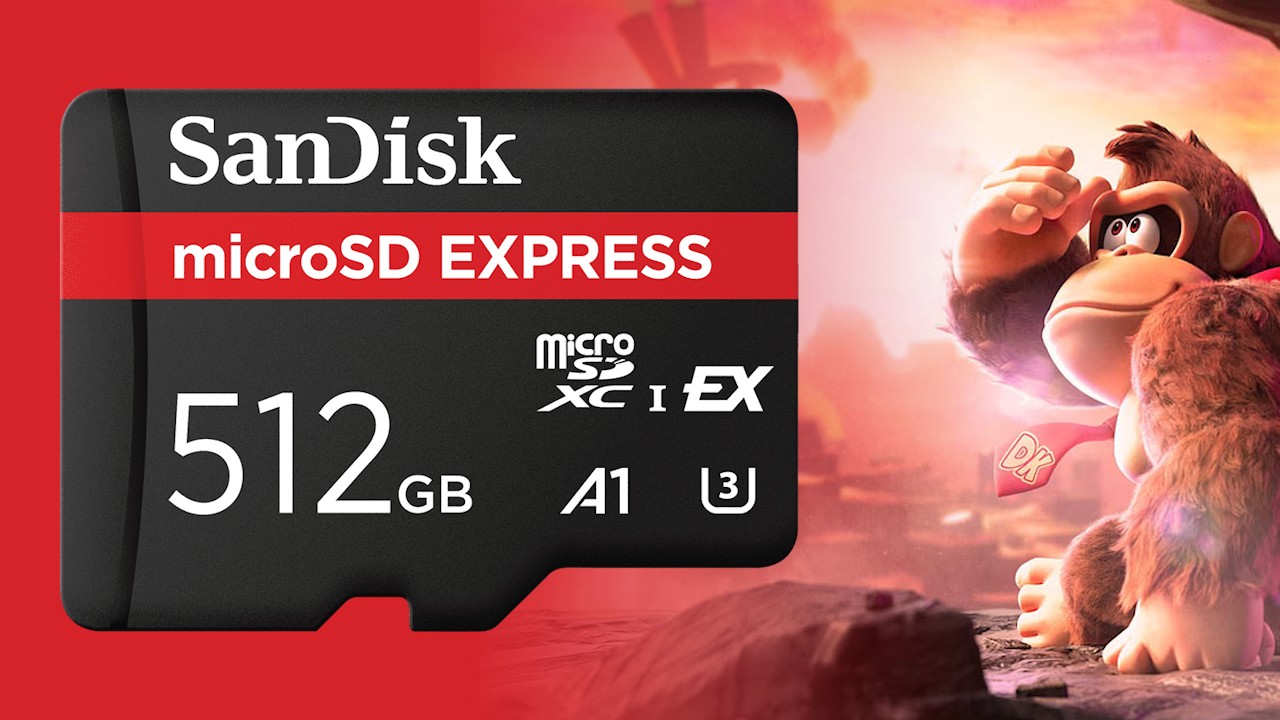
In our opinion, the best Nintendo Switch 2 SD card that balances storage space and price is SanDisk’s 512 GB option for around $120. If you’re interested in buying, it’s currently available on Amazon here. Do note that the price may have changed if you’re reading this after the original publish date.
If you’re looking for more storage and want to splurge, you can also go for Lexar’s 1 TB option here. Many Nintendo Switch 2 owners were picking this one up around the system’s launch due to the high storage space.
A good tip to save storage space
A lot of Nintendo Switch 2 games take up a whole lot of storage space. Even 1 TB of space, the largest size a microSD Express card can currently be, can fill up fast if you download some of the larger titles like the Final Fantasy remakes. So even though 512 GB is currently the best value, even that fills up fast.
The best solution is actually something I’ve been doing myself for a while – splitting my games library between physical and digital where applicable. This isn’t likely to be of interest to everyone, but my personal rule is that if a game takes up more than 15 GB, I go physical if possible. Of course, that all goes out the window with game-key cards, but we’ve listed some Nintendo Switch 2 games below that would be worth getting physically (fully on the cartridge, not a game-key card) – along with the amount of space you’ll save by not downloading it to your system.
- Mario Kart World (23.4 GB)
- The Legend of Zelda: Tears of the Kingdom – Switch 2 Edition (20.1 GB)
- The Legend of Zelda: Breath of the Wild – Switch 2 Edition (24.1 GB)*
- Kirby and the Forgotten Land – Nintendo Switch 2 Edition (16.7 GB)
- Metroid Prime 4: Beyond – Nintendo Switch 2 Edition (27.7 GB)
- Yoshi and the Mysterious Book (20.6 GB)
- Splatoon Raiders (20 GB)
- Kirby Air Riders (21.9 GB)
- Cyberpunk 2077: Ultimate Edition (60.6 GB)
*The Legend of Zelda: Breath of the Wild’s Switch 2 Edition requires an extra 2-3 GB because it unfortunately does not include the DLC on cart.
Of course, many of these physical games will eventually receive updates if they haven’t already, but the storage space the updates take up is generally going to be relatively small. Kirby Air Riders, for example, is a great idea to get physically because it’s not getting any DLC or major content updates from here on out – which means the physical version is going to account for a majority of the game’s content going forward, save for minor updates the game has received since launch.
In any case, what are your best storage-saving ideas? Do you highly recommend any specific microSD Express card, or advise avoiding one in particular? Let us know in the comments down below.
Nintendo Everything is a participant in the Amazon, Best Buy, and GameStop affiliate programs. The website may receive a partial commission through orders placed with these retailers.