Jewish academic and Hebrew scholar Irene Lancaster shares some insights into the Jewish background of the book of Numbers.
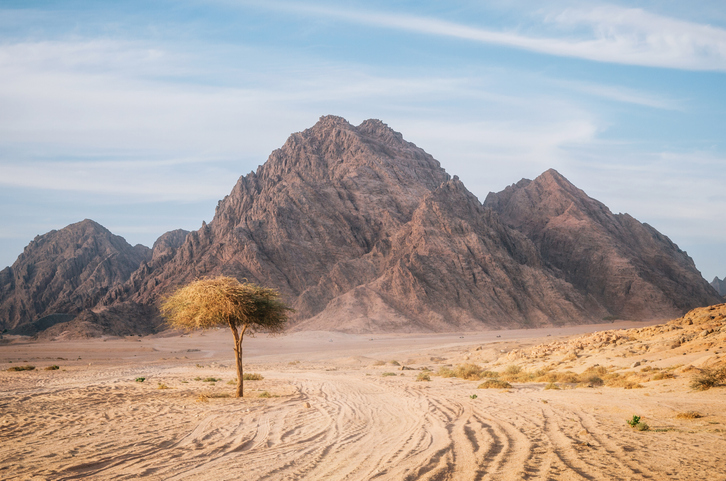
‘In the desert’ (BaMidbar) is the name given to the 4th Book of the Bible, known as ‘Numbers’.
Numbers 1:1 goes: ‘And the Lord spoke to Moses in the Sinai desert.’
But why is the desert the best place to receive this teaching? According to Jewish teaching this is the best place because the desert is ownerless and devoid of possessions. Like the desert, the Torah is open to all and is therefore ownerless and does not encourage possessiveness.
Another reason that the Torah is given in the desert is that, because it is unencumbered by material possessions, so a person is less likely to be distracted and can therefore fully direct their time and energy to the words of Torah.
In addition, usually this Book is read just before the festival of Shavuot (Pentecost), which deals with the giving of the Torah at Mount Sinai, situated in this very desert.
A further reason is that at Shavuot we also read the Book of Ruth, dealing with famine and destitution, resulting in good deeds, ultimately bringing redemption and the eventual birth of the Messiah.
As the prophet Jeremiah declaims of true repentance: ‘I remember the loving kindness of your youth, your love as a bride, your following after me in the desert, in an land unsown (Jeremiah 2:2).’
Interestingly, there are two possible Haftorah readings to accompany the beginning of this 4th Biblical Book. Often the reading comes from the prophet Hosea (2: 1-22).
In contrast to the arid desert, Hosea tells the people that: ‘The number of the children of Israel shall be as the sand of the seashore, which can be neither measured nor counted.’
Like the prophet Jeremiah, Hosea starts by chiding the people, but then states: ‘I will betroth you to Me forever and I will betroth you to Me with righteousness and with justice and with loving kindness and with much mercy.’
However, when Shabbat falls on the day before the New Moon, a special Haftorah is read instead (1 Samuel 20: 18-42). This Haftorah deals with the deep friendship forged between between Jonathan (son of King Saul) and David. This is the case this year, when the portion is read on May 16, ushering in the New Month of Sivan.
Jonathan tells David: ‘The Lord shall be between me and thee and between my seed and thy seed forever.’
This closest of ideal friendships is a human parallel to the bond forged between G-d and His people.
There are always ups and downs in relationships and even G-d can feel scorned. However, repentance and the willingness to make amends is a very positive trait and one that is warmly encouraged in Judaism.
Just as G-d made a covenant with us, which He continuously restores even after we go astray, so it is incumbent on us to deal in similar fashion with our fellow human beings.
Coming up to the festival of Shavuot, 49 days after Pesach, when we were liberated from our slave-like environment, we remember that the real goal of liberation was the desert experience.
We endured this time of trial for 40 years, leading up to the giving of the Torah at Mount Sinai on the 6th day of Sivan, ushering in the festival of Shavuot.
We therefore endeavor to remember our ongoing condition of potential slavery, followed by our miraculous redemption from Egypt. Jews are taught never to forget our journeys in the desert and eventual gift of the Torah whose teachings we try to live out in a daily basis, as best as we can.